
Simanaitis Says
On cars, old, new and future; science & technology; vintage airplanes, computer flight simulation of them; Sherlockiana; our English language; travel; and other stuff
FENDER-BENDERS ’WAY UP THERE PART 2
YESTERDAY WE WERE ENCOURAGED TO LOOK SKYWARD on the advice of Hannah Richter and her Science article “Planned Satellite Megaconstellations Could Generate Runaway Space Debris.” Today in Part 2, we open with a tidbit about bizarre goings-on above our heads.
Avoidance Maneuvers. Later in her discussion of satellite maneuvering, Hannah Richter offers an astounding tidbit: “… on average, SpaceX satellites conduct one collision avoidance maneuver every 75 seconds.”
Imagine these high-stakes dodgem-games!
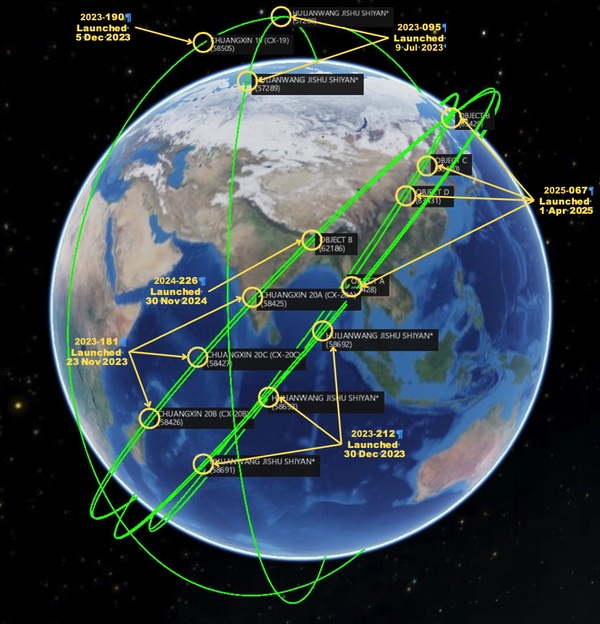
Future Swarms and the Kessler Syndrome. Richter recounts, “Of the 16 planned constellations, comprising nearly 1.7 million satellites, six passed the threshold into runaway debris, among them China’s Guowang, Cowboy Space Corp.’s Stampede, and Blue Origin’s Project Sunrise. Perhaps the most notable generator of debris would be Starmind, SpaceX’s plan for 1 million satellites to act as orbital data centers. Three more proposals reached an unstable state, where debris would increase but not endlessly.”
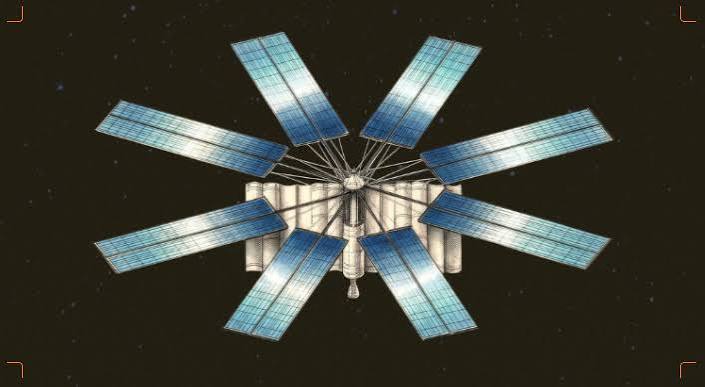
Once more, a depressing tidbit for me personally: We’re worrying about data centers consuming our terrestrial water and electricity; now add to it a million more orbiting perhaps erratically overhead.
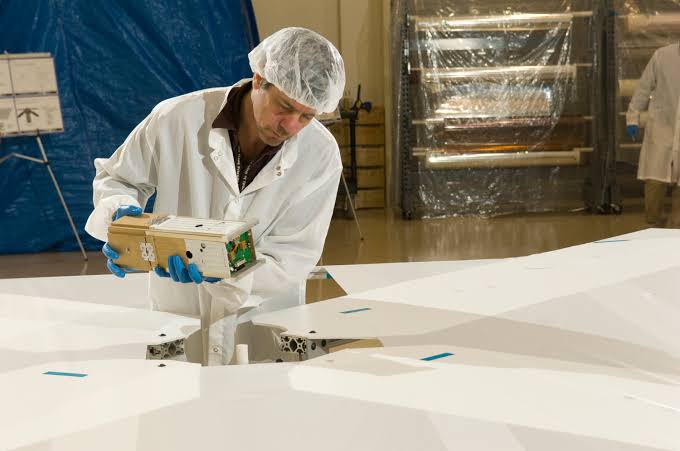
A NanoSail-D satellite weighs about 9 lbs. Image by NASA/MSFC/D. Higginbotham via NASA.
Nor Are Less Ambitious Constellations a Solution. “Lewis found problems,” Righter cites, “even with less ambitious constellations. One, proposed by Eutelsat, became unstable with a mere 528 satellites, in part because of those satellites’ proposed orbital layout; another, from E-Space, induced Kessler syndrome with ‘nanosatellites’ of just 10 kilograms apiece, based on the assumption that such small satellites lack the propulsion capabilities necessary for collision avoidance. To Lewis, the proposals collectively are ‘not meeting what you’d argue to be a requirement to maintain or achieve sustainability and safety in space.’ ”
Other Opinions. Richter cites Clayton Swope, deputy director for the Aerospace Security Project at the Center for Strategic and International Studies, a policy research organization, who “is skeptical of Lewis’s simplistic model, preferring the more complex ones NASA and ESA use to account for the behavior of individual satellites. But Aaron Boley, a space sustainability researcher at the University of British Columbia who was not involved in the study, says the analysis highlights a crucial point: just how few rules have been set for operating in space, including who must maneuver in the case of a collision course.”
A Need for Perfect Information. Richter cites astronomer Samatha Lawler of the University of Regina, who was not involved in the new analysis: “In the absence of having perfect information about what these satellite operators are planning, this is as good as it gets. It just so nicely shows how detached from reality these proposals are.”
Ha. Elon Musk detached from reality? A show of hands, please? Er, no; not that particular gesture. ds
© Dennis Simanaitis, SimanaitisSays.com, 2026


Hands? Fists? Birds? Eagles? Double Eagles? …
Actually I was thinking of Musk’s straight-arm/hand salute.—d
Aside from the almost inevitable accidental collisions from that free-for-all that these players want to launch up there, what about deliberate attacks on critical infrastructure by bad actors masking themselves as “accidents”. Just how reliable can this infrastructure be with all the chaos.
Then again with all these objects up there maybe the sun will be blocked out, then ……