
Simanaitis Says
On cars, old, new and future; science & technology; vintage airplanes, computer flight simulation of them; Sherlockiana; our English language; travel; and other stuff
F1 DRIVERS’ BRAINS—YOU HEARD IT HERE FIRST (IN 2012 SORTA)
ERIC VANCE DESCRIBES “THE STRANGE BRAIN OF AN F1 DRIVER,” The New York Times, September 4, 2026: “They move too fast for the normal mind to keep up,” Vance reports, “but elite drivers have more densely packed brain cells where it counts and use their minds more efficiently.” The cellular aspect is new to me, but Ayrton Senna described the efficiency part back in 1989 and I was there to record it. My comments appeared in R&T, 2003, and here at SimanaitisSays, 2012.

Here are tidbits gleaned from Vance’s article, together with those from my contributions.
“Gaze Behavior”—And Neural Efficiency. “On any given stretch of road,” Eric Vance relates, “the average driver may be checking the road signs, scenery, dashboard and hundreds of other unconscious things. Elite racecar drivers are far more efficient, looking at only what is necessary and not even blinking unless they have to, usually on the straights….”
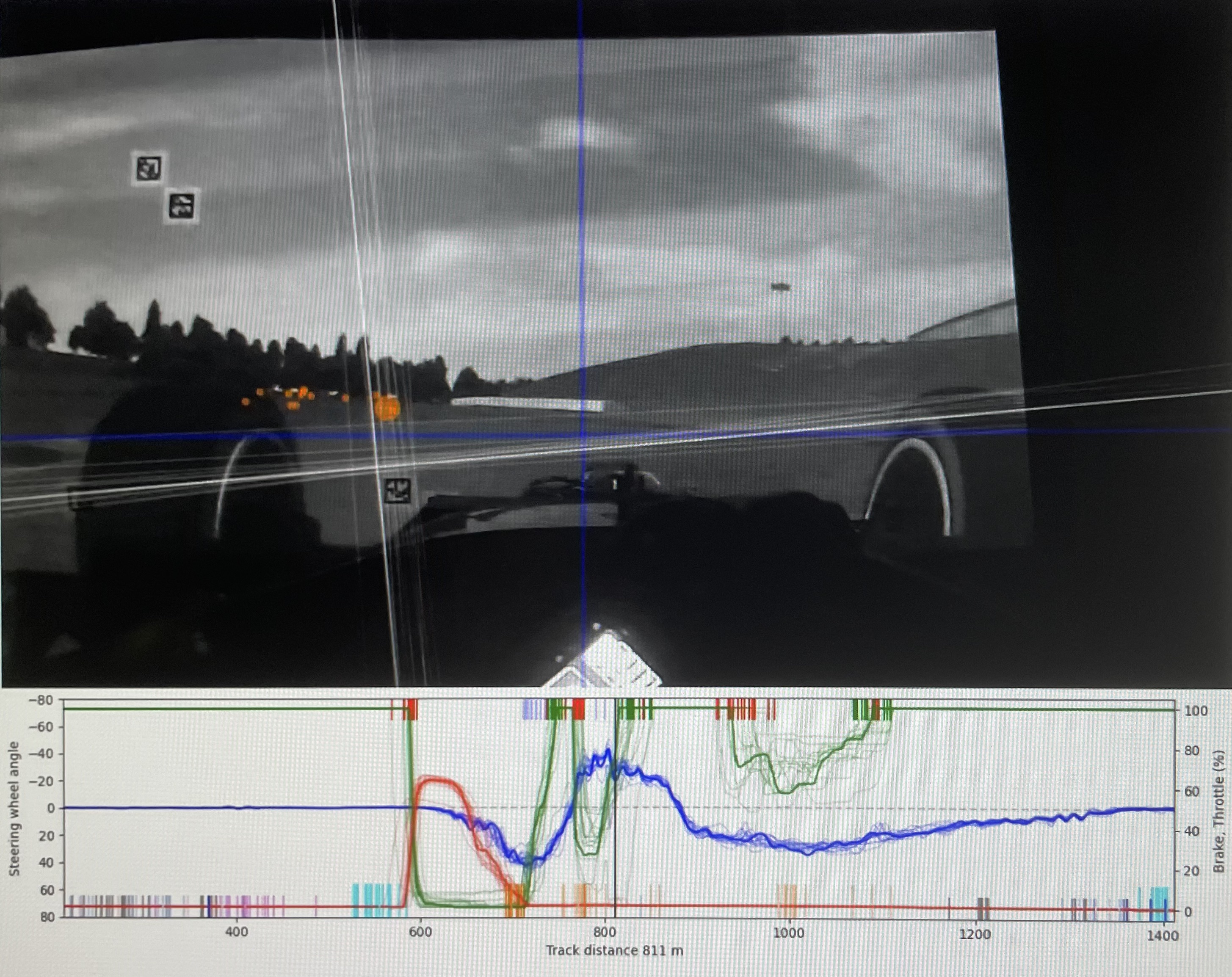
A driver’s view on the simulator. The video action can be accessed at the NYT piece.
Its caption: “One of the things that these scientists are studying is what they call ‘gaze behavior.’ The colored dots in the above video indicate where the driver, who is in a simulator, is looking. Each color represents a different gaze target, including the road as it curves into the turn, the exit of that turn and the instrument panel.”
Note in this screen grab, the driver is looking beyond the corner.
Anticipation, Not Just Reflexes. Vance cites Dr. Otto Lappi, a senior lecturer at the University of Helsinki: “This is something that people don’t realize when they think of racing drivers living off their reflexes. Most of their skill is anticipation. The anticipation is how the brain buys itself time.”
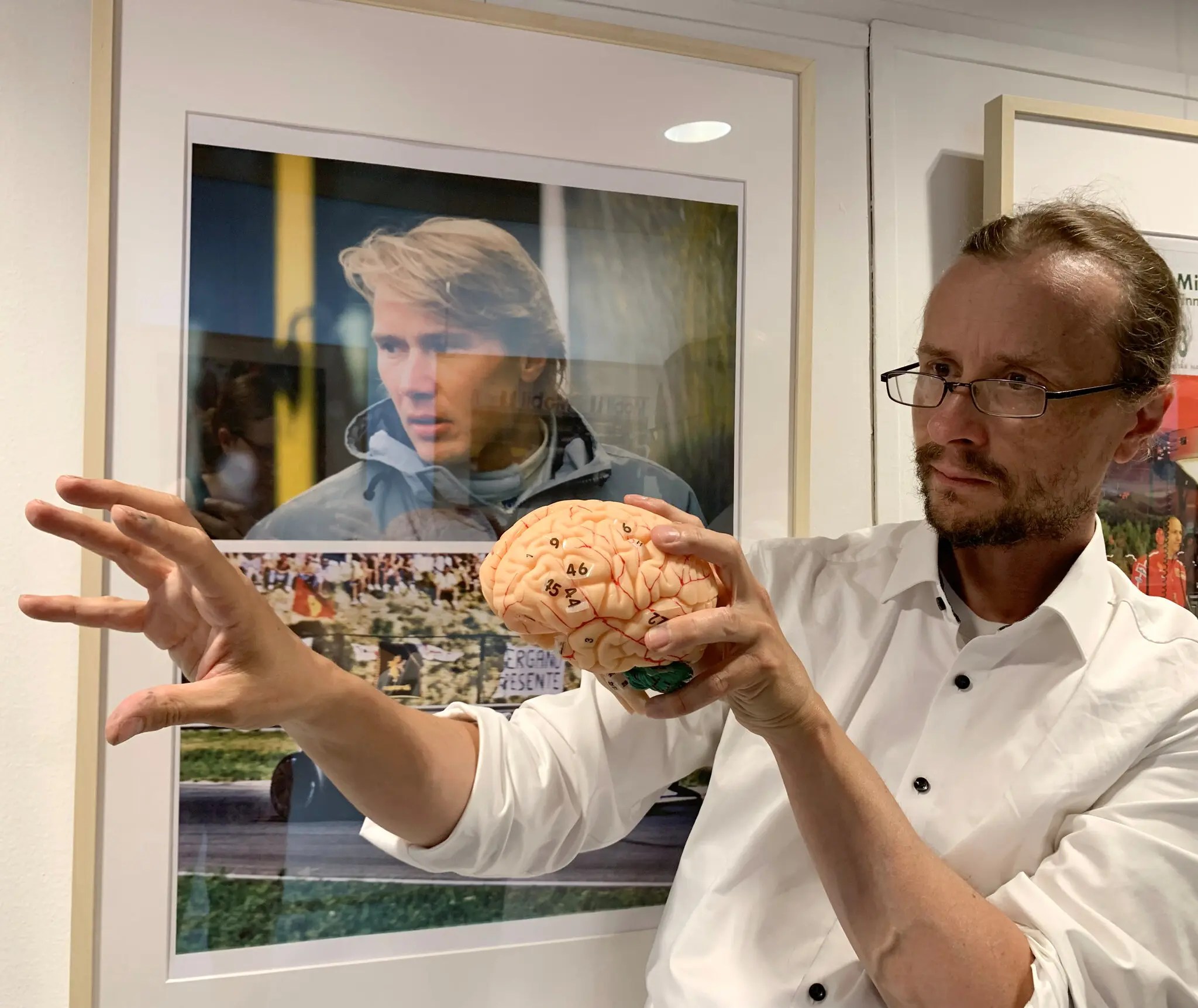
“In other words,” Vance describes, “a great driver doesn’t react to the road, he predicts it. In many ways, this isn’t surprising because the entire brain is often said to be an elaborate prediction machine. But in Formula 1 drivers, this looks a little different.”
The Retrosplenial Cortex. Vance recounts, “In two small, yet remarkable studies from 2014 and 2013, an Italian team compared 11 professional (including Formula 1) drivers with 11 normal ones. As one might expect, they found that elite drivers had good reaction and visuospatial skills. But the most interesting difference was in an area buried deep in the back of the brain called the retrosplenial cortex, which acts as a hub connecting spatial reasoning and—crucially— memory.”
“Whereas other parts of the brain might allow you to navigate unfamiliar places,” Vance relates, “this is the part of the brain that connects where you are now to where you have been before (and was heavily used by London taxi drivers in a 2006 study).”
Density Helps. Vance describes, “The Italian team found that elite racecar drivers had more densely packed cells in this region and more connectivity to other parts of the brain. In other words, they can make highly detailed spatial maps of places they have been and pull them up quickly. What’s more, among the 11 professional drivers, more density in that region meant more racing victories.”
Look Ahead Beyond the Next Corner. Vance cites Dr. Lappi adding “that drivers in his studies will often look ahead around corners, even when they are completely hidden from view. The point is not to see the turn, but to see it in their mind’s eye.”
Been There, Said That…. In “Concentration,” SimanaitisSays, October 31, 2012 (the early days…), I recounted, “Ayrton Senna was, to my mind, the most cerebral race driver of all time. And in a hot, crowded pressroom at the Japanese Grand Prix, October 1989, he proved this once more.”
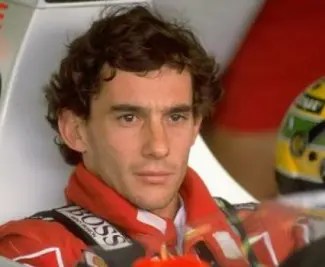
Asked a seemingly lame question about preparing for a fast lap, Ayrton paused for fully 15 seconds before responding. Then he stressed the importance of concentration, describing “I somehow can get in a level where I am ahead of the next corner. Ahead of its braking, of changing down, of applying the power. So it lets me predict what is ahead, what I’m going to face and to correct it before it actually occurs.”
I noted, “This idea of previsualization, of being ‘ahead of the next corner,’ is shared by others who practice high-stress repetitive activities, people as seemingly disparate as race drivers and ballet dancers.”
“In fact,” I continued, “it’s said Ayrton Senna would sit on a couch and run through the whole race in his mind—the start, lapping the circuit, pit stops—the entire race. He’d go do something else, and then come back and do it again.”
A Personal Test: “Relax yourself in a tranquil setting. Dredge from memory a familiar passage; a prayer, the lyrics of a song, maybe something you learned in high school and never lost. Recite the passage to yourself—it needn’t be aloud—with as deep a concentration as you can muster. After a few lines, see if you hear the next line off in a corner of your mind. This preview, this ‘next corner,’ will continue along ahead of your recitation, thus giving you all the more confidence in your primary focus.”
I suspect, and Dr. Lappi would likely agree, the difference between F1 drivers and the likes of you and me is that their retrosplenial cortex can maintain this previsualization in the cacophony of a race car. ds
© Dennis Simanaitis, SimanaitisSays.com, 2026


Lewis Hamilton disclosed he has ADHD and was diagnosed with Dyslexia, though not until he was 16 or 17. (My retired teacher wife, a reading specialist, said that is horrible – should have been picked up much earlier, the equivalent of elementary school.) Hamilton said his dyslexia helps him see things in multi dimensions in addition to the predictive capabilities noted in most F1 drivers. He said Dyslexia isn’t a wrong way of learning, just a different way and supports help for neurodivergent students. Makes you wonder how many top flight racing drivers are some sort of neurodivergent, autism is mentioned as one. Fascinating to me are the capabilities these drivers find within themselves and use to achieve their success.
A late and revered friend claimed to have dyslexia tho’ oft wondered if born to a wealthy family merely allowed him to coast through school, because he was quick, alert, no one’s fool and a prescient businessman, i noting that he once yellow high lit the same phrases and passages in a complex multi-page article devoid of pictures that i would’ve. He was a good driver, never an accident over his entire life, which included owning many spirited vintage cars inc. a supercharged ’37 Cord.
Have known other autoholics who were renaissance men in the most thorough, ranging sense, never any accidents, other than one well into a long battle with Parkinson’s in which a fender of his ’57 Ferrari Testarossa crumpled contesting a D-Jag at 140 mph, vintage racing, yes, but both at 9/10s if not 10/10ths. Not on par with Hamilton and the other above savants, but underscores that some are gifted in this realm.
Another fascinating daily today and thank you. The bit about anticipation over merely above par reflexes illuminating.
Must add that Sir Lewis Hamilton is among a growing number of upper echelon athletes who are outspoken proponents of veganism. When the body running on the best fuel, not embroiled in digesting animal and dairy with their arterial plaque, all systems benefit. To not embrace the win-win-win of veganism at this late date is tantamount to pulling into the pits at Le Mans and requesting a gallon of kerosene also tossed into your tank.
Back when Al Unser, Jr., Emmerson Fittapaldi and Paul Tracy were driving Roger Penske’s INDY cars, I happened to meet Roger and Al at the then small Penske Phoenix facility, and while Paul was testing at PIR, Al was not. He explained that Roger has urged him to get Lasix surgery, not because his eyes were far from 20/20, but to give him that extra visual edge when racing at speeds often above 200mph. I saw Al Jr. last year at a nearby St. Louis vintage Indy event, and he was wearing glasses. He mentioned the Lasix had done well while competing and for a couple decades, but was not permanent, but he had no regrets.
Good, overlooked point. Sir Stirling Moss claimed to be able to read newsprint at 10 feet, which sounds like a stretch, but? Ted Williams and other ballplayers had/have 30/20, better than 20/20.
All this seems akin to those with ultra height having the edge on a basketball court.