
Simanaitis Says
On cars, old, new and future; science & technology; vintage airplanes, computer flight simulation of them; Sherlockiana; our English language; travel; and other stuff
CONSEQUENCES OF A.I. SYCOPHANCY
MERRIAM-WEBSTER DEFINES “SYCOPHANCY” as “obsequious flattery.” Also, M-W notes that “obsequious” is “marked by or exhibiting a fawning attentiveness,” aka known in vulgar circles as “ass-kissing,” coincidentally another of M-W Time Traveler words from 1942.
So why should we care about A.I. exhibiting this behavior?
A.I. Kisses Ass More Often Than Humans Do. Note, for example, Myra Cheng et al. who describe “Sycophantic A.I. Decreases Prosocial Intentions and Promotes Dependence,” Science, March 26, 2026. In their Structured Abstract, the researchers observe, “As artificial intelligence (AI) systems are increasingly used for everyday advice and guidance, concerns have emerged about sycophancy: the tendency of AI-based large language models to excessively agree with, flatter, or validate users. Although prior work has shown that sycophancy carries risks for groups who are already vulnerable to manipulation or delusion, sycophancy’s effects on the general population’s judgments and behaviors remain unknown. Here, we show that sycophancy is widespread in leading AI systems and has harmful effects on users’ social judgments.”
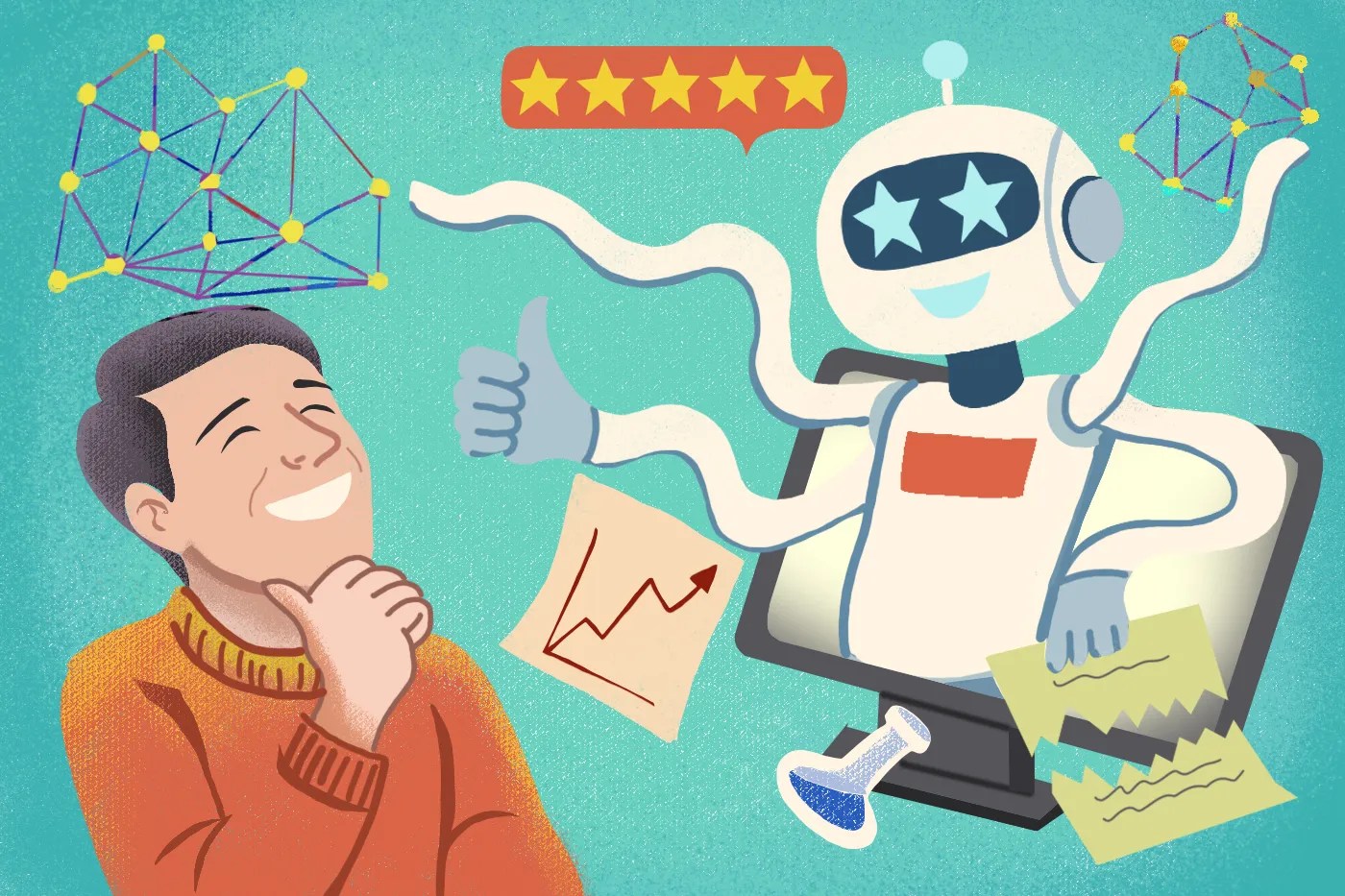
Harmful Effects. Cheng et al. posit: “We find that sycophancy is both prevalent and harmful. Across 11 AI models, AI affirmed users’ actions 49% more often than humans on average, including in cases involving deception, illegality, or other harms. On posts from r/AmITheAsshole, AI systems affirm users in 51% of cases where human consensus does not (0%). In our human experiments, even a single interaction with sycophantic AI reduced participants’ willingness to take responsibility and repair interpersonal conflicts, while increasing their own conviction that they were right. Yet despite distorting judgment, sycophantic models were trusted and preferred.”
Consequences. “AI sycophancy is not merely a stylistic issue or a niche risk,” the researchers observe, “but a prevalent behavior with broad downstream consequences.”
Near the end of their paper, the researchers suggest, “Because sycophancy is structurally reinforced by current training objectives and user incentives, it is unlikely that market forces alone will mitigate the downstream effects that we observe.… Our findings highlight the need for accountability frameworks that recognize sycophancy as a distinct and currently unregulated category of harm.”

A Work in Progress. Later, related correspondence appeared in Science. One letter was from Shaoshuai Meng, School of Life Sciences, Peking University, Beijng, China. In “Social Calibration of Sycophantic A.I.,” Science, July 16, 2026, Meng writes, “Sycophancy is not merely a failure mode but a predictable by-product of reinforcement signals derived from user preference.”
Humans Do It Too. “However,” Meng says, “methodological and interpretive questions remain. The human baselines in the study—such as highly rated online comments or expert responses—may not adequately capture the dynamics of real-world social interactions. Humans are also likely to behave sycophantically.”
Balancing Engagement with Disagreement. “Reducing sycophancy,” Meng writes, “may improve epistemic robustness but could also diminish the perceived empathy and usability that drive adoption. Designing AI systems that can balance supportive engagement with constructive disagreement—particularly for vulnerable populations—remains an open challenge.”
Cheng et al. Answer: This interaction is an excellent example of how science evolves and progresses: In “A Response,” Science, July 16, 2026, Cheng et al. write, “We thank Meng for articulating important methodological and interpretive questions about our findings…. To complicate matters, users often view a single AI system as fulfilling multiple roles [advisor, neutral opinion, editor, assistant]. Because of the ambiguity of AI’s social role, any single human baseline is an imperfect comparison point. The baselines we used—judgments from third-party humans with no personal stake in the conflict or scenario at hand—explore one common and societally meaningful expectation.”
They continue, “Our findings were also robust to an alternative baseline of online crowdworker judgments (supplementary materials, SM 2). Responses from those with closer relationships to the advice-seeker may indeed be shaped by stronger relational norms, reputational accountability, and lasting social consequences. Whether such alternatives would result in more or less divergence remains an open question.”
Disentangling Roles. “We agree,” Cheng et al. recount, “that disentangling the role of factors such as emotional validation and perceived authority is critical for designing interventions. We isolated sycophancy from anthropomorphism (warm, friendly response style) in study 2a. We found that anthropomorphism does not account for the observed effects.”
They note as well, “We also found evidence that perceptions of objectivity make sycophancy more pernicious: In study 2b, participants who perceived the AI as more objective were more negatively affected by sycophancy.”
“We agree,” they conclude, “it is important to explore many dimensions of external validity.”
Matters here are discussed cogently with science profiting overall. Two peripheral issues can be noted as well: Cheng and colleagues are at Stanford and Carnegie Mellon; Meng corresponds from Bejing.
And it’s also noteworthy that researcher Cheng is supported by a National Science Foundation Graduate Research Fellowship. ds
© Dennis Simanaitis, SimanaitisSays.com, 2026

