
Simanaitis Says
On cars, old, new and future; science & technology; vintage airplanes, computer flight simulation of them; Sherlockiana; our English language; travel; and other stuff
A THRICE-WED GWENDA, A THRICE-CITED PASHA, AND MARGARET THATCHER’S LGBTQ ATTACK PART 1
GEEZ, IS EVERYTHING CONNECTED? Even a 1961 colloquium at Worcester Poly?
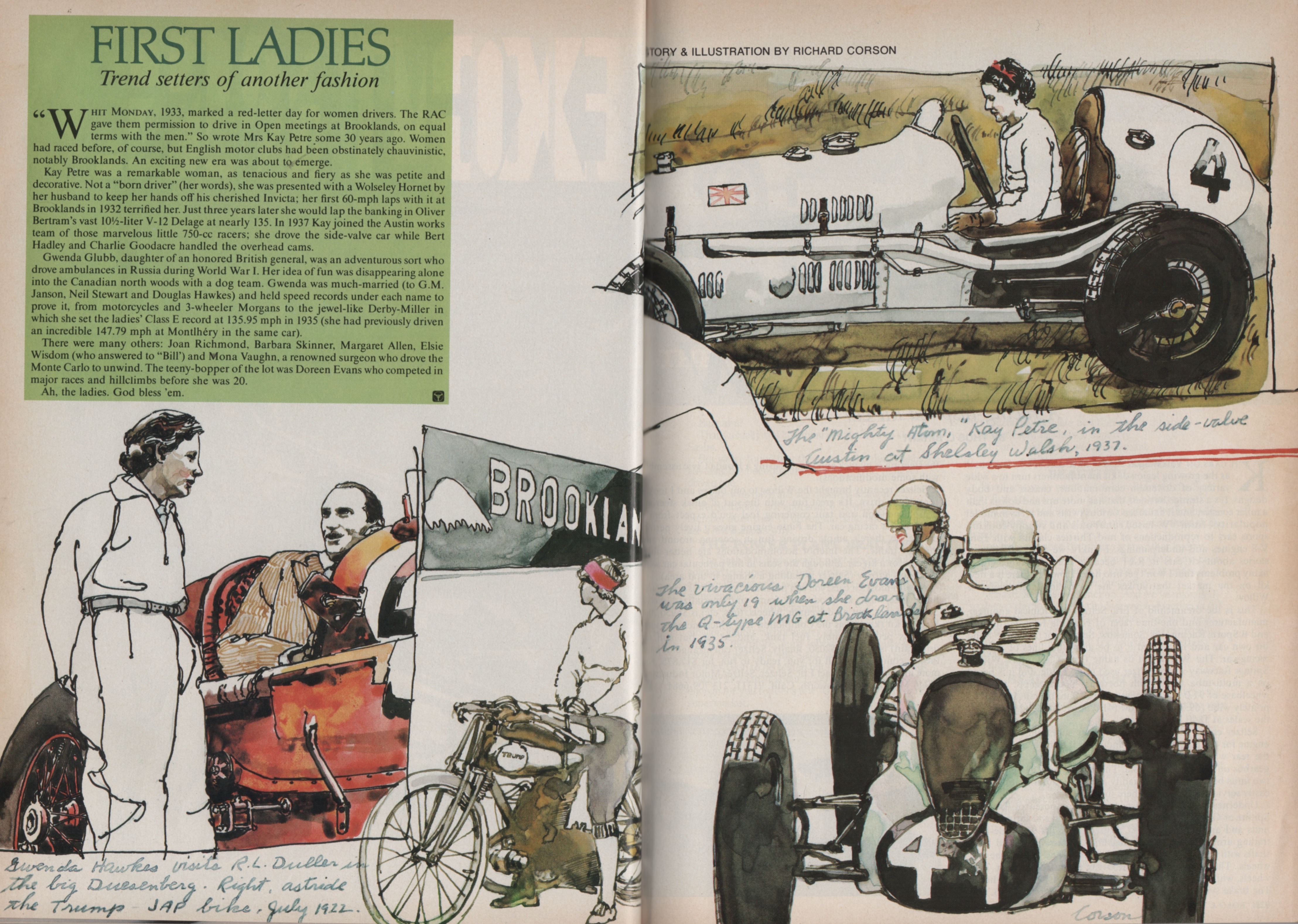
So there I was, recently leafing through the 1981 R&T bound volume and encountering “First Ladies: Trend Setters of Another Fashion,” written and illustrated by Richard Corson. Here, in Parts 1 and 2 today and tomorrow, are the results.
For other examples of his neat work, see “Richard Corson Bristol 450,” “ ‘John Cobb & the Napier-Railton’ Richard Corson R&T,” and “R&T and Other Art,” all at SimanaitisSays.
June 5, 1933. “Whit Monday, 1933,” Corson noted, “marked a red-letter day for women drivers. The RAC gave them permission to drive in Open meetings at Brooklands, on equal terms with the men.” Three of these trend setters were Kay Petre, Doreen Evens, and Gwenda Glubb.
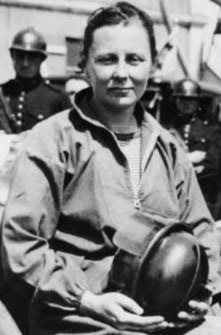
Corson summarizes her life’s accomplishments: “Gwenda Glubb, daughter of an honored British general, was an adventurous sort who drove ambulances in Russia during World War I. Her idea of fun was disappearing alone into the Canadian north woods with a dog team. Gwenda was much-married (to [Sam] Janson, Neil Stewart and Douglas Hawkes) and held speed records under each name to prove it, from motorcycles and 3-wheeler Morgans to the jewel-like Derby-Miller in which she set the Ladies’ Class E record at 135.95 mph in 1935 (she had previously driven an incredible 147.79 mph at Montlhéry in the same car.)”
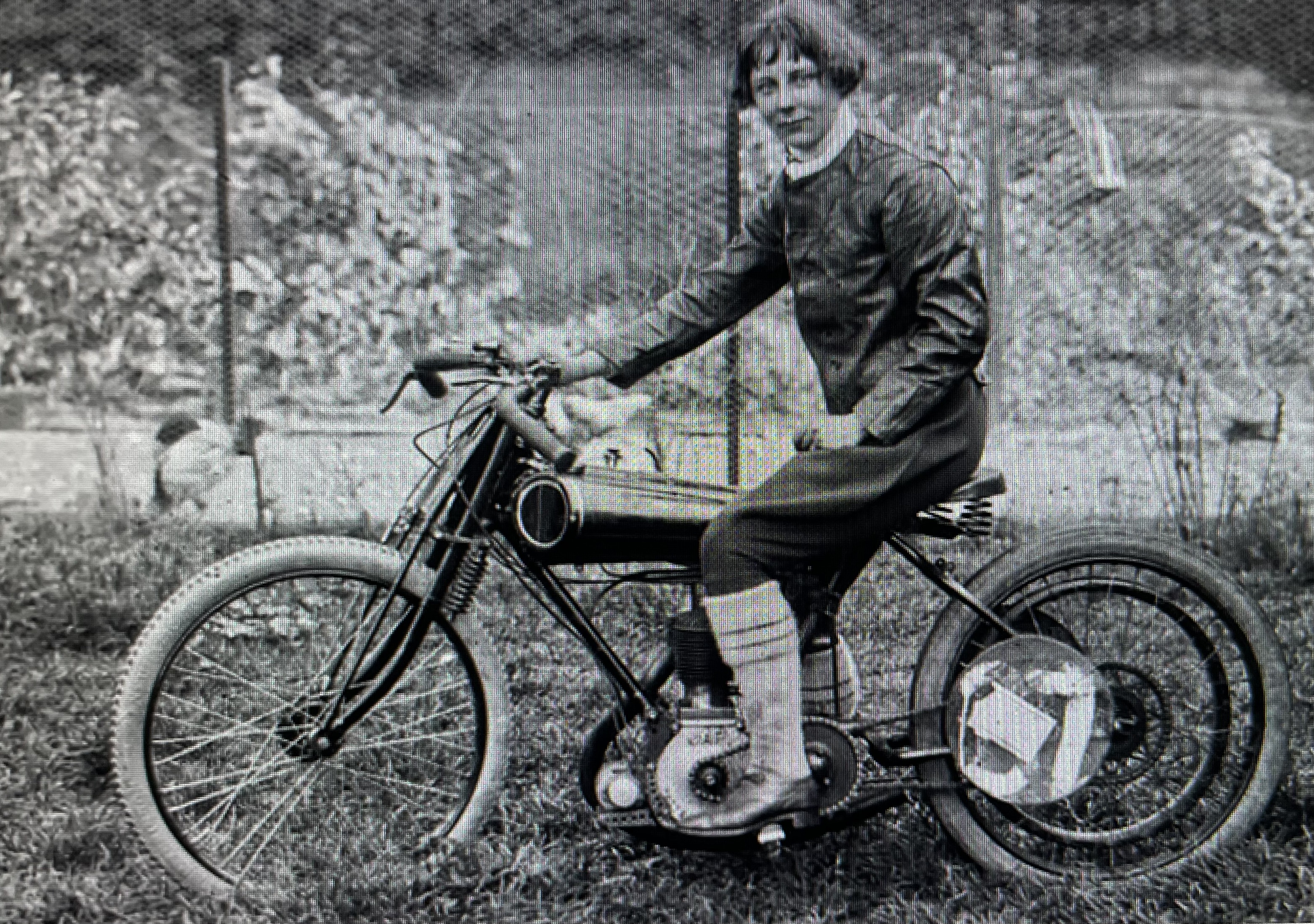
Gwenda, age 26, and her American Ner-a-car at Brooklands in 1921. This and following images from Tampa Bay Auto Museum.
The Motorsport Memorial recounts, “Under official scrutiny, she created a new 1000-mile record on the fragile bike. In 1922 she rode a 249 cc Triumph-JAP continuously around the Brooklands track for 24 hours, at an average speed of 44.65 mi/h (71.84 km/h) to break the Double-12 records.”
Thrice-Wed, Each With Motorsports Theme. Her first husband, Motorsports Memorial notes, was “Colonel [Sam] Janson, the British concessionaire of the Dutch car company Spyker, but the marriage didn’t last. She then married Lieutentant-Colonel Niel R. Stewart of Scotland, who was her co-driver on long-distance records and managing director of Trump Motorcycles. In 1924 the Stewarts settled in France, living near Linas-Montlhéry and Gwenda began breaking record after record with a Rudge 350 motorcycle and with a Morgan Super Aero three-wheeler.”

“At Arpajon,” Motorsport Memorial describes, “she averaged an impressive 118 mi/h (189.86 km/h), which became the all-time three-wheeler record, and at Linas-Montlhéry she set almost 50 new records, including the flying kilometer as well as the 2500-kilometer long distance race.”
Adding a Wheel. In the early 1930s, Gwenda turned to four-wheel records: She teamed with W. Douglas Hawkes, another former Brooklands driver who, Motorsport Memorial observes, “made two starts in the Indianapolis 500, in 1922 and in 1926.” Unrelated tidbit: Dentist Alfred Moss, Stirling’s dad, finished 16th overall in the 1924 Indy 500.
Motorsports Memorial recounts, “A designer and engineer of some note, Hawkes directed the Derby car factory, based in Courbevoie, Hauts-de-Seine department, France.” Gwenda, in turn, established new records in an American Miller front-wheel-drive racer enhanced with Derby parts and a new 2-liter V-8 engine (the Derby-Miller).
Tomorrow in Part 2, we continue Gwenda’s adventures with Derby cars. Indeed, in time she took Hawkes as her third and final husband. And wait, there’s more.
© Dennis Simanaitis, SimanaitisSays.com, 2026

