
Simanaitis Says
On cars, old, new and future; science & technology; vintage airplanes, computer flight simulation of them; Sherlockiana; our English language; travel; and other stuff
WE USTA HEAR AMERICA PINGING
“TO UNDERSTAND THIS (HISTORICAL) ABNORMALITY OF COMBUSTION,” I wrote (sans the parenthetical modifier) in R&T back in December 1979, “we’d be wise to begin by examining the combustion process as God and Nicolaus Otto intended it.” You know, the old “Suck/Squish/Pop/Pooey” of intake, compression, power, and exhaust strokes.
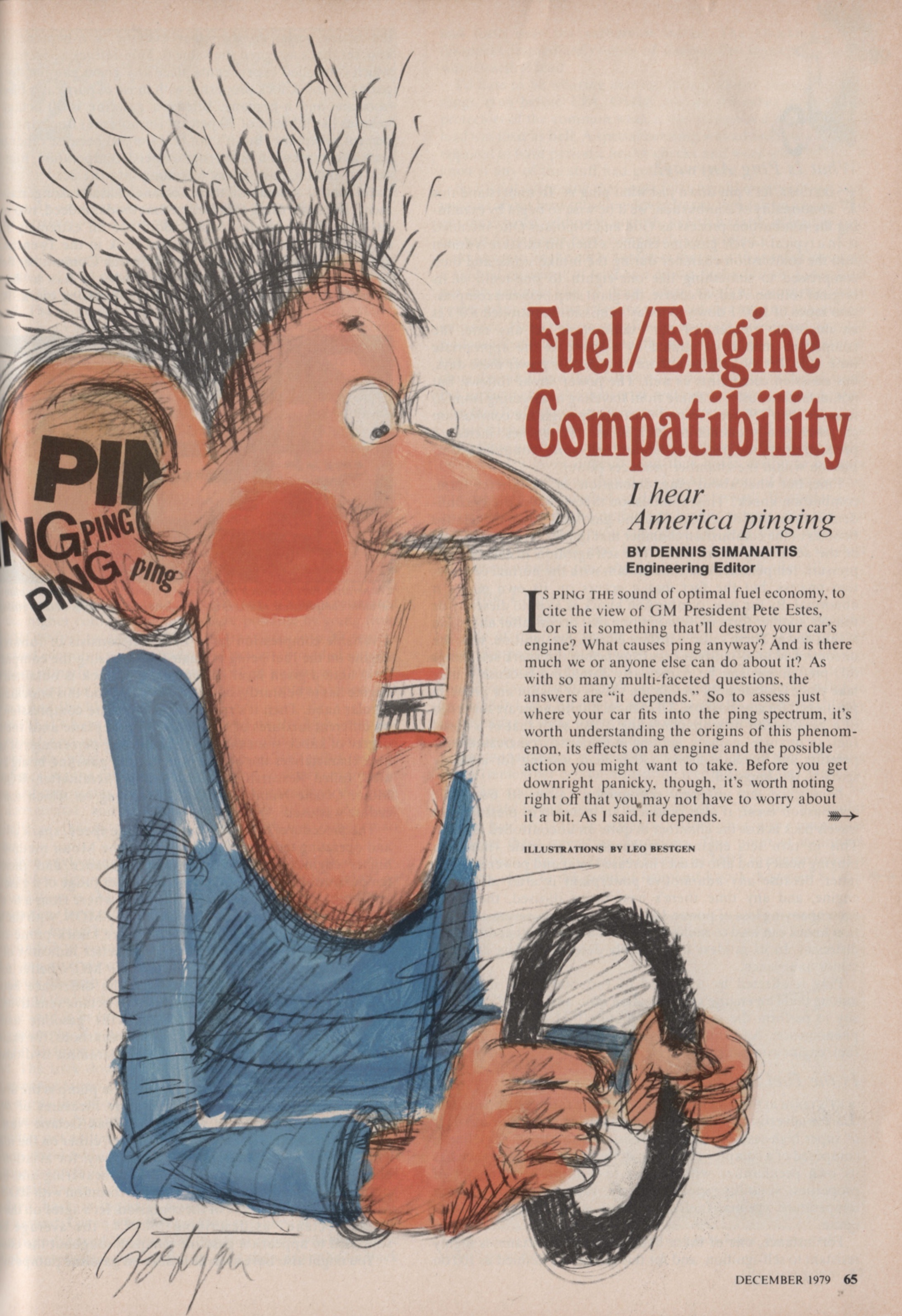
What is Ping? The abnormality of ping, detonation, or its extreme form, combustion knock, I noted, is “the sound of self-igniting end-gas, stuff out in the boonies of the combustion chamber that ignites on its own ahead of the advancing flame front.” This ignition in the wrong place and time “sets engine components to resonate (thus, the pinging noise).”
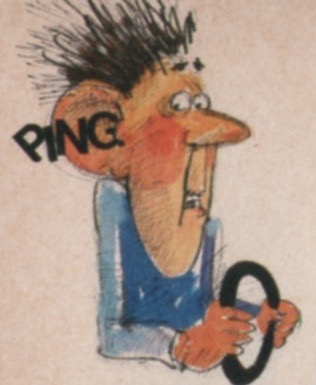
“It’s accompanied by increased heat and power loss,” I noted. “In its most extreme form, severe combustion knock can lead to melted piston crowns and other attendant distresses. In its mildest form, barely detectable ping is only a minor annoyance.”
Back then I cited GM President Pete Estes calling ping “the sound of optimal fuel economy,” but then remember the part about melted piston crowns.

Lead and the Fuel Expert’s Tie. There’s an oft-told tale of the 1921 discovery of tetraethyl lead as an antiknock agent. In fact, I repeated it back in 1979: “Given a badly knocking engine, a Model T with its timing advanced, for instance, the fuel expert would sprinkle a bit of mysterious liquid on his tie, and then wave the tie back and forth over the carburetor intake. The knocking would disappear immediately—and, of course, the mysterious liquid was tetraethyl lead.’ ”
“I’d hate to be wearing that tie, though. Since from the very beginning, even before EPA, OSHA, and all the other alphabetical protectors of the common weal, it was recognized that lead was toxic as hell.”
A Modern Observation. The U.S. eliminated lead in motor fuels in 1996 after a 26-year phaseout. However, it wasn’t until 2021 before the stuff was banned worldwide. Gad, let’s hope the tetraethyl lead people don’t get to Trump.
Knock and Gasoline Octane. “A fuel’s octane rating, stripped of all the advertising jargon we enjoyed during those glorious days of super high-test, measures its resistance to knock.” One of the hydrocarbons, iso-octane, is highly resistance to knock and it’s defined as 100 on the octane scale. At the other extreme, n-heptane is a real knocker and is assigned the value 0.
A fuel’s octane is determined by its place in the iso-octane/n-heptane spectrum. Two experimental methods are cited: Research Octane Number, RON, and Motor Octane Number, MON. “As a general rule,” I noted, “RON is a better indicator of heavy-throttle low-speed knock resistance, while MON better tests part-throttle or high-speed operations.”
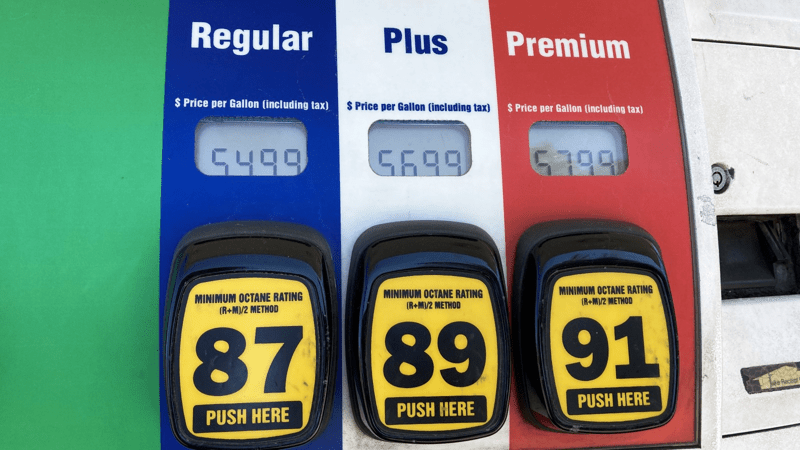
Three Grades of Gasoline. “Pump Octane” is the average of RON and MON. With the 1970s beginning of lead removal and other environmental concerns, gasoline suppliers eventually added a Mid-grade 89-90 (Pump) Octane to its Regular 87 and Premium 91-94.
Back to 1979 Ping. “Are the Engines at Fault?,” I asked rhetorically. “It’s clear that lower compression ratios lessen an engine’s appetite for octane, but they reduce efficiency as well. So this tradeoff has to be considered very carefully. We’ve seen compression ratios stabilize around 8.0:1 or a bit higher, and it’s generally agreed they’ll stay in this range. Going lower with normally aspirated engines only trades away too much efficiency.”
See Wikipedia for today’s general 8:0- to 12:0- range, with several innovative variations.
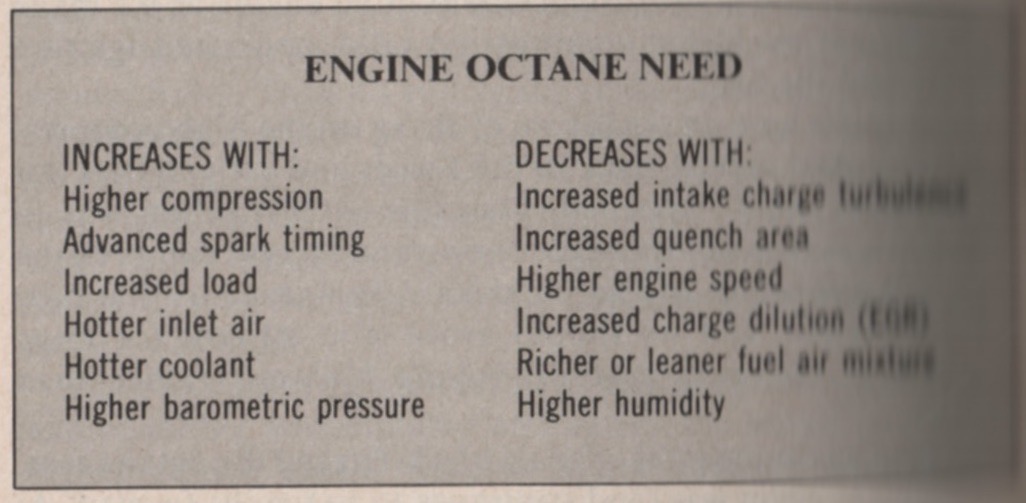
Searching for MBT. “For a given set of steady-state speed, load, fuel-air mixture, etc, any particular engine has an ignition advance setting that gives maximum torque at these operating conditions. This point of minimum spark advance for best torque (known as MBT to engine folks) is also close to the point of incipient knock, however. So in a very real sense, an engine that’s timed optimally for performance is tiptoeing particularly near ping.” (By the way, don’t confuse MBT with methyl tertiary butyl ether (MTBE), another thing entirely.)
Enter the Knock Sensor. I noted, “Knock sensors, on several new cars, turbocharged and otherwise, are automakers’ responses to this, and we’re likely to see more as time goes on. These devices allow timing advances that approach MBT (and incipient knock) without production variations and normal wear turning the engine into a recognizable pinger.”
How prophetic: Today, all gasoline cars have knock sensors—thus, the “usta” in this article’s title.
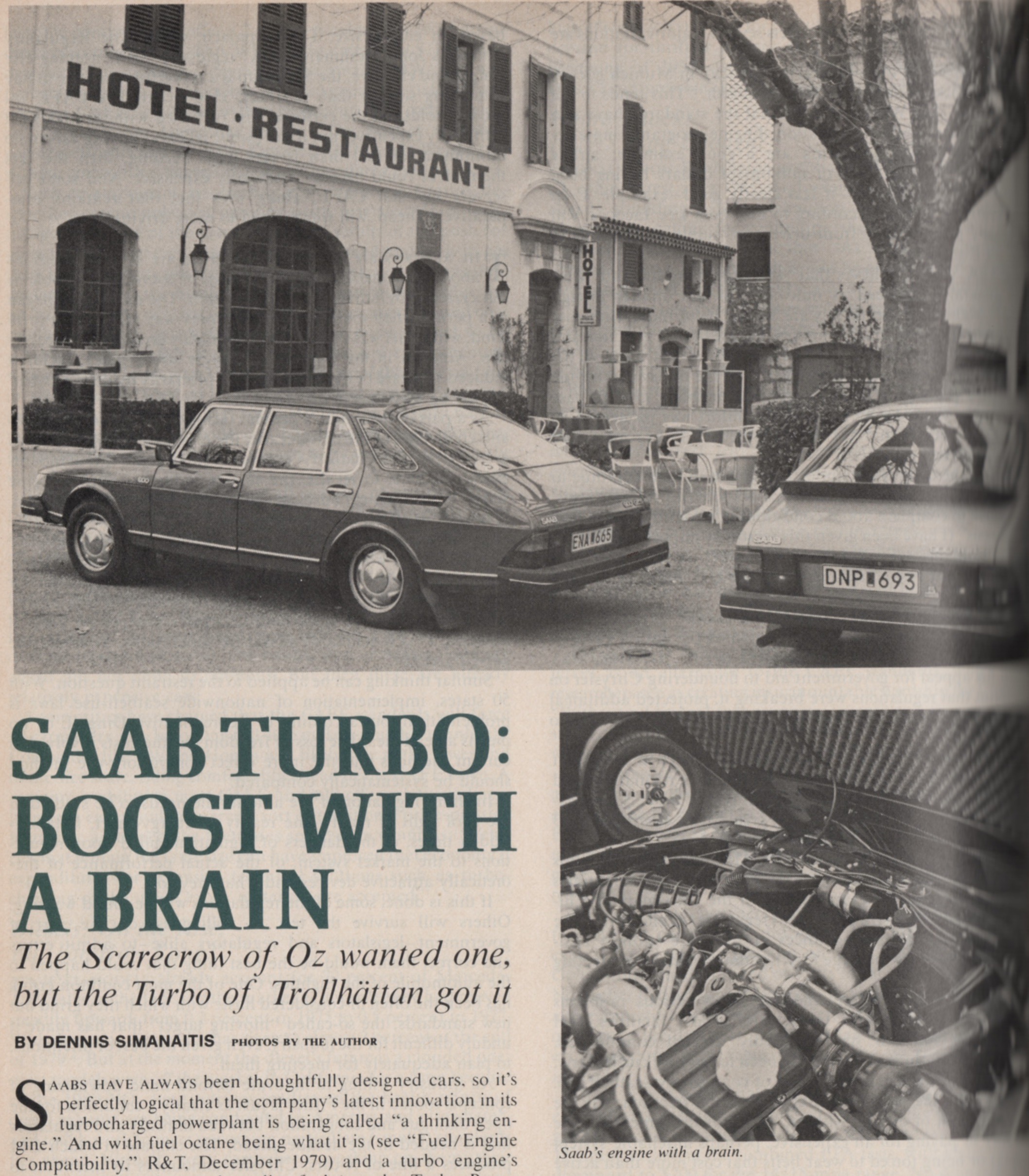
Celebrating the Wizardry of Saab’s APC. Within a year, in 1980 I discussed Saab’s Automatic Performance Control.
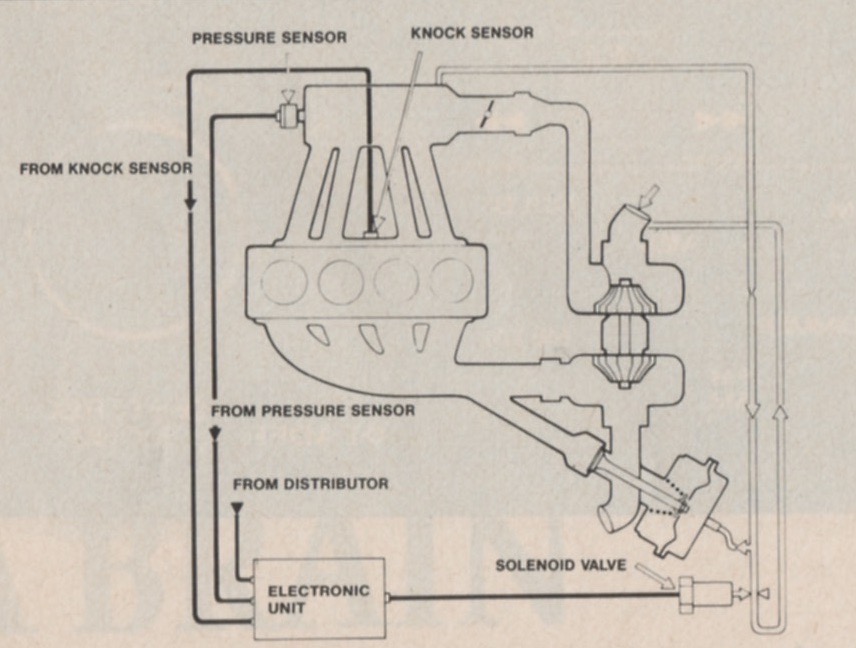
“First,” I described, “there’s a pressure sensor similar to an oil pressure sender unit linked with the intake manifold, on the pressurized side of the compressor. Second, there’s a knock sensor of piezoelectric crystal type on the cylinder head, nestled between the intake runners of cylinders 2 and 3. Last, a sensor in the distributor keeps track of engine rpm, because detonation is rpm-specific as well…. The electronic brain ponders these three signals and sends a control impulse to a solenoid valve that’s added to the wastegate circuitry.”
All, Sorta Familiar to Me. With a funny story associated to it: During my days at SAE’s Automotive Engineering magazine, I had summarized an SAE technical paper about APC presented by Saab engineers.
Later at an auto show, an SAE colleague and I were examining an odd sparkplug-looking gizmo at the Saab display. We asked about it, and the Saab rep replied, “That’s the knock sensor of our APC. You can learn about it over there.” And he pointed to my nearby SAE Automotive Engineering writeup. Opps; I had never seen actual hardware in preparing the piece. Fumbling at my lanyard name-tag, I smiled and thanked him. ds
© Dennis Simanaitis, SimanaitisSays.com, 2026
 Simanaitis Says
>>“That’s the knock sensor of our APC. You can learn about it over there.” And he pointed to my nearby SAE Automotive Engineering writeup. Opps; I had never seen actual hardware in preparing the piece. Fumbling at my lanyard name-tag, I smiled and thanked him. ds <<
Reminds me of an incident at work when my boss called me into his office to say that we were going to submit a proposal to a refinery client for the design of a blast resistant control building, and handed me a set of drawings to review to help in developing our proposal.
I got back to my office, unrolled the drawings and observed that they had my professional stamp and signature for a project that I had designed for a former employer about 10 years prior. He never noticed, and I didn’t bother to say anything to him as he was very much like Dilbert’s boss. I still laugh about it today when I think about it.
Wonderful overview, many thanks. Road & Track really blew it when they succumbed to corporate journalism in the aughts, losing you, Phil Frank & Joe Troise, Peter Egan; never to be replaced.
Those of us long playing with ancient cars remember the cries of doom when unleaded became the “new” game, somehow overlooking that since the 1920s through the ’70s, Amoco offered nothing but, used by tens of millions of cars throughout the East and Midwest.
An auld auto/aero mechanic, pilot friend, a disciple of L.J.K. Setright, whose masterful The Power to Fly his bible, claimed all else being equal, an ohv engine could brook an entire full number higher compression–8:1 over 7:1, for example–before pinging. But it widely considered that compressions over 8.5:1 not practical in flathead (side-valve, valve en bloc) engines, which most domestic engines still were into the early 1950s.
While perhaps prudent for those pulling trailers in the mountains, most with old cars enjoyed in less demanding situation nonetheless use, for example –not an emissary for the company — Red Line Lead Substitute, which uses sodium as the dissimilar metal protecting exhaust valve and seat from the nano second kiss. Potassium was tried in Europe but left deposits.
Recall seeing oil pans dropped from largely original California cars of the ’30s and ’40s in the late ’70s. There was an inch-thick layer of lead like black Play Doh.
Studies then and in the early ’80s showed children in schools near freeways tested lower than those in more benign locales.
Meanwhile, to this day, many folks still believe it is somehow advantageous to use premium gas in cars engineered for regular. Good luck trying to explain to the contrary.
A perceptive article .
I’m still running carbys and contact points so those wonderful (IMO) knock sensors and attendant timing delay modules are not helpful . (more’s the pity, watching the timing drift forward and back in a so controlled fuel injected engine sold me on their benefits ) .
Anyway there’s also sub audible ping, this too can damage the alloy pistons and increase wear on the rod bearing shells .
For this reason I was taught long ago in my California smog licensing training to set the full advance timing then if it still knocks retard the timing by one degree and test drive / ride it again until nothing is heard…..
This is the similar training GM used to give in the 1940’s, they tell you to set the timing and so on, take the vehicle out on the road and in third (top) gear and 30 MPH, stamp on the throttle ~ if you heard -any- ping/knocking, stop and retard the timing a tiny bit and repeat .
Learning this made my old 235’s more economical as well as more powerful than most others .=8-) .
These days except for a few geezers like you and I this is all theoretical as the computer monitors and adjusts the timing on the fly .
I don’t miss leaded gasoline one bit ~ I was a pump jockey in those days and sniffed far too many fumes .
-Nate
Nate, that timing procedure was precisely what I learnt from a late auto/aero mechanic/machinist pilot friend, who tuned everything from the stovebolt Chevies you mention, Crosleys to Pierce-Arrows.
Right y’are re: tuning returning both economy and performance. On my ancestors, once got 22.5 mpg from a long ago owned ’40 Packard One-Twenty, 282-ci inline L-head with overdrive, slightly taller 4.09 rear cog per factory non-OD cars in place of 4.36:1 in those leaving Detroit with overdrive, 2.95 instead of 3.14:1 overall, 32 psi Denman bias ply tires, some of that at 65 mph freeway.
Remember the Mobil Gas Economy Runs? Bob Estes, an Inglewood, CA Lincoln-Mercury dealer sponsoring Lincolns for the Carrera Panamericana Mexican road race, entered a 4,375 lb. curb weight, 336-ci flathead V-8 ’51 Lincoln “sport sedan” with optional 3.31 “plains” rear end for 2.39:1 in overdrive, winning its class with 25.488 mpg.
Chrysler protested, so the car impounded, torn down, found to be 100% stock.
Motor Trend editor Griff Borgeson then drove the above car nearly a thousand miles; traffic, deserts, mountains, every speed up to a top, fifth-wheeled 100.67 mph, impressed with the big Lincoln’s performance, noting that even in such hefty barouches, “a big engine lightly stressed equals or betters a small engine pushed to its limit.”
Borgeson echoed the above fuel economy, remarking if the car had sea-level instead of high-altitude carburetor jets they might’ve eclipsed the Mobil Gas figure.
Fuel injection is the main advancement since yore, other than unleaded being the rule of the land. Drum brakes will stop you fast as discs, just not repeatedly at high speeds, as Ferrari learned five times from Jaguar at 1950s Le Mans.
But, Nate, we ain’t geezers. We just stretch daily and pace ourselves, veganism not “retarding” us or Sir Lewis Hamilton, the leading Formula One driver.