
Simanaitis Says
On cars, old, new and future; science & technology; vintage airplanes, computer flight simulation of them; Sherlockiana; our English language; travel; and other stuff
HORTUS DELICIARUM—THE GARDEN OF DELIGHTS
MY RECENT TREATISE ON PRETZELS got me consulting The Authorized King James Version of the Bible. Prompting of this biblical research was straightforward: Queen Esther and King Ahasuerus enjoying a pretzel in this 12th-century illumination from Herrad of Landsberg‘s Hortus deliciarum.
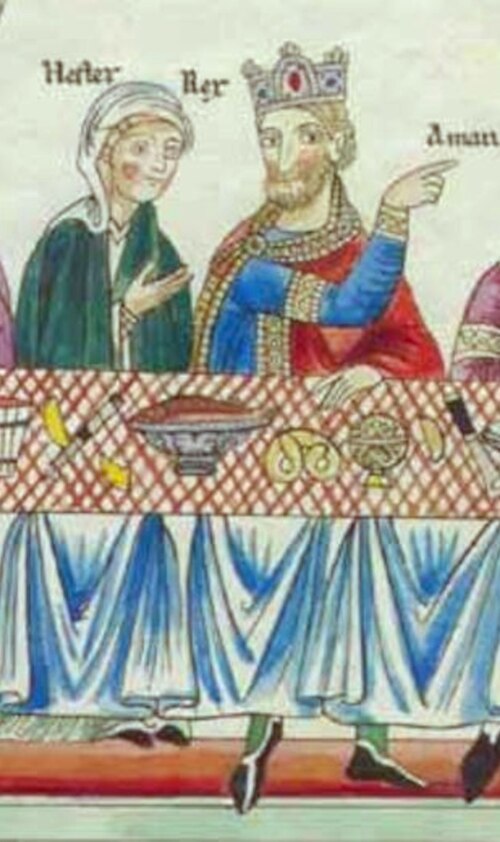
Just who was Herrad of Landsberg and what was her Hortus deliciarum, known these days as The Garden of Delights? Following here are tidbits gleaned primarily from Wikipedia, augmented by my typical Internet (and my atypical King James) sleuthing.
The Jewish Holiday Purim. Wikipedia recounts, “Purim (Hebrew: פּוּרִים) is a Jewish holiday that commemorates the saving of the Jewish people by Queen Esther from annihilation at the hands of an official of the Achaemenid Empire named Haman, as it is recounted in the Book of Esther.”
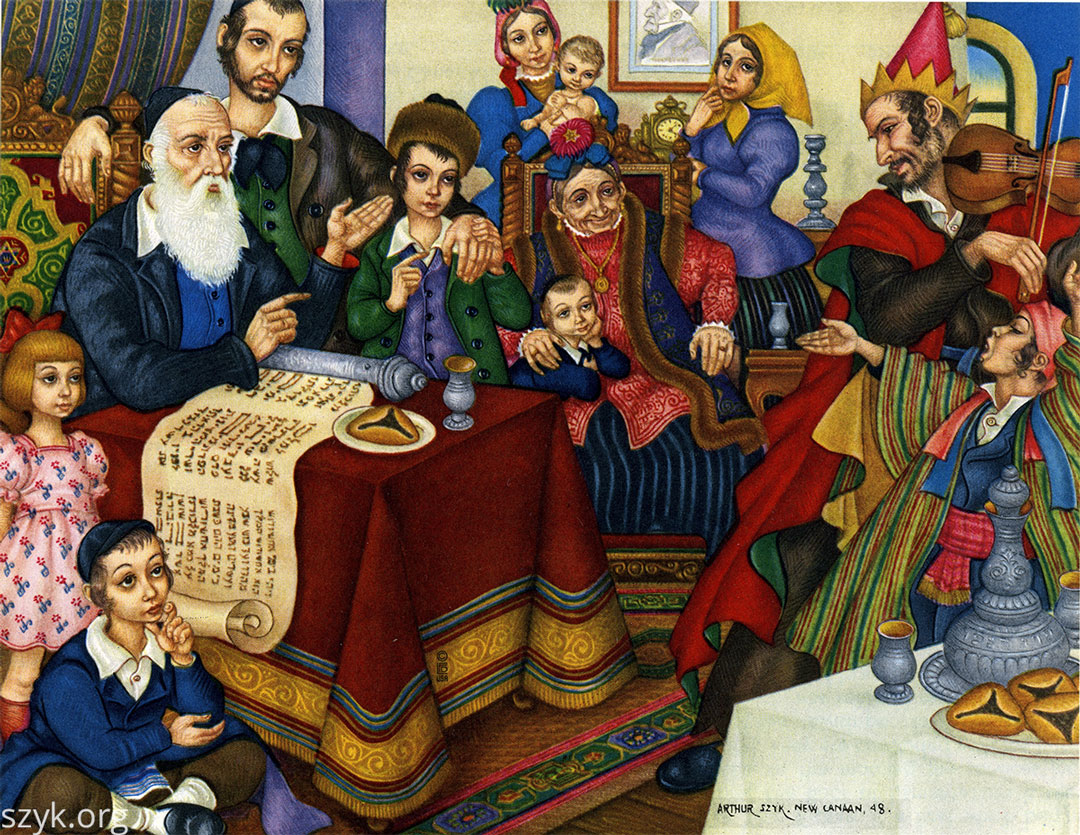
Wikipedia describes that the Book of Esther “is one of the Five Scrolls (Megillot) in the Hebrew Bible and later became part of the Christian Old Testament.“
A King James Narrative. According to Esther 2:7, “And he [King Ahasuerus] brought up Hasassah that is, Esther, his uncle’s daughter: for she had neither father nor mother, and the maid was fair and beautiful; whom Mordecai, when her father and mother were dead, took for his own daughter.”
From Esther 2:9: “And the maiden pleased him, and she obtained kindness from him…. and he preferred her and her maids unto the best place of the house of the women.”
Not to put a twist on it, but this place eventually featured pretzels, or so Herrad of Landsberg imagined.
Fast Forward to About 690 A.D. Wikipedia describes, “Mont Sainte-Odile Abbey, also known as Hohenburg Abbey, is a nunnery, situated on Mont Sainte-Odile, one of the most famous peaks of the Vosges mountain range in the French region of Alsace.”
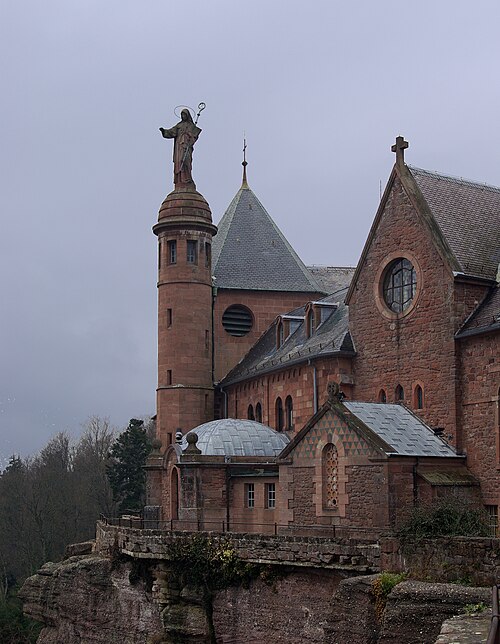
Mont Sainte-Odile Abbey. Image by Mattana via Wikipedia.
The Abbey was founded about 690 by Adalrich, Duke of Alsace for his daughter, Odile, who was its first abbess. It became a house for ladies of nobility. Wikipedia recounts, “Devastated by fire several times, the abbey church was rebuilt in 1050 and consecrated by Pope Leo IX.”
Wikipedia continues, “When in the first half of the 12th century the monastery began to decline, its discipline was restored by Abbess Relindis of Bergen near Neuburg an der Donau, who became abbess of Hohenburg in about 1140. During her rule Hohenburg became famous for its strict discipline as well as the great learning of its nuns.”
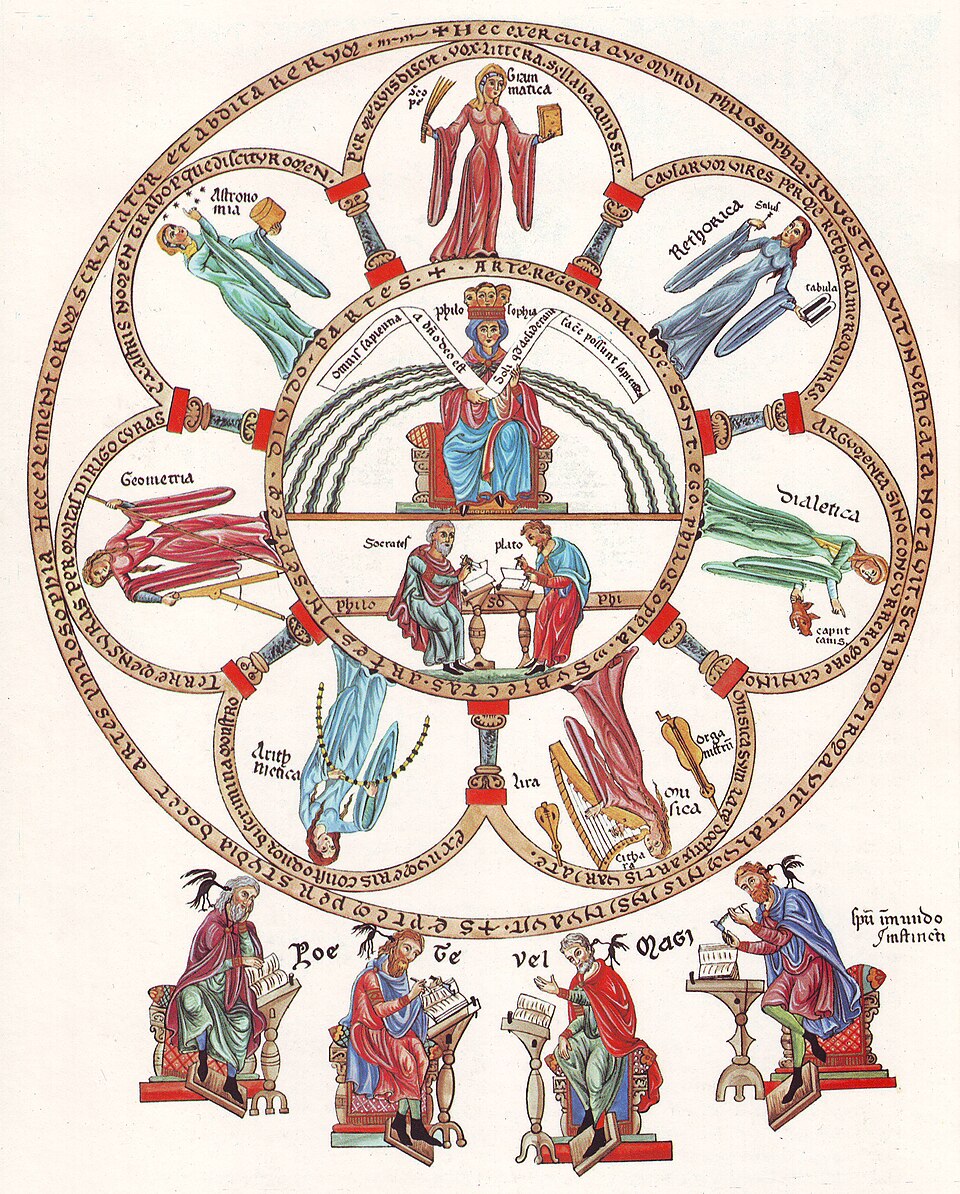
Philosophia et septem artes liberales (Philosophy and the Seven Liberal Arts), as illustrated in the Hortus deliciarum. Description of the illumination. This and following images from Wikipedia.
Along Comes Herrad of Landsberg. Herrad was born about 1130 at the castle of Landsberg, the seat of a noble Alsatian family; she entered Hohenburg Abbey at an early age. Wikipedia describes, “At the abbey Herrad received the most comprehensive education available to women during the 12th century.”
Wikipedia continues, “As she grew older she rose to a high position in office at the abbey, and was soon put in charge of governing and educating her fellow nuns…. Herrad was elected abbess in 1167.”
Herrad’s Hortus Deliciarum. Wikipedia describes the work as “an illuminated encyclopedia, begun in 1167 as a pedagogical tool for young novices at the convent. It is the first encyclopedia that was evidently written by a woman. It was finished in 1185, and was one of the most celebrated illuminated manuscripts of the period.”
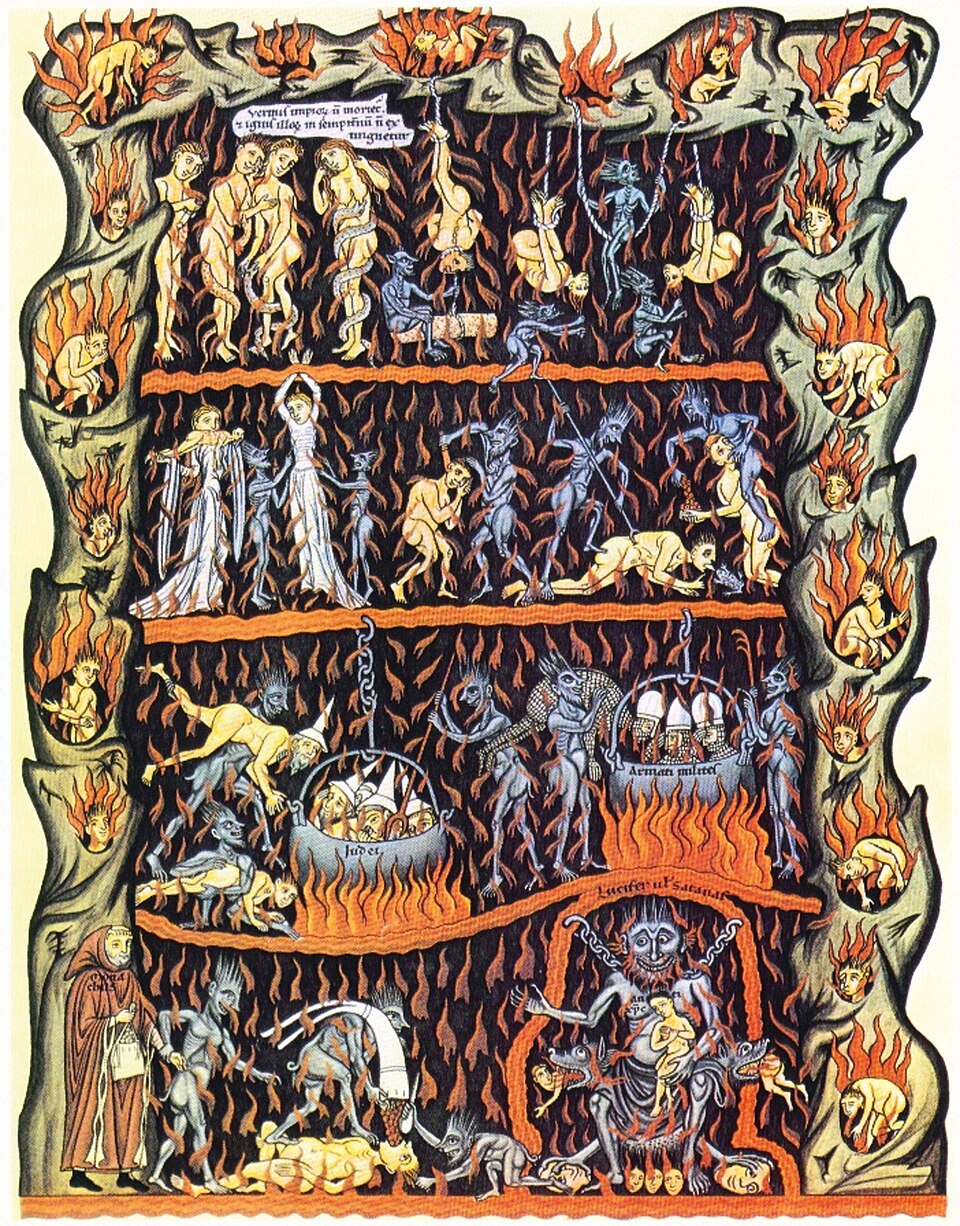
Hell, as illustrated in the Hortus deliciarum. The Devil can be seen at bottom right.
A Compendium of 12th-Century Knowledge. Wikipedia observes, “The majority of the work is in Latin, with glosses in German. Most of the manuscript was not original, but a compendium of 12th-century knowledge. The manuscript contained poems, illustrations, and music, and drew from texts by classical and Arab writers.
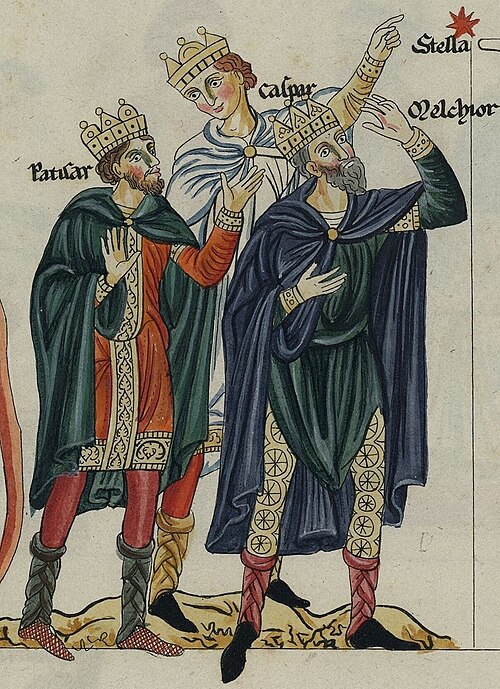
A familiar trio. The Three Magi, an illustration from the reproductions of the Hortus deliciarum by Christian Moritz Engelhardt, 1818
Its Musical Significance. The Hortus deliciarum, recounts Wikipedia, “is one of the first sources of polyphony originating from a convent. [The earlier Gregorian chant was purely monophonic.] The manuscript contained at least 20 song texts, all of which were originally notated with music. Those that can be recognized now are from the conductus repertory, and are mainly note against note in texture. The notation was in semi-quadratic neumes with pairs of four-line staves. Two songs survive with music intact: Primus parens hominum, a monophonic song, and a two-part work, Sol oritur occasus.”
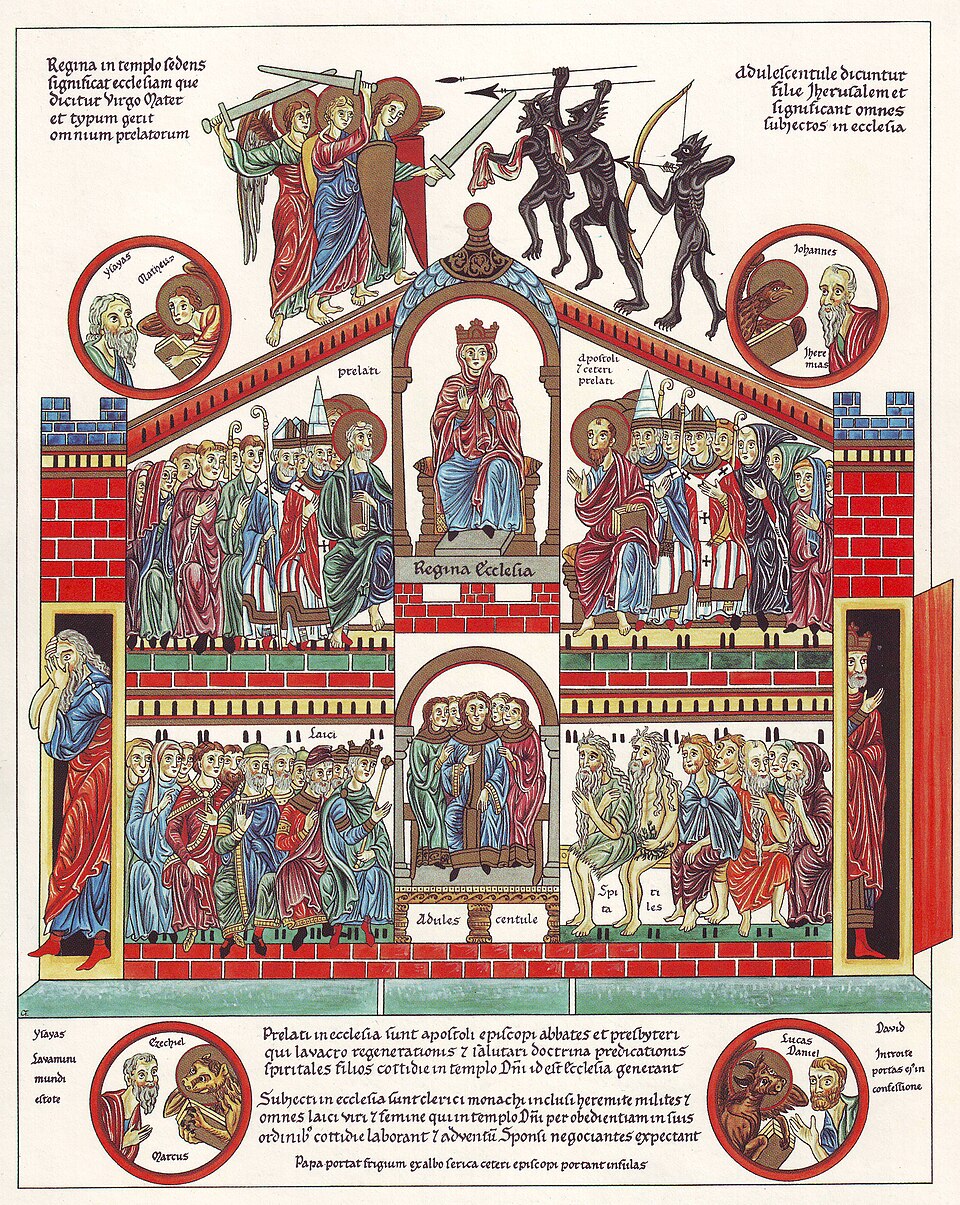
An illustration of the ecclesia from the Hortus deliciarum.
Poems, Music, and Art. Wikipedia relates, “Interspersed with writings from other sources were poems by Herrad, addressed to the nuns, almost all of which were set to music. The most famous portion of the manuscript is its 336 illustrations, which depicted theological, philosophical, and literary themes amongst others.” See the Wikipedia Commons selection of Hortus deliciarum.
And don’t forget that 12th-century pretzel. ds
© Dennis Simanaitis, SimanaitisSays.com, 2026

