
Simanaitis Says
On cars, old, new and future; science & technology; vintage airplanes, computer flight simulation of them; Sherlockiana; our English language; travel; and other stuff
JUST WHEN YOU THOUGHT IT WAS SAFE TO GO BACK IN THE CRETACEOUS SEA PART 2
YESTERDAY, WE LEARNED FROM AAAS SCIENCE THAT THE CRETACEOUS SEA contained cephalopods of unprecedented size. Sources for this are Phie Jacobs’ “Octopus ‘Krakens’ as Large as Semi-Trucks Stalked Ancient Seas,” and Shin Ikegami et al.’s “Earliest Octopuses Were Giant Top Predators in Cretaceous Oceans.” Today in Part 2, we learn more about these beasties.
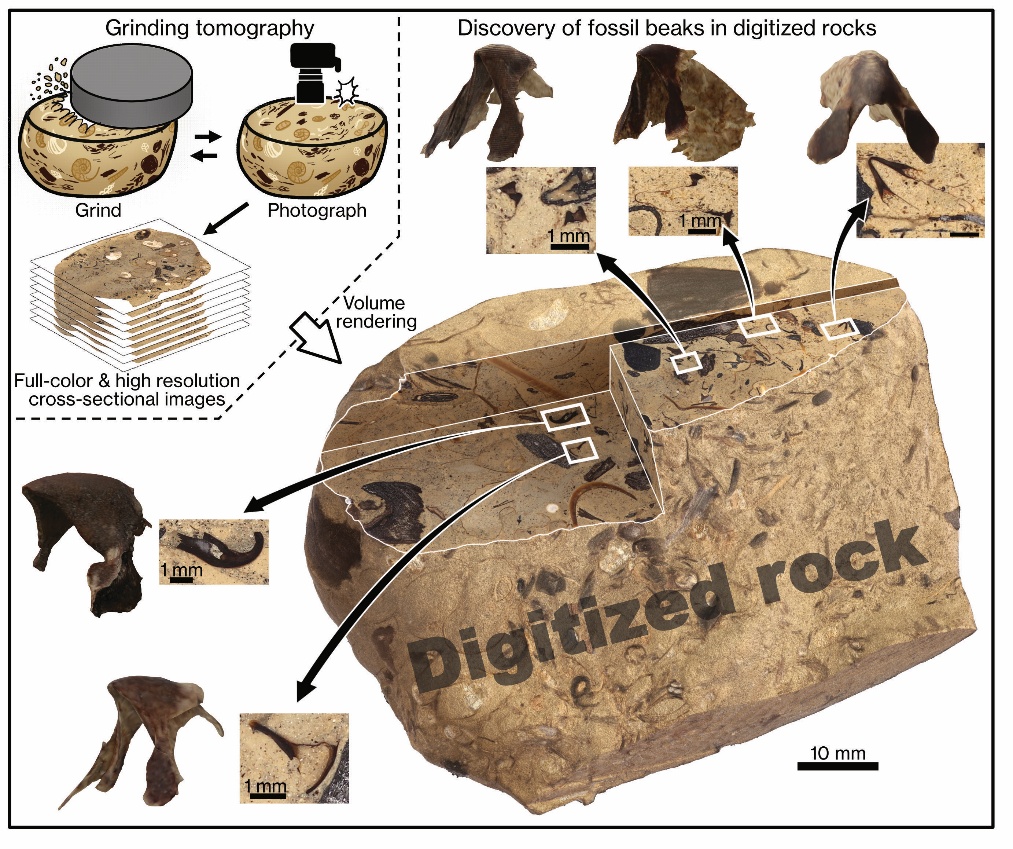
Science’s Phie Jacobs describes, “To analyze these fossils, researchers must carefully extract them from the surrounding rock, risking damage to delicate structures, or examine relatively low-resolution grayscale images from computed tomography (CT) scanning.”
Digital Fossil Mining. “Last year,” Jacobs recounts, “Hokkaido University paleontologists Yasuhiro Iba and Shin Ikegami developed a technique they call ‘digital fossil mining’ to get a better look at these beaks. They grind away a superthin layer from the fossil-bearing matrix, take a high-resolution photo, then repeat the process thousands of times. These images are then assembled into 3D, full-color models. The team previously used this method, which Landman describes as ‘astonishing,’ to reveal a treasure trove of hidden beaks—pushing back the first appearance in the fossil record of two major orders of squid by millions of years.”
This and the following images from Science.
Fossil Beak Chips and Scratches. The researchers note, “Most extant octopuses and cuttlefishes are generalist carnivores that consume both soft and hard prey, mainly crustaceans, shelled mollusks, other cephalopods, and bony fishes. Frequent durophagous predation on hard-shelled prey causes wear of their jaw tips and jaw edges, which is absent in nondurophagous cephalopods such as squids. This wear provides reliable evidence of durophagy, in a broader sense carnivory, in fossil cephalopods.”
An Etymological Pause. The term “durophagous” deserves some research. Its Ancient Greek and Latin roots describe eating hard-shelled or exoskeletal organisms: Latin duro, “hard,” as in the English word “durable.” Phagous, Ancient Greek φαγειν, “to eat.”
Whence, for example, the nickel-word “anthropophagous” for “cannibal.”
Jacobs describes, “Extensive wear on the jaws of the Cretaceous octopuses suggests they belong to the latter category [i.e., durophagous]. In some cases, roughly 10% of the total jaw length had been worn away, suggesting these beasts regularly crunched on hard shells and bones.”
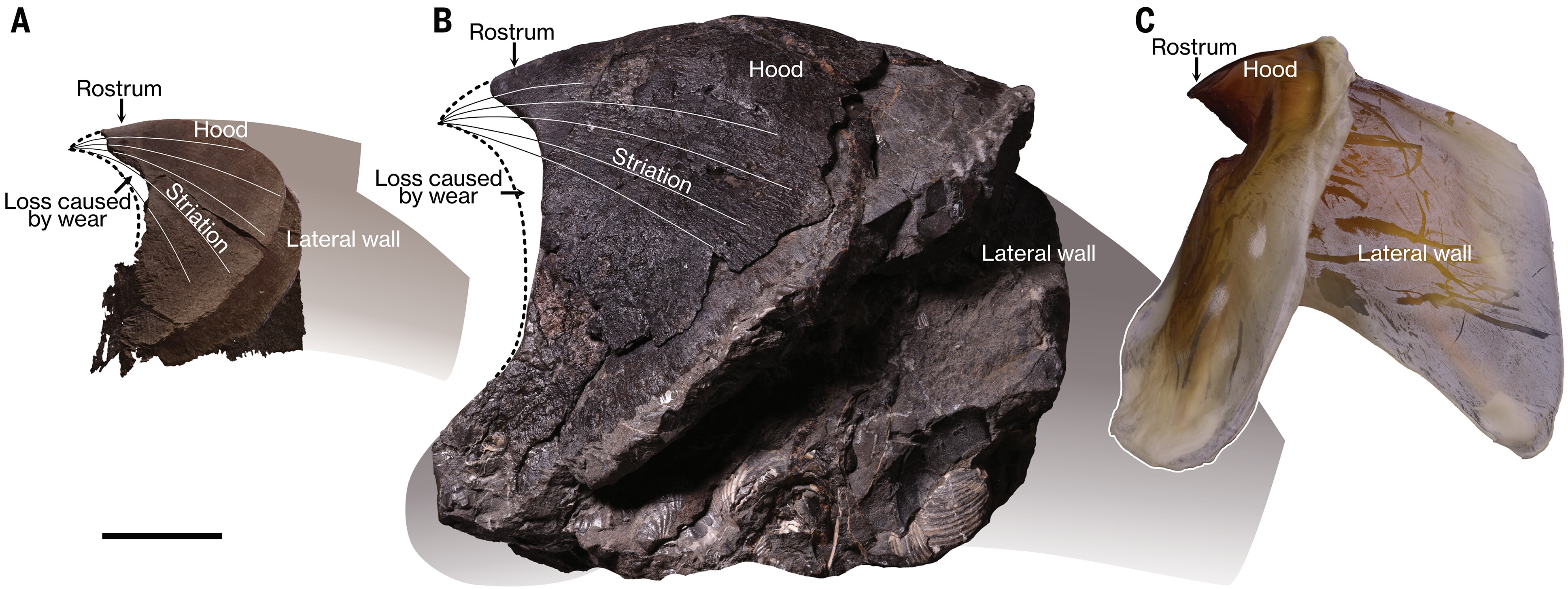
Lower jaws. At left, a digital fossil jaw of N. keletzkyi. Middle, an actual well-preserved fossil jaw of N. haggarti. At right, jaw of an extant giant squid Architeuthis dux. Scale is 20 mm.
Righties or Lefties? Jacobs continues, “The beaks also tended to be more degraded on one side than the other, which Shin says may indicate the cephalopod equivalent of handedness—and even braininess. Just as humans are right- or left-handed, modern octopuses prefer to use certain arms for particular tasks. ‘This laterality,’ Shin explains, ‘is related to the complexity of the brain.’ ”
Becoming a Top Predator. The researchers recount, “Vertebrates and cephalopods evolved jaws contemporaneously between 423 to 407 Ma, an innovation that improved feeding efficiency…. Long after the rise of vertebrate top predators, octopuses evolved body plans capable of rivaling them, as demonstrated here.”
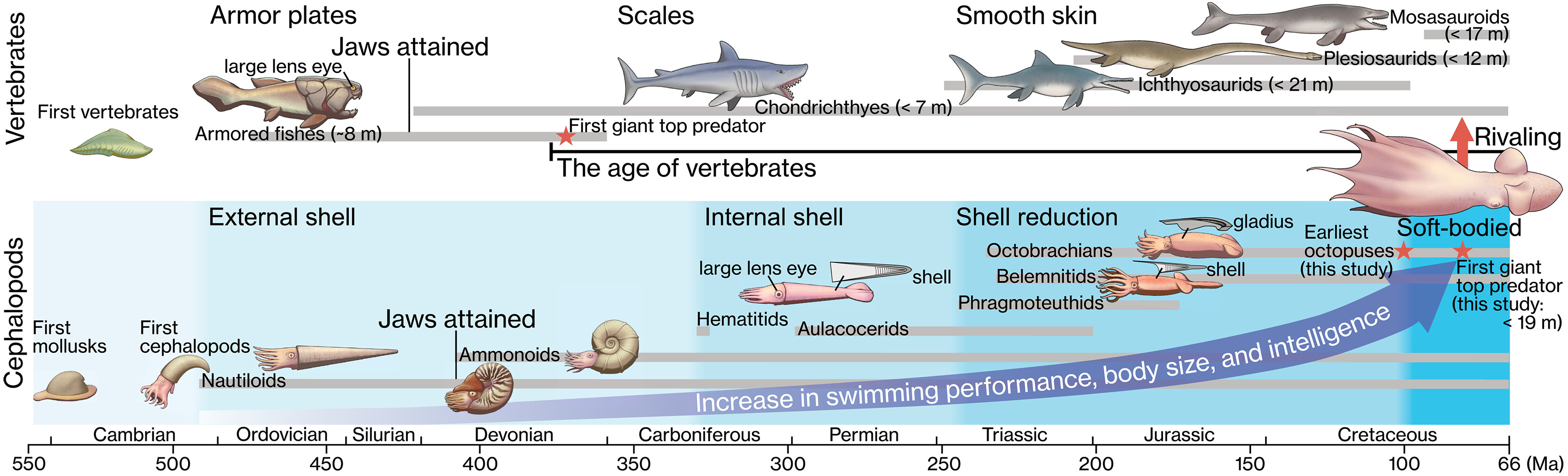
Convergent evolution among marine top predators in the Paleozoic-Mesozoic.
The researchers conclude, “Our discovery of octopus top predators highlights that this convergent evolution of robust jaws and the reduction of superficial skeletons in cephalopods and vertebrates is essential for becoming a large, intelligent marine top predator.”
And, in any case, N. haggari would have certainly kept me out of the Cretaceous Sea. ds
© Dennis Simanaitis, SimanaitisSays.com, 2026

