
Simanaitis Says
On cars, old, new and future; science & technology; vintage airplanes, computer flight simulation of them; Sherlockiana; our English language; travel; and other stuff
JUST WHEN YOU THOUGHT IT WAS SAFE TO GO BACK IN THE CRETACEOUS SEA…. PART 1
AAAS SCIENCE TELLS US ABOUT NANIOUTEUTHUS haggarti: “the largest invertebrate ever described,” an octopus that makes even the sea-monster krakens of legend seem playful.
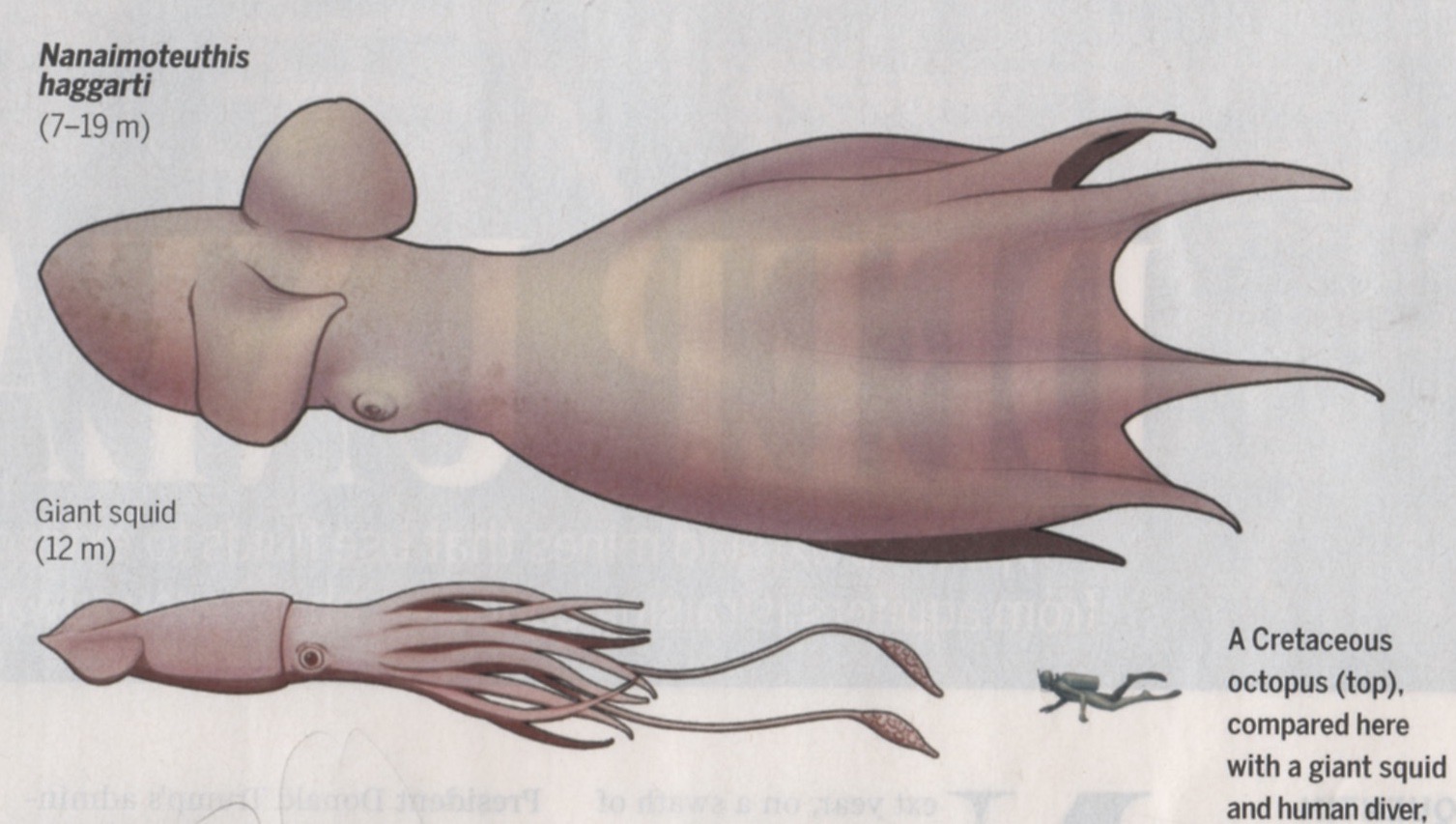
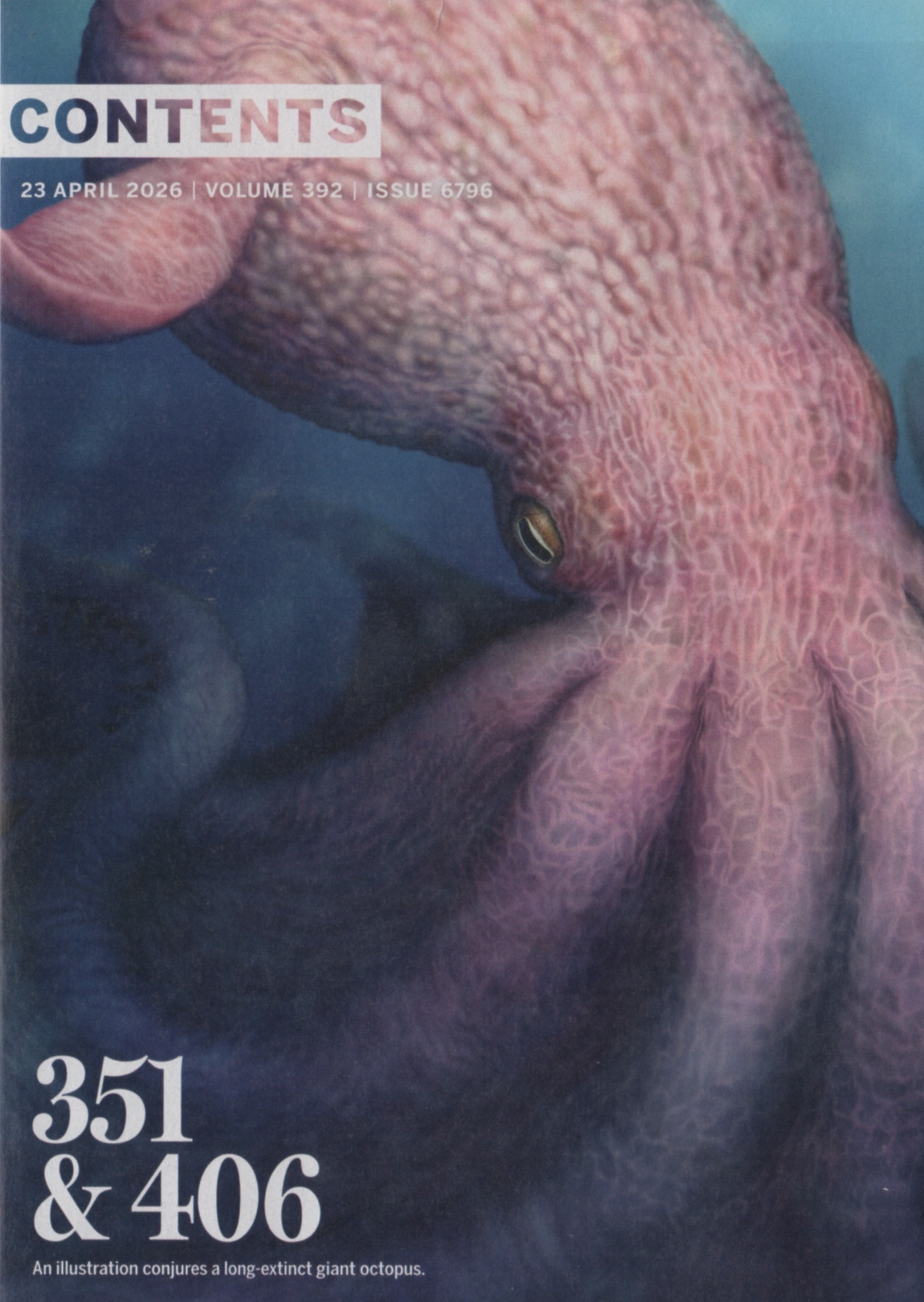
What’s more, the 23 April 2026 Science offers three levels of detail: Phie Jacobs describes “Octopus ‘Krakens’ as Large as Semi-Trucks Stalked Ancient Seas.” And Sacha Vignieri offers an Editor’s Summary of Shin Ikegami et al’s technical paper “Earliest Octopuses Were Giant Top Predators in Cretaceous Oceans.”
Following in Parts 1 and 2 today and tomorrow are tidbits gleaned from all three.
Editor’s Summary. Sacha Vignieri recounts, “The Kraken, the giant cephalopod of legend, was feared by sailors for centuries. Later interpretations suggested that it may have been based on sightings of the giant squid, which can be 10 meters long…. Ikegami et al. describe fossil octopods from the late Cretaceous that truly would have fit the description of the monster, reaching up to 19 meters in length.”
“Wear patterns on their jaws,” Vignieri summarizes, “suggest that these octopods preyed upon the large reptiles present at the time, including plesiosaurs and mosasaurs. The authors interpret asymmetry in these wear patterns as an indication of corresponding asymmetry in behavior, suggesting complex brain development and, potentially, high intelligence.”
Recall “Sea Aliens,” SimanaitisSays, September 14, 2017: “The octopus is as near to intelligent alien life as anything found on this planet.”
From Ikegami et al’s Abstract: “Top predators,” the researchers note, “drive changes in ecosystem structure. For the last ~370 million years, large-sized vertebrates have dominated the apex of the marine food chain, while invertebrates have served as smaller prey. Here we describe invertebrate top predators from this ‘age of vertebrates,’ the earliest finned octopuses (Cirrata) from Late Cretaceous sediments (~100 to 72 million years ago), as identified based on huge, exceptionally well-preserved fossil jaws and their wear.”
Phie Jacobs Quotes Paleontologists: “ ‘When you think of the Cretaceous, you immediately think of mosasaurs and plesiosaurs,’ says Neil Landman, a paleontologist at the American Museum of Natural History who wasn’t involved in the study. But the new work suggests early octopuses, including one potentially measuring 19 meters in length—as long as a semitrailer truck—could have been just as formidable. The findings, Landman notes, challenge the ‘vertebrate-centric’ narrative surrounding the era’s big beasties, revealing that ‘gigantic octopuses’ also served as apex predators.”
Methodology. Jacobs observes, “Because the soft bodies of squids and octopuses don’t preserve well, ‘the fossil record is very patchy,’ says Christian Klug, a paleontologist at the University of Zurich who wasn’t involved in the research. In many cases, the only traces of these early cephalopods are their chitinous beaks.”
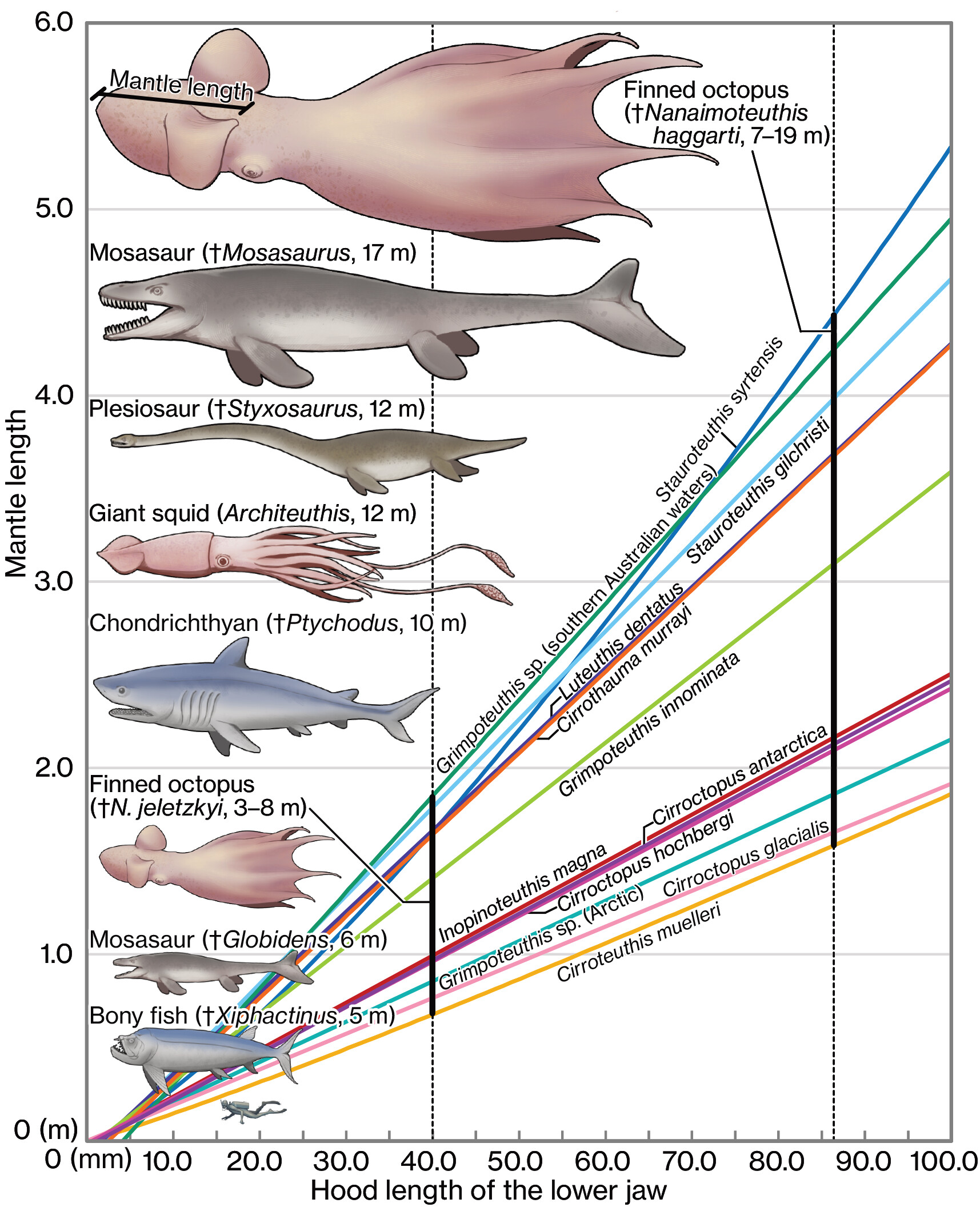
Fortunately, there’s an allometric relationship among overall sizes of Late Cretaceous creatures and their lower jaw length.
Tomorrow in Part 2, researchers construct 3D models of these fossilized beaks and use them to discern the creatures’ eating habits. I learn a new term as well: “durophagous.” ds
© Dennis Simanaitis, SimanaitisSays.com, 2026

