
Simanaitis Says
On cars, old, new and future; science & technology; vintage airplanes, computer flight simulation of them; Sherlockiana; our English language; travel; and other stuff
PUMPING URANIUM?
QUENTIN SEPTER EXPRESSES “DEEP UNEASE” in AAAS Science, April 23, 2026: “A push to expand mines that use fluids to extract uranium from aquifers is raising concerns about groundwater pollution.” Following are tidbits gleaned from Septer’s article, augmented by my usual Internet sleuthing.

Chemist Klaproth’s Lab Work. “In 1789,” Quentin Septer describes, “a German chemist named Martin Heinrich Klaproth took a lump of black ore called pitchblende from a mine in Bohemia, dissolved it in a solution of nitric acid, and neutralized it with potash, causing a mysterious yellowish substance to precipitate. Klaproth named the substance uranium in honor of the planet Uranus, discovered just a few years earlier.”
In Situ Recovery of Uranium Mimics Klaproth’s Technique. Septer notes that some 160 years later, geologists “found the element isn’t just locked in rock—it moves through groundwater. They learned that oxygen-rich water oxidizes uranium, forming soluble compounds that migrate through aquifers. When that groundwater encounters so-called reducing conditions—created by organic matter and low oxygen levels—the dissolved uranium precipitates back into solid ore.”
This “In Situ Recovery” essentially replicates, deep underground, the chemical extraction methods that scientists had been refining in laboratories since Klaproth’s time.
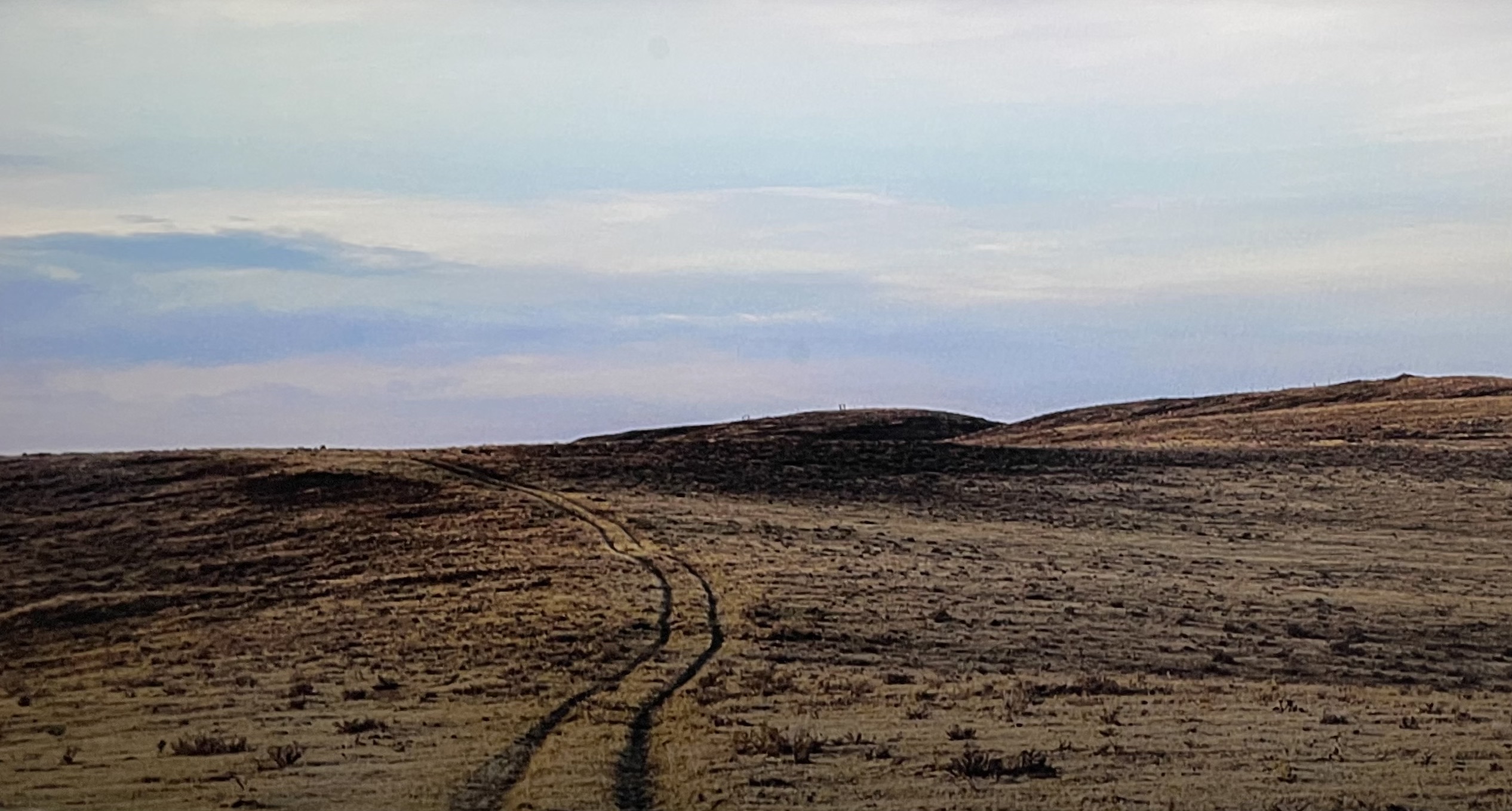
Image by Kristina Barker/Rapid City Journal via AP and Science.
The Dewey Burdock ISR Project. Septer describes, “Next year, on a swath of rolling South Dakota grassland, engineers plan to start drilling for energy—not oil or gas, but uranium. Thousands of wells will inject specially treated water into a uranium-rich sandstone formation up to 230 meters underground, where the fluid will leach the uranium into the surrounding groundwater. Additional wells will lift the water to the surface, where workers will extract the uranium and convert it to a concentrated form called yellowcake, to be refined into fuel for nuclear power plants or components of nuclear weapons. Miners will then pump the wastewater deep underground.”
The Numbers. Septer recounts, “Over the 16-year life of the project, enCore Energy plans to drill 1461 injection wells that will pump groundwater enriched with dissolved oxygen and carbon dioxide into the sandstone. The oxygen will oxidize uranium minerals, converting them from insoluble uranium-IV to soluble uranium-VI uranyl ions. The carbon dioxide will form carbonate complexes that keep the uranium in solution. More than 850 production wells will pump the uranium-laden water to the surface, where a central processing plant will extract up to 450 tons of uranium per year.
Septer recounts, “ISR mines already produce more than half of the world’s uranium and have long been touted as a cheaper and more environmentally sustainable alternative to open-pit and underground mines. They don’t dig up large tracts of land or produce vast piles of toxic tailings, and they use less water than traditional mining methods.”
Contaminated Water? “Despite those advantages,” Septer continues, “Dewey Burdock has drawn fierce opposition and lawsuits from local communities and Native American tribes. One concern is that the region’s complex, fractured geology will allow contaminated water to leak into major aquifers that supply water to communities and farms across South Dakota’s rugged Black Hills region. Another is that the project won’t be able to comply with federal rules that require ISR mines to restore groundwater to premining conditions.”
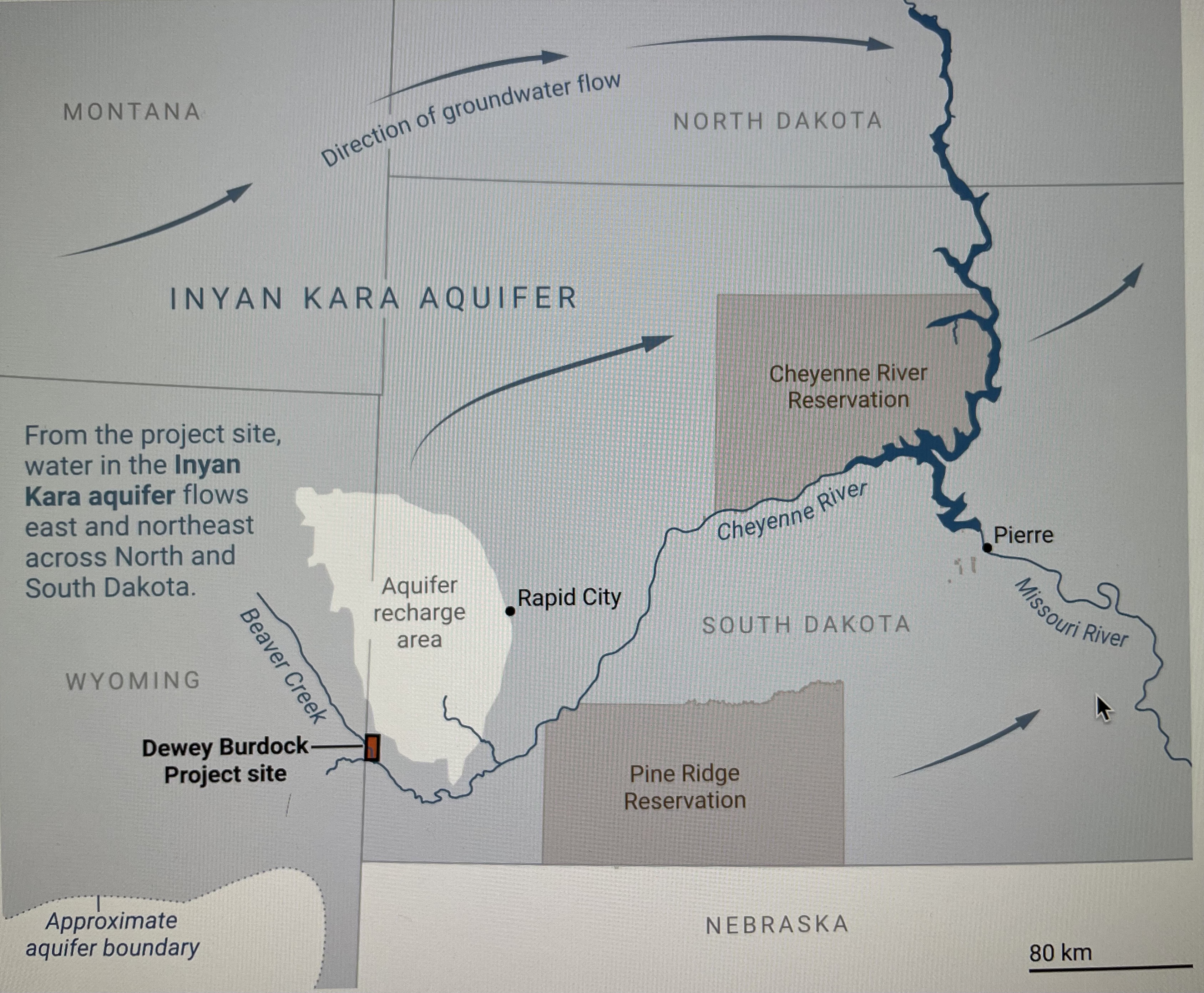
Septer recounts, “Mine opponents also worry the mine would endanger another aquifer that is the primary drinking water source for much of western South Dakota, including Rapid City, the state’s second-largest city. It sits within the Madison Formation, which lies just below the Minnelusa Formation—enCore Energy’s planned wastewater disposal zone. USGS researchers have found that the Madison and Minnelusa are connected through faults, fractures, and breccia pipes (porous features that form after dissolved rock collapses).”
Questionable Cleanup Options. Septer cites long-term implications of the Smith Ranch-Highland project, a defunct ISR mine in Wyoming: “After the unit closed in 1991, the mine’s owners tried to clean the aquifer using a combination of techniques. Even after 7 years of work, however, uranium concentrations were 3.53 milligrams per liter—far above the premining baseline of 0.05 milligrams per liter and 117 times higher than EPA considers safe for drinking water, the team reported in 2012 in the Journal of Environmental Monitoring.”
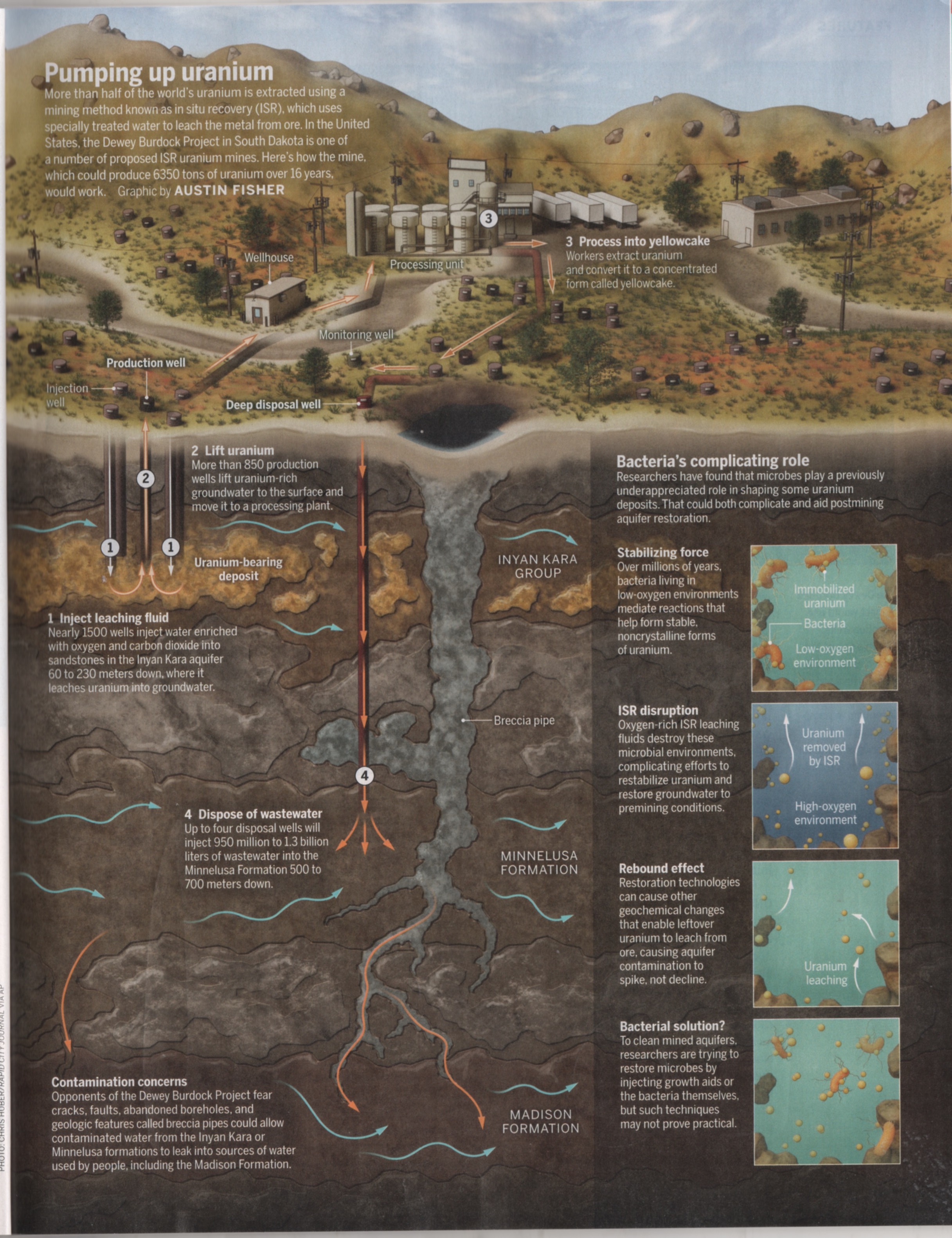
And Then There Are The Microbes. Septer describes, “The microbes involved in this process—in the genera Geobacter, Pseudomonas, and Clostridium—don’t directly consume or process the uranium. Instead, they immobilize the element through various mechanisms.”
Good News, Bad News. “On the one hand,” Septer notes, “microbially mediated uranium may be easier to liberate than crystalline forms, opening the way to more economical—and potentially more environmentally benign—ISR mining methods. At the same time, however, it could greatly complicate postmining restoration, because immobilizing the uranium again could require restoring a microbial ecosystem that is essentially destroyed by ISR.”
Regulatory Matters. Septer reports, “South Dakota officials, meanwhile, are still deciding whether they will issue state permits, and NRC is now considering whether to renew the project’s license, originally issued in 2014. A ballot measure that declares uranium mining a public nuisance, overwhelmingly approved in 2022 by voters in the project’s home county of Fall River, could also prove a stumbling block. County residents assert the measure effectively bans the mine, but it’s not clear it overrides state and federal law.”
Federal regulators seem more than a little tilted in the direction of the mining industry: Septer cites, “That’s because they can grant ISR mines relief from regulatory standards if restoration proves ‘technically impracticable from an engineering perspective.’ ”
What?? You’d think if cleanup were technically impracticable, the entire process would be as well. ds
© Dennis Simanaitis, SimanaitisSays.com, 2026


Truly it seems like humans fail to learn the most basic lessons at times .
-Nate