
Simanaitis Says
On cars, old, new and future; science & technology; vintage airplanes, computer flight simulation of them; Sherlockiana; our English language; travel; and other stuff
GRESLEY A3 PACIFIC—HANDLES LIKE IT’S ON RAILS
“IN AN AGE OF COMPACTS, ECONOMY CARS, MINI CARS AND OTHER TRIVIA,” R&T Contributing Editor Tony Hogg observed, “it is a great relief for us when occasionally we are able to get our hands on a machine which has some real guts to it.” Here, sixty years later, are tidbits about the Gresley A3 Pacific locomotive.
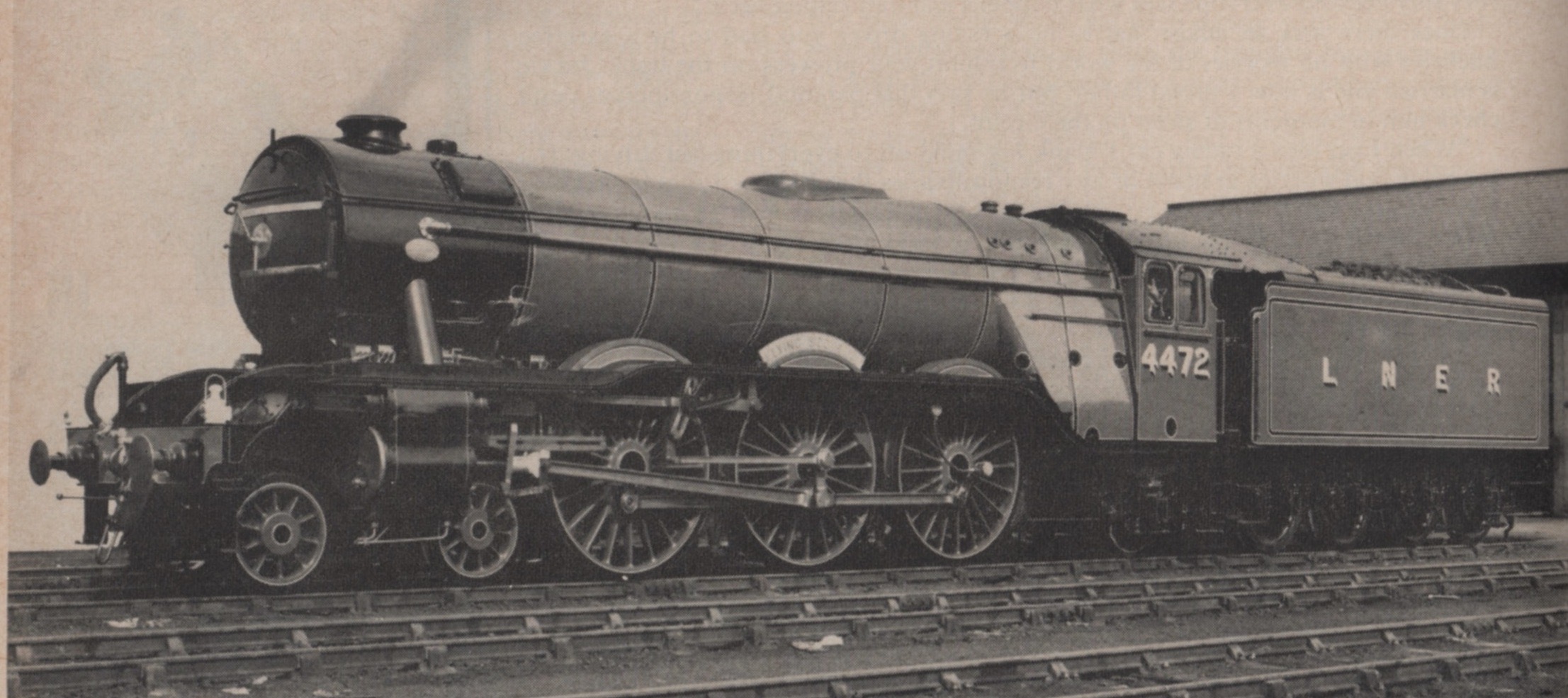
Acquiring Such Transportation. “Englishman Alan Pegler invited us to test his personal steam engine,” Tony recounted. “Running your own steam locomotive is a bit like drinking champagne for breakfast; not everybody can afford it, but it can be a great pleasure for those who can.”
Tony described, “Pegler acquired the habit three years ago when British Railways was offering a selection of used locomotives for sale at scrap value. Passing his friendly neighborhood used locomotive lot one day, he saw a 1923 model in good condition with only 2,076,000 miles on the clock. The price was a mere $9000, so quite naturally he bought it.”
To put this price in perspective, the R&T “Market Place” in May 1966 listed a “1964 Ferrari GTO, Le Mans body. Prepared and just overhauled by factory. Superb, extremely fast. Used in only a few hillclimbs, usually overall winner. Splendid road car. Best offer over $9000.”
The Catch. “Unfortunately,” Tony observed, “the terms of the [locomotive] sale were that his purchase had to be removed within a specific time, and how do you remove something that is 70 ft long, 13 ft high and weighs 175 tons?”
The Solution. Tony described, “Pegler solved the problem by reaching an agreement with British Railways whereby BR houses it for him, lets him use the tracks and provides a trained crew when required. All of which we feel is most commendable for an organization that normally seems to be buried up to its neck in bureaucracy.”
“After taking delivery,” Tony continued, “Pegler spent another $25,000 on a complete overhaul and restoration, including a pale green and black paint job in the original livery of the now defunct London and North Eastern Railway. Since its restoration the locomotive has covered some 20,000 miles, most of them towing trains full of railroad enthusiasts to enable Pegler to meet some of the operating costs.”
I wonder if the GTO buyer offered tifosi thrill rides?
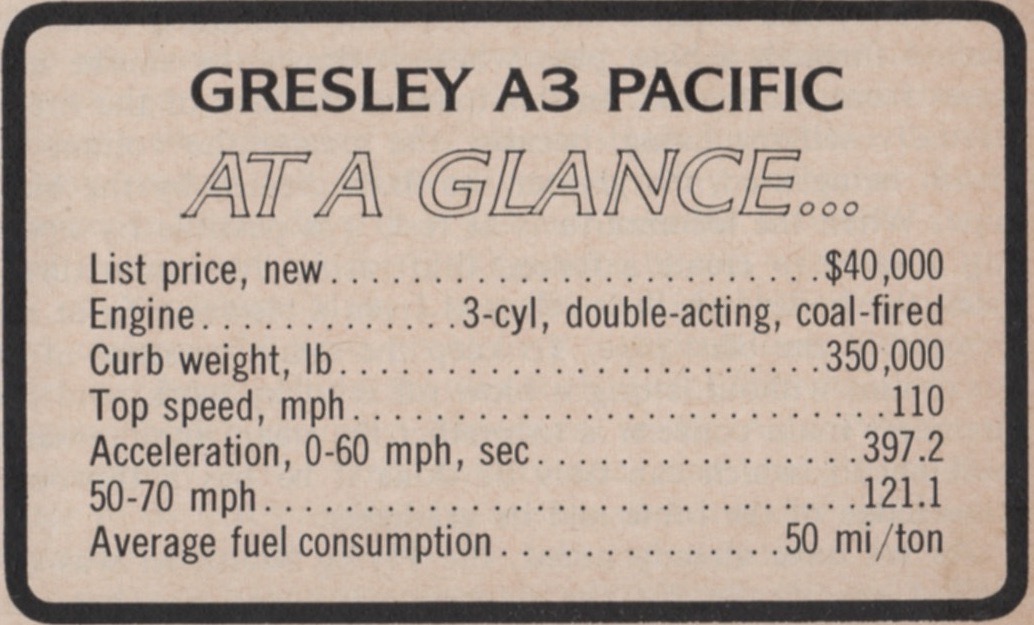
Gresley Was the Man; “Flying Scotsman,” the Name. Tony recounted, “The designer was Sir Nigel Gresley who, in his day, was the Colin Chapman of the steam locomotive, and this machine was constructed specifically to haul express passenger trains between London and Scotland. It was named the Flying Scotsman, which is also the name of the train it normally pulled.”
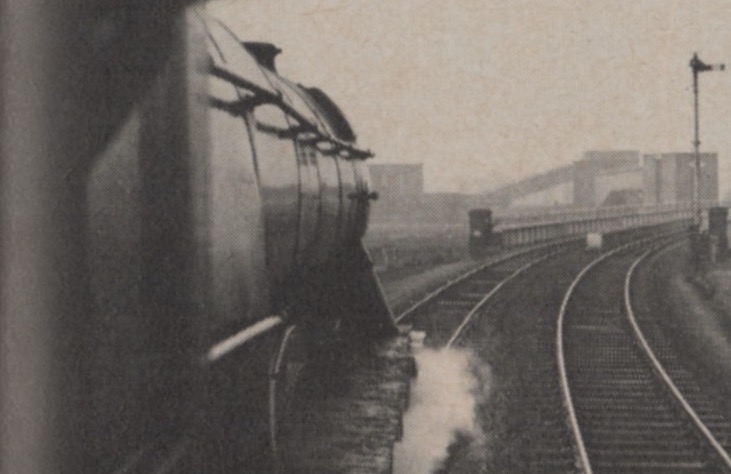
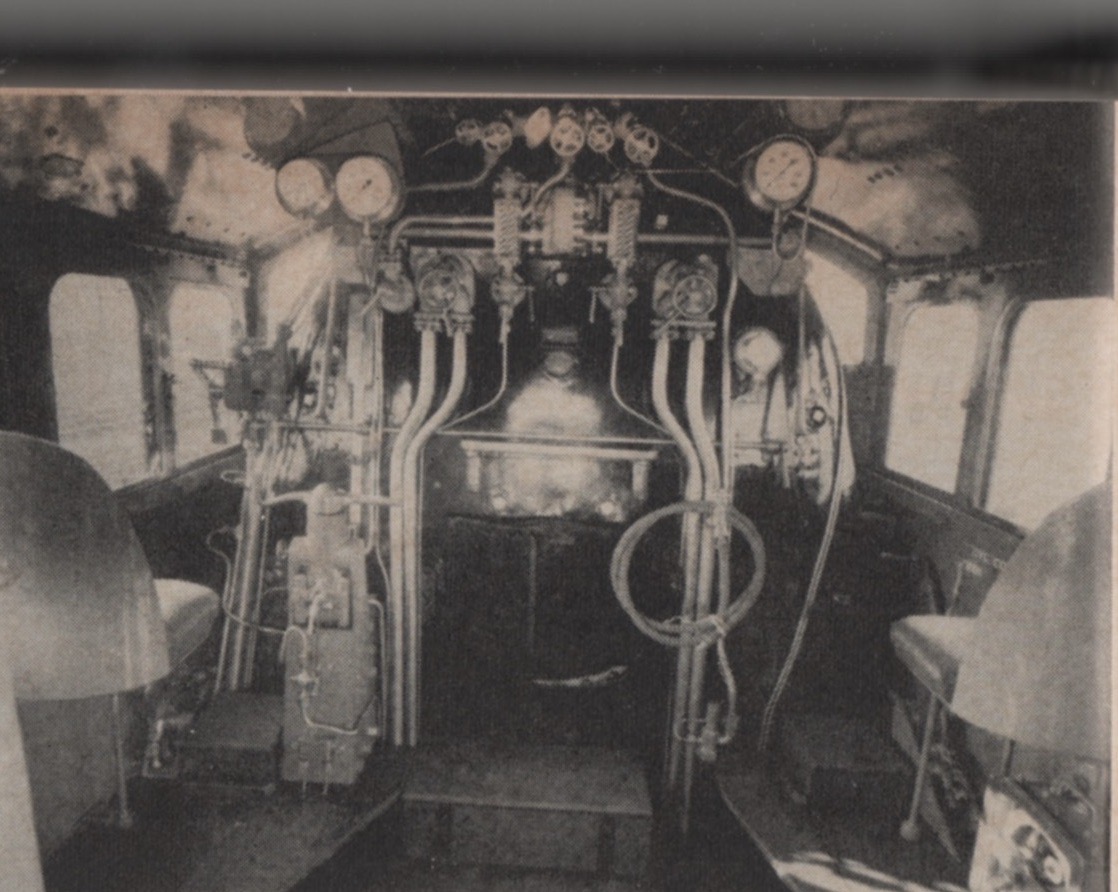
Quite the Driving Position. Tony described, “Climbing aboard (stepover height 51 in.), we were struck immediately by the Spartan interior and lack of creature comforts for the crew. On the other hand, through the steam which seemed to envelop everything we were able to discern a complete absence of those chintzy little plastic knobs, buttons, and warning lights so common today.”
3 = Conventional 12. Tony explained, “The Flying Scotsman has three cylinders with a bore and stroke of 19 x 26 in., which is a long way from the over-square ratios fashionable today. The third cylinder is not visible because it is located in the center, between and in line with the two outside cylinders. Because the cylinders ‘fire’ on each stroke and in each direction, this arrangement is the equivalent of a conventional 12-cyl internal combustion engine.”
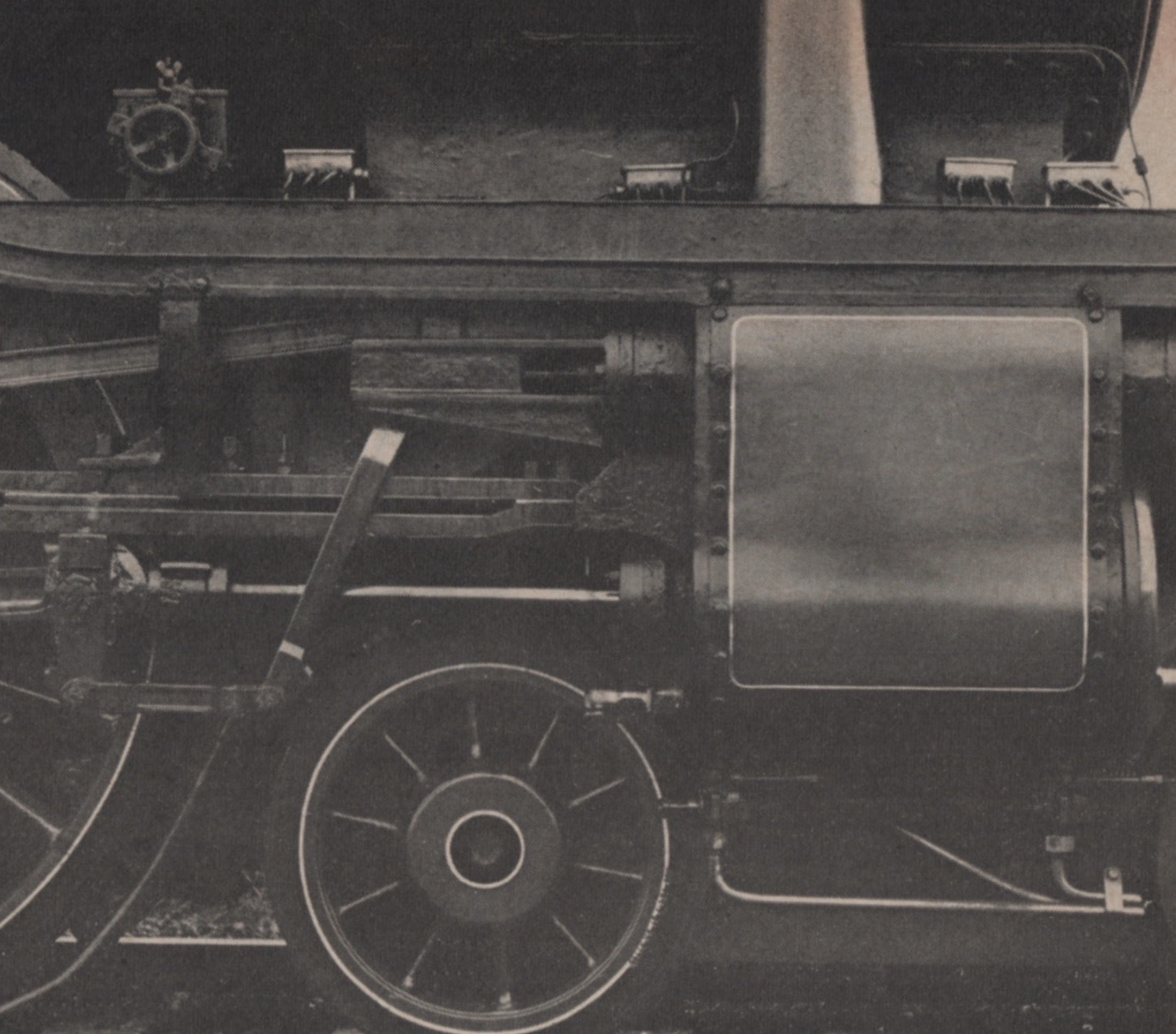
O.K. on Coal, But Thirsty. “The Flying Scotsman,” Tony recounted, “carries 6000 gallons of suitably softened water and 10 tons of coal. The coal supply is sufficient for about 500 miles, but the water consumption is prodigious—in the region of 60 gal per mile—so the whole 6000 gal is consumed in 100 miles.”
On-the-Go Water Troughs. “When steam was in general use,” Tony related, “there was provision for taking on water at all stops, and also by means of water troughs set up between the tracks so that the engineer could pick up water without reducing speed, an effective if splashy method.”
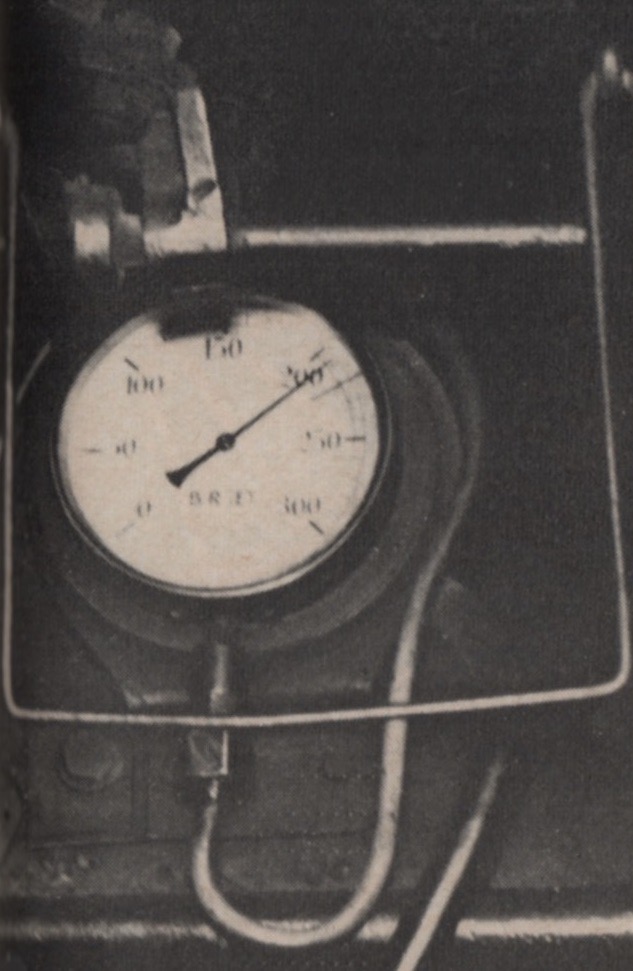
A Crew of Two. Tony described, “Gresley A3s were designed for a crew of two—an engineer and a fireman…. The job of the fireman is to maintain steam pressure throughout the run, which is not always easy. The steam pressure gauge on the Flying Scotsman is red-lined at 220 psi and the fireman endeavors to keep it simmering at a steady 219.”
Coal Details. Tony observed that Gresley A3s run best on Yorkshire Main Large Washed Cobbles. The fireman uses a shovel to feed the fire and he tries to maintain a thin red layer which gives off a brilliant orange/red flame.”
A Speedy Machine. “The schedule,” Tony said (being a Brit, he properly pronounced it ‘sch’ not the Yank ‘sk’), “called for some steady cruising in the 90s and Edgar Hoyle, a retired locomotive engineer (‘engine driver’ is the British term) recalls travelling as fast as 110 mph on occasions.”
Tony noted of railway speeds, “The Flying Scotsman was running over 100 mph in 1923 when the Land Speed Record stood at 133 mph.”
Tony’s Driving Impressions: “The first thing to do when operating a steam locomotive is to get up bloody early in the morning and light the fire. You can then go back to bed for another four hours while it comes to a boil or, alternatively, get to work on the 75 lubrication points that have to be attended to daily.”
Acceleration. “To draw away from rest is surpringly difficult and calls for much more skill than just dumping a clutch and shifting some gears. The technique is to use about 65% cut-off, which is nearly full travel, and then open the regulator cautiously to feel the weight of the train.”
“On a damp day,” Tony recounted, “this usually promotes wheelspin, which can easily be detected because 30 tons of revolving and reciprocating steel suddenly breaks loose beneath you.”
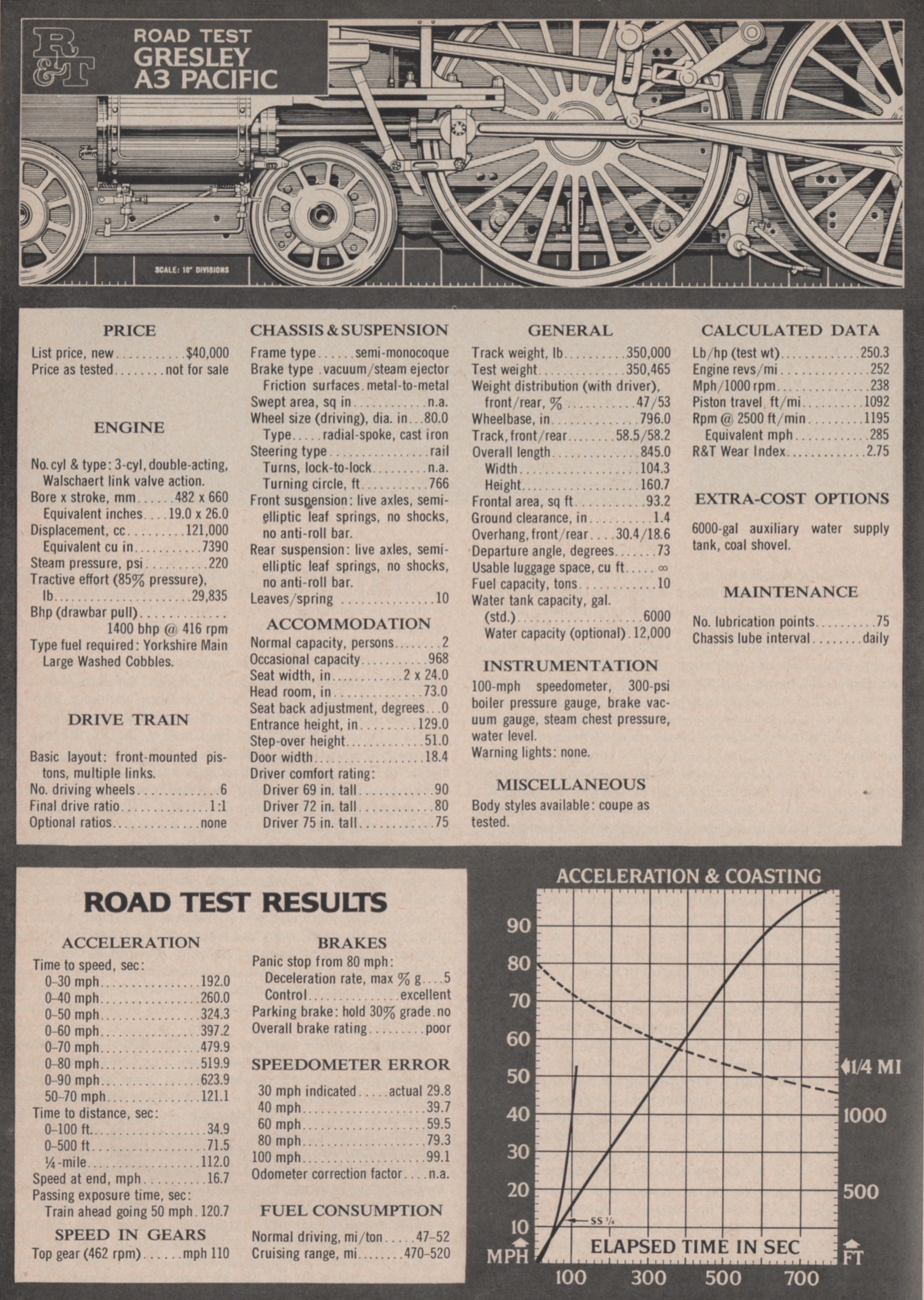
“Acceleration is dismally slow and our best 0-60 time was 397.2 sec, which is ridiculous in these days of 8-sec quarters. On the other hand there are few dragsters capable of pulling 600 tons at 90 mph, so it is really a question of what you want out of life.”
Isn’t that always the way? Though it’s clear that Tony had a really good time. ds
© Dennis Simanaitis, SimanaitisSays.com, 2026


Pretty cool .
I remember riding steam trains in the late 1950’s with my father at amusement parks outside of Boston .
-Nate
I remember seeing it parked in a State Belt Line (waterfront switching) yard in SF, while it and its (fancy and light weight, not meeting US regulations but operating with a waiver) train was on a tour (interrupted at the time due to a temporary lackamunny). Quite impressive. At the time, graffiti were not an issue, but these days extreme security would be needed to protect it. See for instance the security posture around the UP 4014 Big Boy steam locomotive currently touring the eastern part of the US.
And yes, I do remember those April road tests in R&T. They were a cherished feature.
“…the water consumption is prodigious—in the region of 60 gal per mile—so the whole 6000 gal is consumed in 10 miles.”
Errrm, please re-check figures and math. When I was a mere brat, I lived in Haxby, near York, England, and because the main London-Edinburgh line ran through there, my brother and I became avid trainspotters. A small book listed every engine number and name, so when you saw one, we underlined it. We surely saw this engine in action, but I can’t confirm that because my trainspotting book has since been lost. Darn it!
Agg! My typo. Full Disclosure: Many original sources are “copy and paste,” but my R&T volumes are not amenable to such efficient production. These rely on my typing skills.
Corrected now. Thanks, ambitious.