
Simanaitis Says
On cars, old, new and future; science & technology; vintage airplanes, computer flight simulation of them; Sherlockiana; our English language; travel; and other stuff
MATHEMATICS, A.I., AND THE LEIDEN DECLARATION PART 1
MATHEMATICIANS RECENTLY ZOOMED with Siobhan Roberts who writes “As A.I. Makes Strides in Mathematics, Mathematicians Urge Caution,” The New York Times, June 2, 2026. She sets the stage by recounting, “A week after OpenAI made headlines with an A.I.-generated proof, a new ‘declaration’ by 16 experts raises concerns that the technology threatens math as a discipline.”

OpenAI is just one of the artificial intelligence firms that has begun training its models in higher mathematics. Image by Aaron Wojack for The New York Times.
The OpenAI article to which she refers is “An OpenAI Model Has Disproved a Central Conjecture in Discrete Geometry,” OpenAI, May 20, 2026. It contains both the proof itself as well as companion remarks.
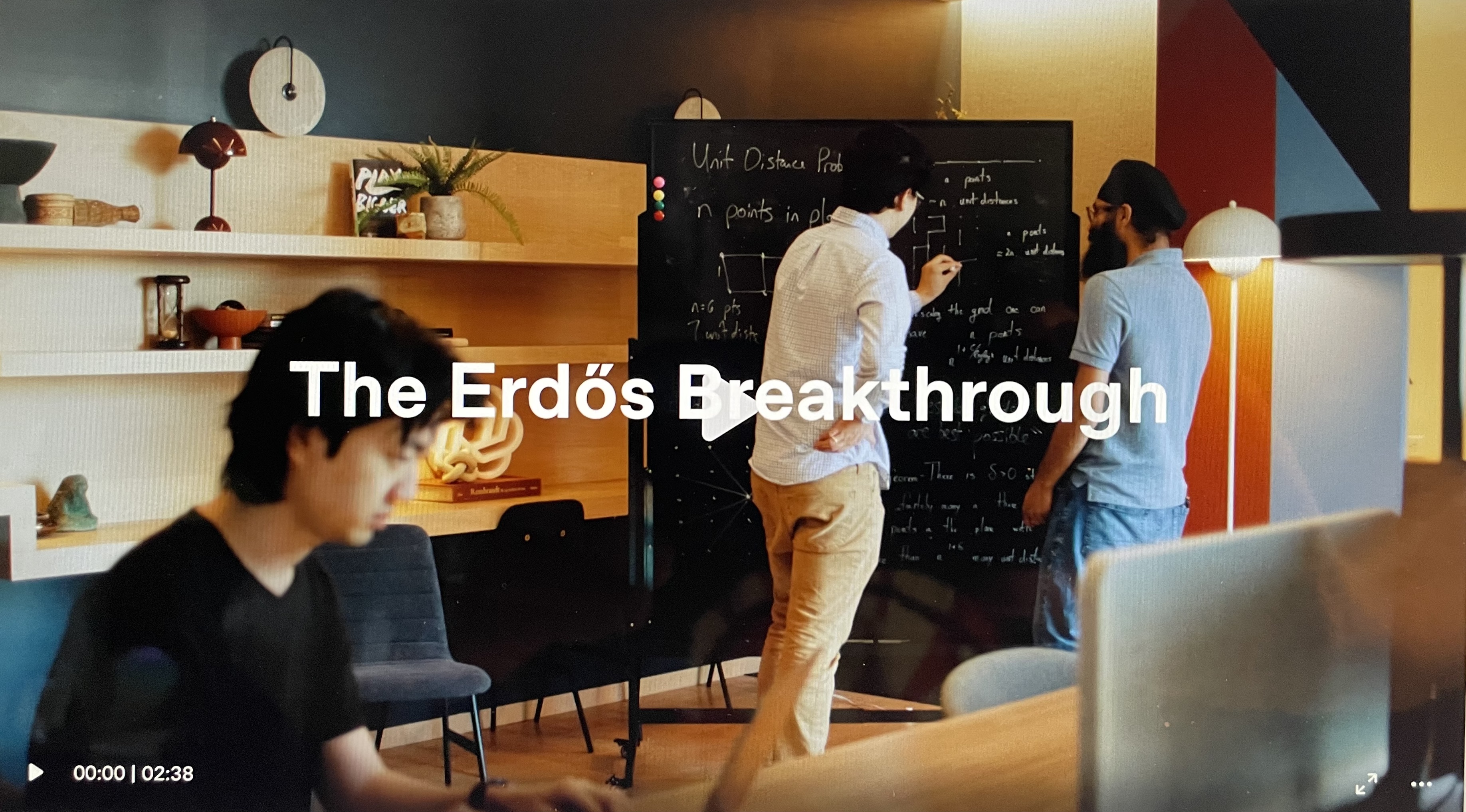
Access to the video is through the OpenAI article.
Here are tidbits gleaned from these articles, together with my usual Internet sleuthing (this time, augmented by my own mathematical background, ancient though it seems).
A Timely Declaration. Siobhan Roberts reports, “On Tuesday, a group of 16 mathematicians, in consultation with colleagues and math organizations worldwide, published the Leiden Declaration on Artificial Intelligence and Mathematics. It aims to ‘frame the conversation about future directions,’ said Dame Ursula Martin, one of the authors, and a mathematician and computer scientist at Oxford.”
Roberts continues, “This effort comes as A.I. models have been making headlines with successful results in research-level mathematics. In late May, OpenAI, the maker of ChatGPT, announced that one of its models had disproved a notable 80-year-old mathematics conjecture in the field of combinatorial geometry.”

Paul Erdős, 1913–1996, Hungarian mathematician, a polymath in discrete mathematics, graph theory, number theory, mathematical analysis, approximation theory, set theory, and probability theory. Image, 1992, by Kmhkmh via Wikipedia.
The Erdős Problems. “The conjecture,” Roberts notes, “is one of some 1,200 problems posed by the Hungarian mathematician Paul Erdős. While some of these ‘Erdős problems’ are considered throwaway questions of narrow interest, others have proved influential and field shaping.”
Erdős Problem 90, the Unit Distance Problem. This particular problem is tantalizingly simple to describe: Given n points in the plane, how many pairs of points can be exactly 1 unit apart?
If the n points are all in a line, the answer is easy. Think of the line of whole numbers, 0, 1, 2, …. n: Counting adjacent points, there are n-1 pairs.
But what about more generally in the plane? Again, it’s easy when n is small: If n = 3, there are three pairs, the three sides of an equilateral triangle.
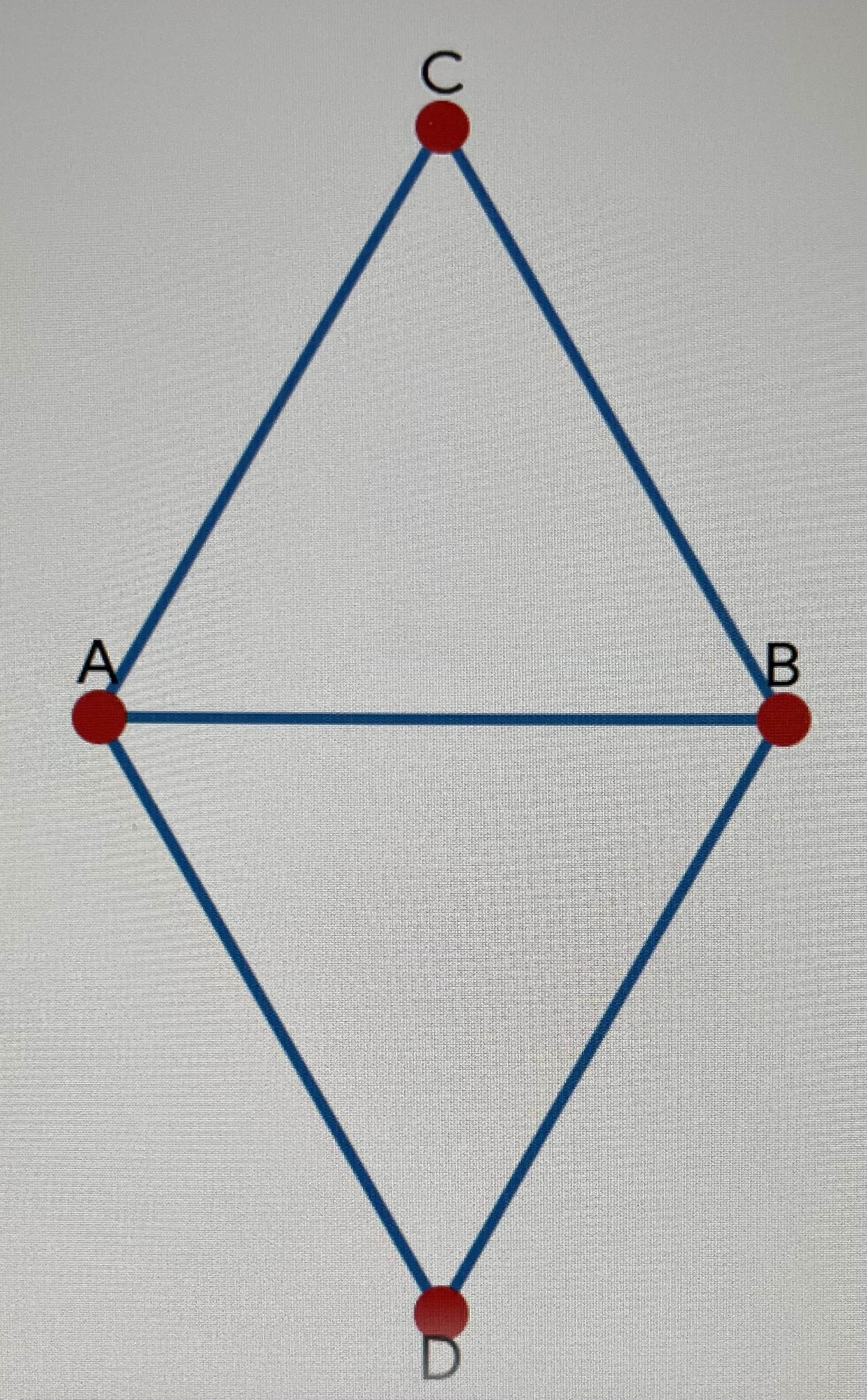
What about n = 4? We could arrange them in a square and say four pairs. But wait: if we align the points into an appropriate rhombus, we get a fifth pair.
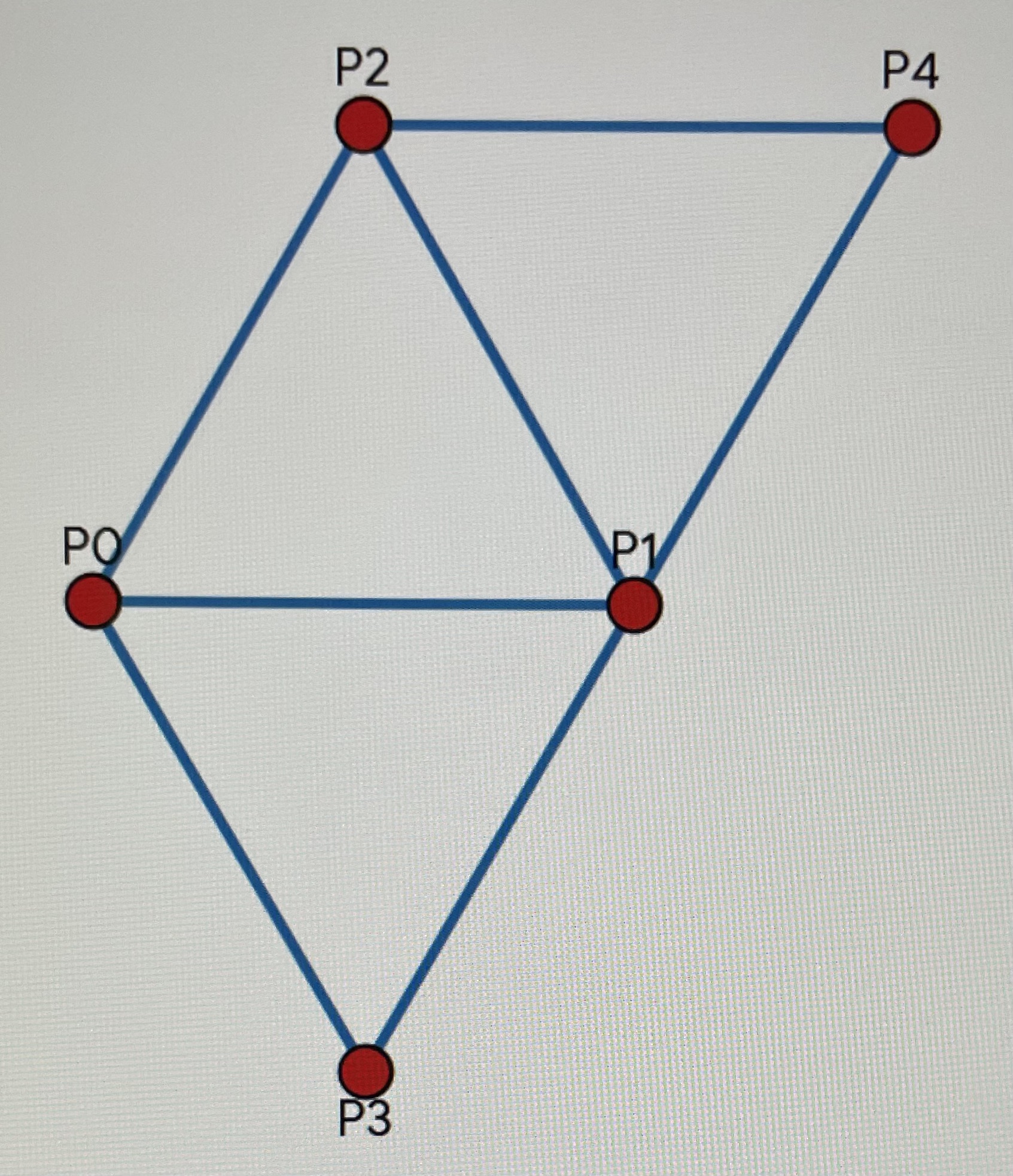
For n = 5, my first thought was the pips on a die and got six pairs. Ha. No, actually there are 7.
The mind boggles as n grows. Indeed, mine boggles early on.
The Old Conjecture: This has been addressed for nearly 80 years: The most recent formulation is based on a scaled square grid arrangement (sorta a complex variation of our rhomboid): The maximum number was conjectured to grow almost linearly, bounded by n 1+C/log log n.
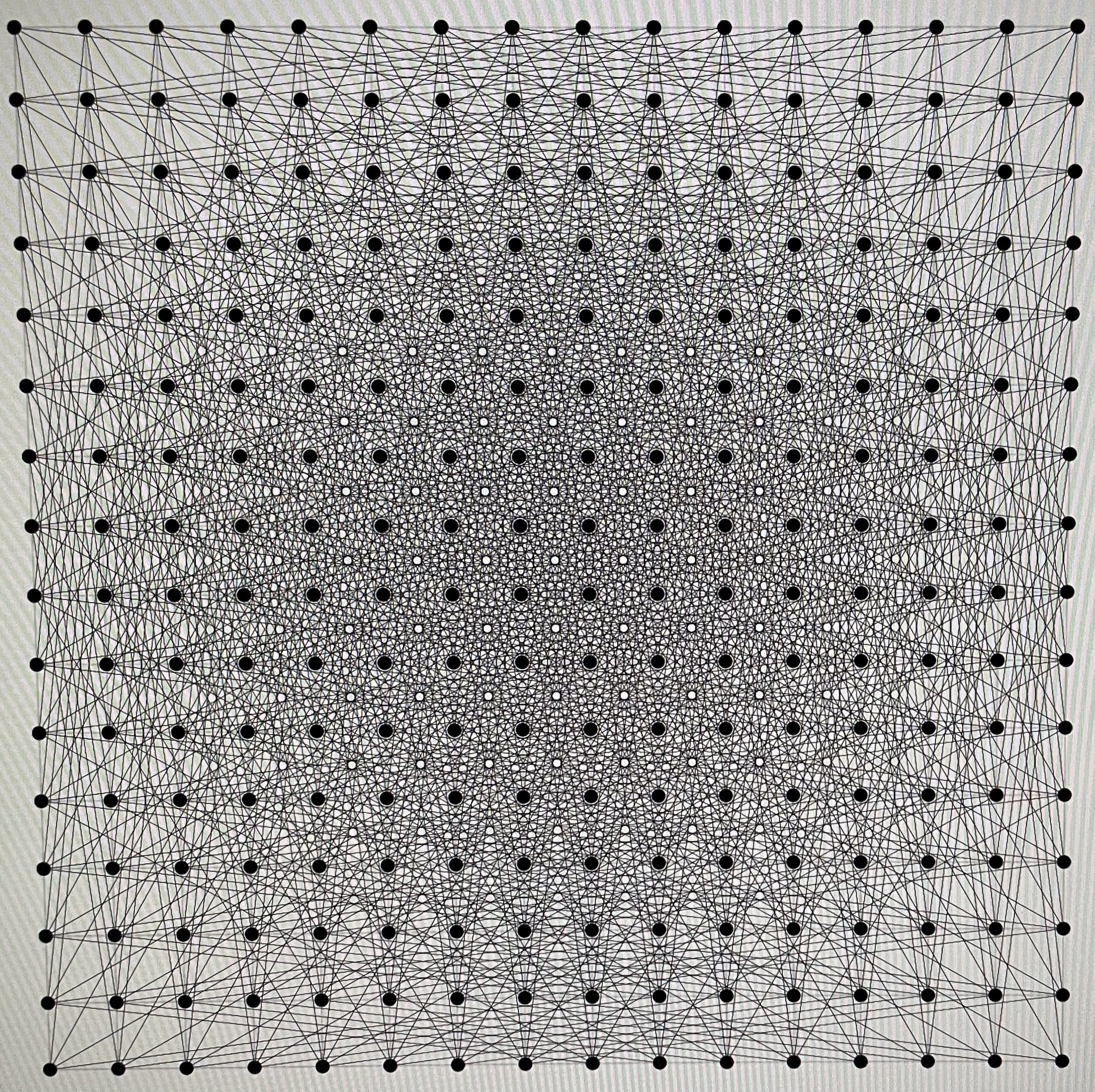
A previously known construction of many unit distances from a rescaled grid. Image from OpenAI.
The OpenAI Model: The OpenAI paper notes, “An internal OpenAI model has disproved this longstanding conjecture, providing an infinite family of examples that yield a polynomial improvement. The proof has been checked by a group of external mathematicians. They have also written a companion paper explaining the argument and providing further background and context for the significance of the result.”
Its Significance: OpenAI continues, “The result is also notable for how it was found. The proof came from a new general-purpose reasoning model, rather than from a system trained specifically for mathematics, scaffolded to search through proof strategies, or targeted at the unit distance problem in particular…. It marks the first time that a prominent open problem, central to a subfield of mathematics, has been solved autonomously by AI…. The proof brings unexpected, sophisticated ideas from algebraic number theory to bear on an elementary geometric question.”

This last point is an interesting one: Cross fertilization of mathematical fields is not unknown, but nor is it a common research methodology. Sorta like a physics problem in optics using a purely mechanical analogy.
Tomorrow we’ll examine the Leiden Declaration addressing the significance of this OpenAI achievement. ds
© Dennis Simanaitis, SimanaitisSays.com, 2026

