
Simanaitis Says
On cars, old, new and future; science & technology; vintage airplanes, computer flight simulation of them; Sherlockiana; our English language; travel; and other stuff
THE ADVANTAGES OF A PRINCIPLED PUBLIC SPHERE PART 1
FROM TIME TO TIME, MY KANTIAN PHILOSOPHICAL LEANINGS COME TO MIND. This time around, curiously, they arise from words of Alex Ross, music critic of The New Yorker, who evidently also knows his way around modern philosophers as well. Ross’s “The Dream of Reason,” The New Yorker, June 22, 2026, has the subtitle “Jürgen Habermas offered a philosophy of hope in a darkening age.” Here, in Parts 1 and 2 today and tomorrow, are tidbits gleaned from the article, a goodly number specifically about Habermas, others selected merely to enjoy the verve of Ross’s writing, together with my usual Internet sleuthing.
Background. To begin with this last perspective, Wikipedia recounts “Jürgen Habermas (18 June 1929–14 March 2026) was a German philosopher and social theorist in the tradition of critical theory and pragmatism. His work addressed communicative rationality and the public sphere. He held professorships at Heidelberg University and Goethe University Frankfurt and directed the Max Planck Institute in Starnberg.”
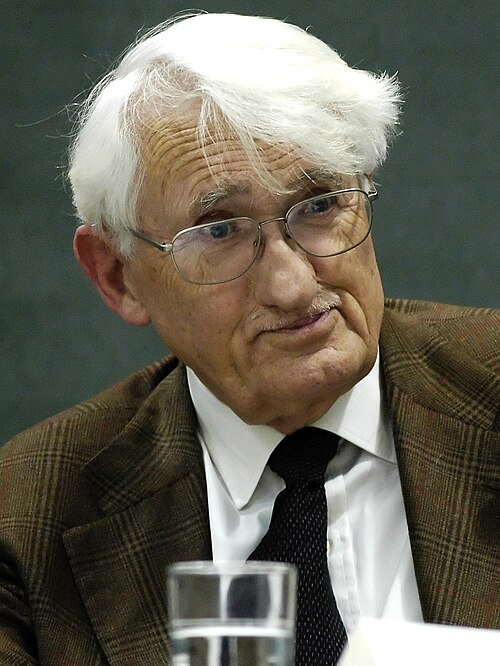
Habermas in 2008. Image by Wolfram Huke via en.wikipedia.
Ross’s Opening (and His Discontent): “You wake up and brace yourself for the barrage of toxic gibberish that constitutes the modern public sphere. Your e-mail is overrun with spam, scams, and smut. There are voice mails from no one about nothing. A glance at the news reveals that the President is continuing to spew lies and obscenities; that a trillionaire is peddling white-supremacist propaganda on a social-media platform he owns; that a chart-topping musical artist is praising Hitler, or apologizing for praising Hitler, or praising Hitler once again. Publications from The Times on down employ clickbait headlines that treat you like a starving rat in a Pavlovian experiment. A.I. systems simulate the experience of talking to an arrogant ten-year-old boy who knows far less than he thinks he does. When pressed, the chatbots admit that they cannot ‘naturally understand human morality, dignity, culture, or meaning.’ It all adds up to a continuous discursive tinnitus—a buzz of random, fake, stupid, sinister chatter that nobody wants and nobody can stop.”
Ouch. But ain’t it the truth.
Ross continues, “The person who should have been best able to explain how we got here was the great German philosopher Jürgen Habermas, who illuminated how a feisty, principled public sphere is integral to democracy. But Habermas died in March, at the age of ninety-six, and, although he remained active until his final months, commenting on Ukraine, Gaza, and Eurobonds, he struggled to understand the turn history had taken.”
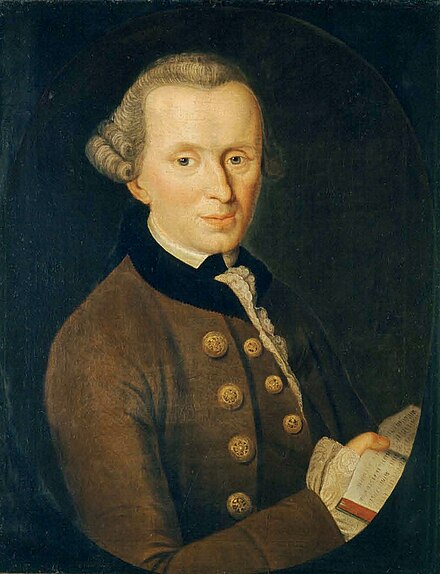
Habermas and Immanuel Kant. Ross describes that Habermas “was not ready to give up on the concept of reason articulated in the writings of Immanuel Kant, whose ideal of Menschenwürde, or human dignity, is enshrined in the first lines of the German constitution. Habermas made it his mission to elaborate a modern philosophy of reason, rooted in dialogue and debate, attuned to a pluralistic world.”
Kant’s famous Categorical Imperative says “We should act in a way that could be a universal rule of conduct,” a sorta fancied-up Golden Rule: “Do unto others as you would have them do unto you.”
Coalescing the Concept. The intellectual challenge is how to coalesce these individuals’ rules into universality. Theodor W. Adorno, a Habermas associate of philosophy’s Frankfort School, feared “The fully enlightened Earth glows under the sign of triumphant disaster.”
Ross observes, “Adorno sees mass culture as a pivotal component of the capitalist scheme to mollify the populace with calculated compensations. It claims to be serving the public while inventing needs that the public had been happy to live without. The façade is democratic—Hollywood stars are just like us!—yet the structure is authoritarian, training us to bow down before celebrity gods. The birth of a fascist President out of the spirit of reality television could be seen as a Q.E.D. for Adorno’s thesis.”
Ouch again. And don’t you enjoy Ross’s way with words.
Habermas’s “Public Sphere.” What resulted in 1962 was Habermas’s book, The Structural Transformation of the Public Sphere.

Ross notes that it was “Habermas’s first major work, and still his most famous. It is a potent mixture of critical theory and social history, tracing the evolution of public discourse and media culture from the eighteenth century to the present. We follow the inception of a space between private and political life where open debate is possible—that of Öffentlichkeit, which can be translated as ‘public’ or ‘publicness’ but is usually rendered as ‘public sphere.’ ”
Tomorrow in Part 2 we’ll continue Ross’s analyses, one problematic aspect being “absorbing news, not acting on it.” Another is Habermas and the Internet. ds
© Dennis Simanaitis, SimanaitisSays.com, 2026


wonderful part one…