
Simanaitis Says
On cars, old, new and future; science & technology; vintage airplanes, computer flight simulation of them; Sherlockiana; our English language; travel; and other stuff
ADVANTAGES OF THE PRINCIPLED PUBLIC SPHERE PART 2
IN PART 1, ALEX ROSS’S “Jürgen Habermas Defended Reason in a Darkening Age,” The New Yorker, June 22, 2026, introduced us to the philosophical concept of the Principled Public Sphere. Here in Part 2, Ross continues analyses of this recently-deceased philosopher.
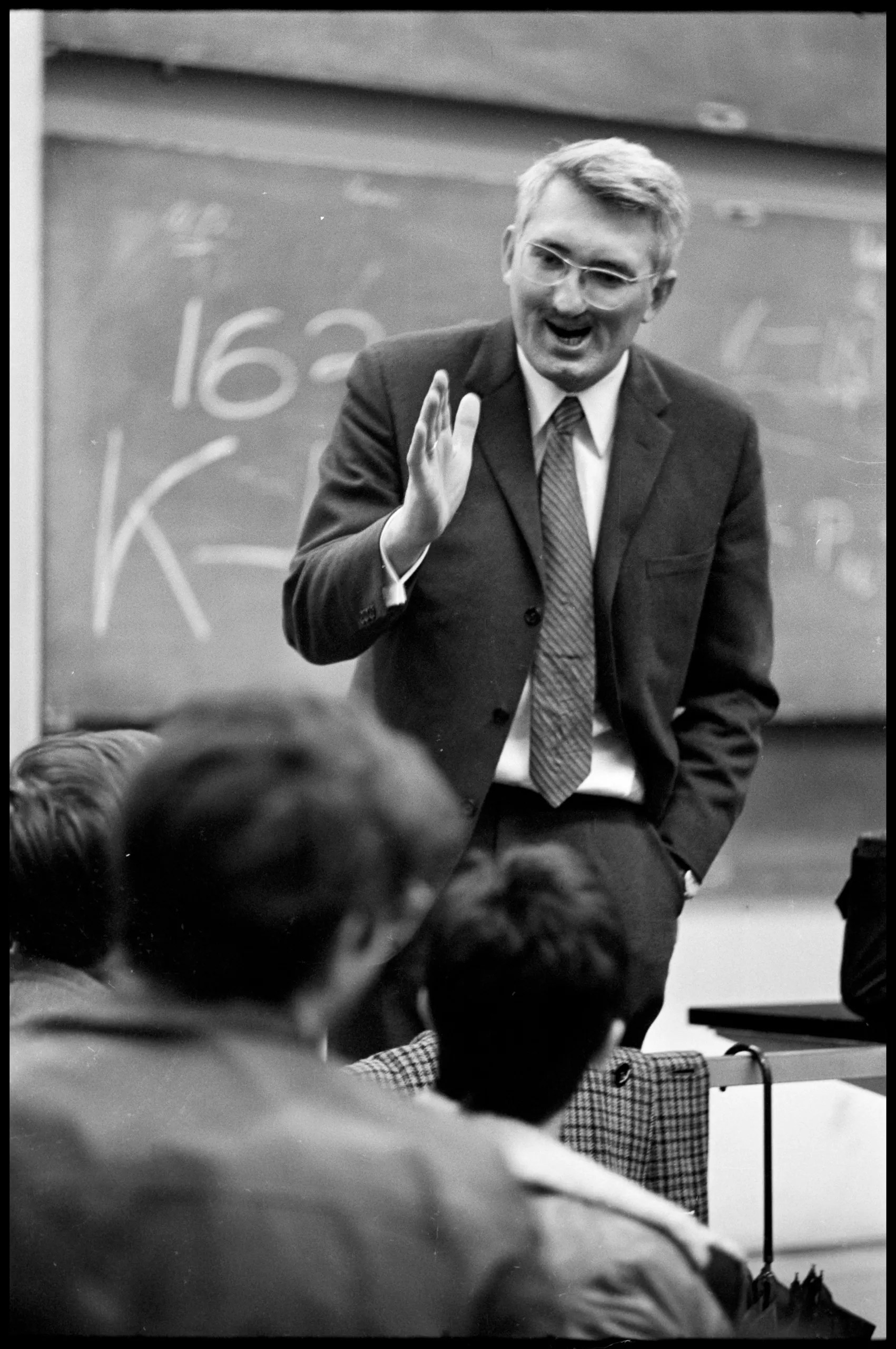
Absorbing News, Not Acting On It. “In the later chapters of ‘Structural Transformation,’ ” [Habermas’s most influential work] Alex Ross relates, “the influence of the Frankfurt School is unmistakable. In the late nineteenth century, the media became increasingly preoccupied by profit. Newspapers fell into the hands of magnates who advanced their own interests. With the entrance of radio and television, information was transmitted instantaneously and universally, yet the public grew passive, absorbing news without necessarily acting on it.”
Isn’t this all too familiar of the present as well?
Another Opening! Another Show! “As media monopolies gained control of discourse,” Ross describes, “a new feudalism arose. Habermas is particularly acute in showing what the modern media landscape can do to politics. Candidates must position themselves as entertainers, performing for voters rather than persuading them. Each campaign season is a Neuinszenierung—a new theatrical production. Decades before anyone talked about filter bubbles, Habermas wrote of a ‘homogeneous opinion climate,’ of ‘fictional consensus.’ ”
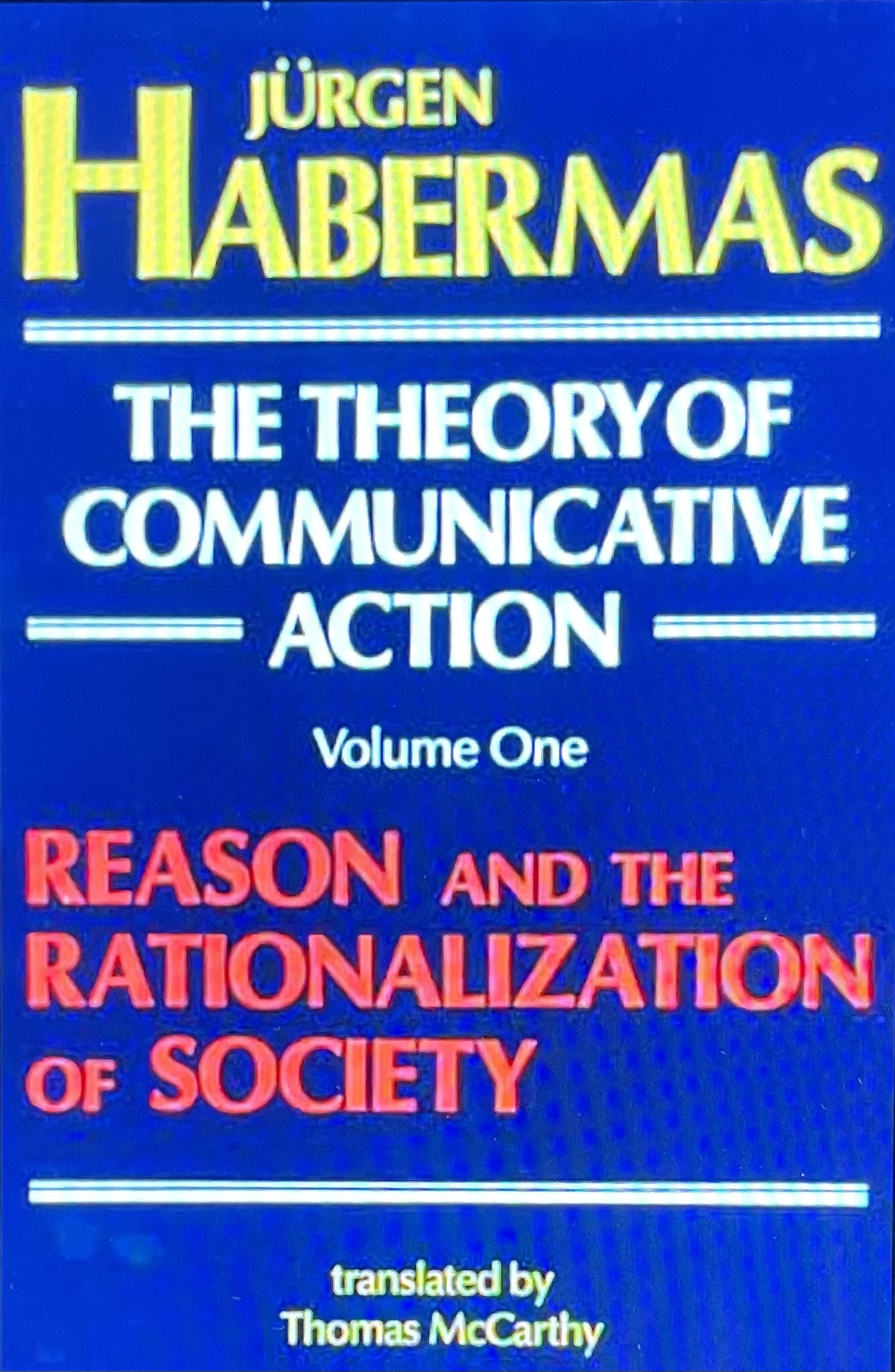
Theory of Communicative Action. With Habermas at Max Planck Institute for the Study of the Scientific-Technical World came his Theory of Communicative Action, a two-volume treatise that Ross calls an attempt “to renovate the meetinghouse of reason…. Unwilling to renounce positivity, Habermas returns to the old Kantian problem: How, in an age of bewildering change and undeniable catastrophe, can rational individuals build a more humane world?”

Ross describes (and I find this daunting): “The book is so encyclopedic that it becomes unwieldy, even by the standards of European philosophy. By the same measure, it feels like a faithful mirror of our hyper-complex world.”
The Importance of Consensus. Ross notes, “Habermas maintained that communication is impossible unless people at least assume that consensus is possible. If you go into every conversation thinking that your counterpart could be a sociopath, you will retreat into paranoid isolation.”
I confess: This is a shortcoming of mine in all too many modern political discussions.
Habermas and the Internet. Ross recounts, “Habermas was well aware of how the internet had deformed his beloved public sphere. At first, he thought that the digital arena could amplify all those anarchic voices on the periphery. Sometimes it has: think of social-media-driven movements such as the Arab Spring, Black Lives Matter, and #MeToo. More often, though, the indirectness and the anonymity of digital exchanges have sabotaged understanding. If, as G. H. Mead argued, face-to-face interactions facilitate the formation of a mature personality, the internet has enabled a mass regression to adolescent bullying and narcissism.”
“Furthermore,” Ross observes, “tech companies designed their platforms to heighten conflict and thereby prolong engagement. It’s as if they had read Theory of Communicative Action and done the opposite.”
Habermas and A.I. “Habermas’s entire world view,” Ross relates, “was premised on the idea of people learning from one another; A.I. annihilates communicative action in the name of hallucinatory conversations with sycophantic machines. The social effects have proved instantly disastrous: rampant disinformation, mass student cheating, cases of users becoming addicted to A.I. or killing themselves with its help. Meanwhile, to the joy of investors, untold thousands of jobs have vanished.”
A.I.’s Personal Affront. “As an added coup,” Ross recounts, “A.I. managed to deliver a personal affront to Habermas a year before his death. In 2024, Google DeepMind unveiled a ‘Habermas Machine,’ which has been described as a ‘scaffolded pair of LLMs designed to find consensus among people who disagree.’ The philosopher had not given Google permission to use his name, and he was horrified when he heard about the scheme.”
For other thoughts on this contentious matter, see also “A.I. Can Help Humans Find Common Ground in Democratic Deliberation,” Tessler et al., Science, October 18, 2024. Be aware as well: The authors are all at Google DeepMind, London. Note, there’s also “Public Opinion Alone Won’t Save Democracy,” Brendan Nyhan and Rocio Titiunik, Science, October 17, 2024. Nyhan and Rocio, both more A.I.-cautious, are at Dartmouth’s Department of Government and Princeton’s Department of Politics, respectively.
Lots of food for philosophical thought here.
Ross’s Summary: “At the heart of Habermas’s omnivorous, at times contradictory, body of work is an idea as simple as it is profound: in adopting the perspectives of others, we learn to become ourselves.”
Ross concludes, “In the end, we need both voices: the critical and the reconstructive, the savage and the sage. The dialectic moves between crashing despair and hovering hope.”
I’m still contending with the ethical coalescence of all those Kantians like me. ds
© Dennis Simanaitis, SimanaitisSays.com, 2026
 Simanaitis Says
Mr. Simanaitis,
I’ve been reading the works on the Columbia University
political science syllabus and initially enjoyed “The Structural
Transformation of the Public Sphere”. Habermas’s explanation of
the historical origins of mail and newspapers was very enlightening
reading. Later in the book I got frustrated with his incessant
academic speak. When I moved on to “Between Facts and Norms”
I was hopeful that his style might have matured since so much time had
passed between the two books. Nope. Here’s a quote:
“Unlike individuals in the state of nature, autopoietic systems no
longer share a common world. To this extent, the problem of
successful communication among independent and self-referentially
operating units, each with its own perspective on the world,
corresponds almost exactly to the familiar phenomenological problem
of constructing an intersubjectively shared world from the egological
achievements of transcendental monads. No more than Husserl
( or later, Sartre ) solved this problem of intersubjectivity, has
systems theory managed to explain how autopoietically closed
systems could, inside the circuit of self-referential steering, be
induced to go beyond pure self-reference and autopoiesis.”
Now there’s a passage that would make Judith Butler blush.
I once had a ’62 ford pick up that had self referential steering.
Thanks again,
Alan Christman
Watch out for those transcendental monads!
Agreed, Alan. I especially like your line about self-referential steering.—ds