
Simanaitis Says
On cars, old, new and future; science & technology; vintage airplanes, computer flight simulation of them; Sherlockiana; our English language; travel; and other stuff
THE HERRING’S RED! PART 1
THIS ETYMOLOGICAL RESEARCH BEGAN with “The Critical Author Caper,” one of my listening adventures on SiriusXM “Radio Classics.” By completion, it warranted Parts 1 and 2 today and tomorrow.

Tangent is also an available source for this particular Sam Spade adventure originally broadcast August 15, 1948. I won’t spoil the fun, but here’s what piqued my interest in “red herring” etymology: At the episode’s conclusion, Sam’s occasionally dizzy helpmate Effie says, “It just goes to show, doesn’t it. If anything like that happened in real life, you wouldn’t believe it.… The author is never the guilty party. He shouldn’t be even a suspect. Maybe a red herring, but…..”
“Type that up, Effie!” Sam interrupts.
“Oh all right, Sam. Anything else?”
“Yeah, phone the drugstore and order some red herring—I mean aspirin.”

Hmm. Red Herring.… Wikipedia describes, “A red herring is something that misleads or distracts from a relevant or important question. It may be either a logical fallacy or a literary device that leads readers or audiences toward a false conclusion. A red herring may be used intentionally, as in mystery fiction or as part of rhetorical strategies (e.g., in politics), or may be used in argumentation inadvertently.”
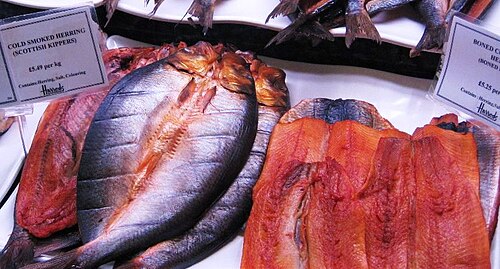
Origin. Wikipedia describes, “There is no fish species called ‘red herring.’ Rather, it is a name given to a particularly strong kipper, made from fish (typically herring) strongly cured in brine or heavily smoked. This process makes the fish particularly pungent-smelling and, with strong enough brine, turns its flesh reddish.”
“In this literal sense,” Wikipedia continues, “as a strongly cured kipper, the term can be dated to the late 13th century in the Anglo-Norman poem The Treatise by Walter of Bibbesworth, which then first appears in Middle English in the early 14th century: ‘He eteþ no ffyssh / But heryng red.’ ”
Off the Trail. “There are variations of the story,” Wikipedia recounts, “but according to one version, the pungent red herring would be dragged along a trail until a puppy learned to follow the scent. Later, when the dog was being trained to follow the faint odour of a fox or a badger, the trainer would drag a red herring perpendicular to the animal’s trail to confuse the dog. The dog eventually learned to follow the original scent rather than the stronger scent.”
Or Are We Talking the Training of Horses? Wikipedia also provides the following recent counterargument: “According to a pair of articles by Professor Gerald Cohen and Robert Scott Ross published in Comments on Etymology (2008), supported by etymologist Michael Quinion and accepted by the Oxford English Dictionary, the idiom did not originate from a hunting practice. Ross researched the origin of the story and found the earliest reference to using herrings for training animals was in a tract on horsemanship published in 1697 by Gerland Langbaine.”
Wikipedia continues, “Langbaine recommended a method of training horses (not hounds) by dragging the carcass of a cat or fox so that the horse would be accustomed to following the chaos of a hunting party. He says if a dead animal is not available, a red herring would do as a substitute.”
Personally, I cling to the original hypothesis. But then I am a cat lover.
Tomorrow we’ll focus on my own etymological research—with, at best, equally mixed results. ds
© Dennis Simanaitis, SimanaitisSays.com, 2026


Hi Dennis Hah! My wife, Linda, loves the old British TV ‘mystery’ series Midsomer Murder, reruns