
Simanaitis Says
On cars, old, new and future; science & technology; vintage airplanes, computer flight simulation of them; Sherlockiana; our English language; travel; and other stuff
PIGEON NAV PART 2
YESTERDAY, WE BEGAN LEARNING ABOUT PIGEON NAVIGATION, thanks to writers and researchers published in AAAS Science, May 28, 2026. Today, the researchers offer details of their methodology.

Pigeon Liver Contains Macrophages Storing Iron. The researchers recount, “To test for tissues with magnetic properties in pigeons, we screened their organs (liver, spleen, muscle, and inner and outer beak) by vibrating sample magnetometry (VSM)…. These magnetic signals, though modest, were 20 to 30 times higher than the magnetometer’s noise level, which indicated an accumulation of iron and thus a substantial accumulation of nanomagnets in pigeon liver, and a much lower accumulation in the spleen.”
Clodronate Treatment Depletes Superparamagnetic Cells. To assay the importance of these macrophages, researchers note, “ A defining feature of macrophages is their elimination after phagocytosis of clodronate liposomes, a widely used approach for macrophage depletion in vivo.”
This elimination, of course, provided the means of assessing macrophage efficacy.
Temporary Macrophage Depletion in Pigeons Impairs Their Homing Orientation and Navigation. The researchers describe their results: “Thirty-four pigeons were trained individually to home over a 19-km route from west to east. After 10 successful training flights, birds were randomized to receive either intravenous clodronate liposomes (n = 18) or control liposomes (n = 16) when the weather forecast predicted completely overcast conditions for the next day. Twenty-four to 28 hours later, pigeons were released individually under completely overcast conditions and tracked using real-time Internet of Things GPS devices.”
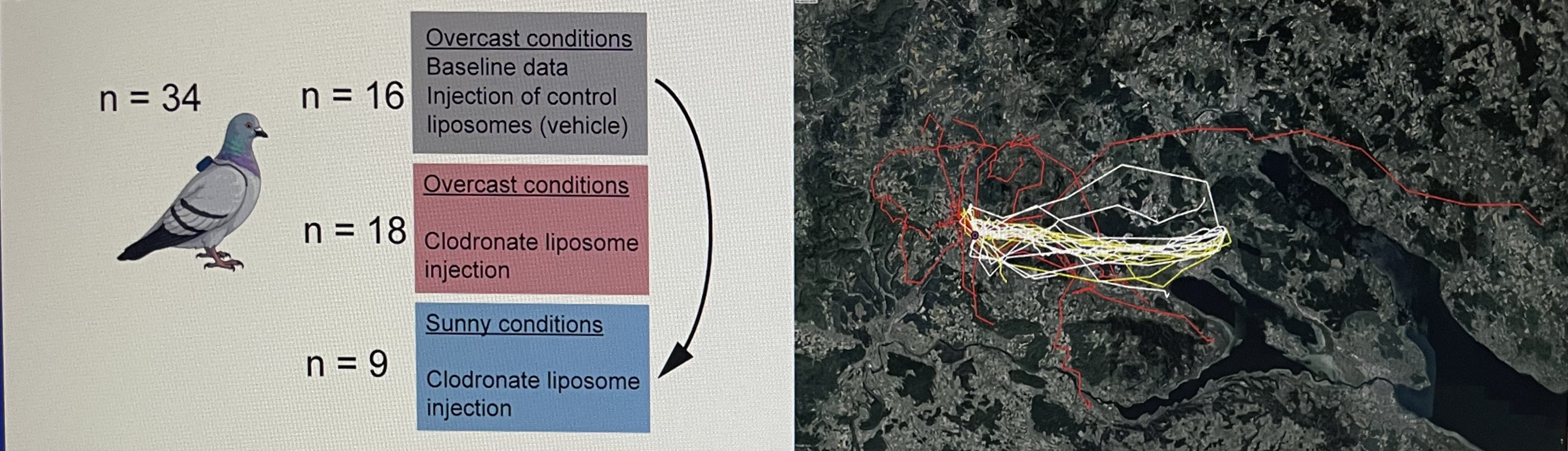
“All control-treated pigeons,” the researchers note, “homed within 70 min, whereas none of the clodronate-treated birds returned on the same day under persistent overcast conditions, instead displaying random spatial orientation. Importantly, macrophage-depleted pigeons homed normally once cloud cover cleared and the sun became visible, indicating intact flight capacity, motivation, and overall health.”
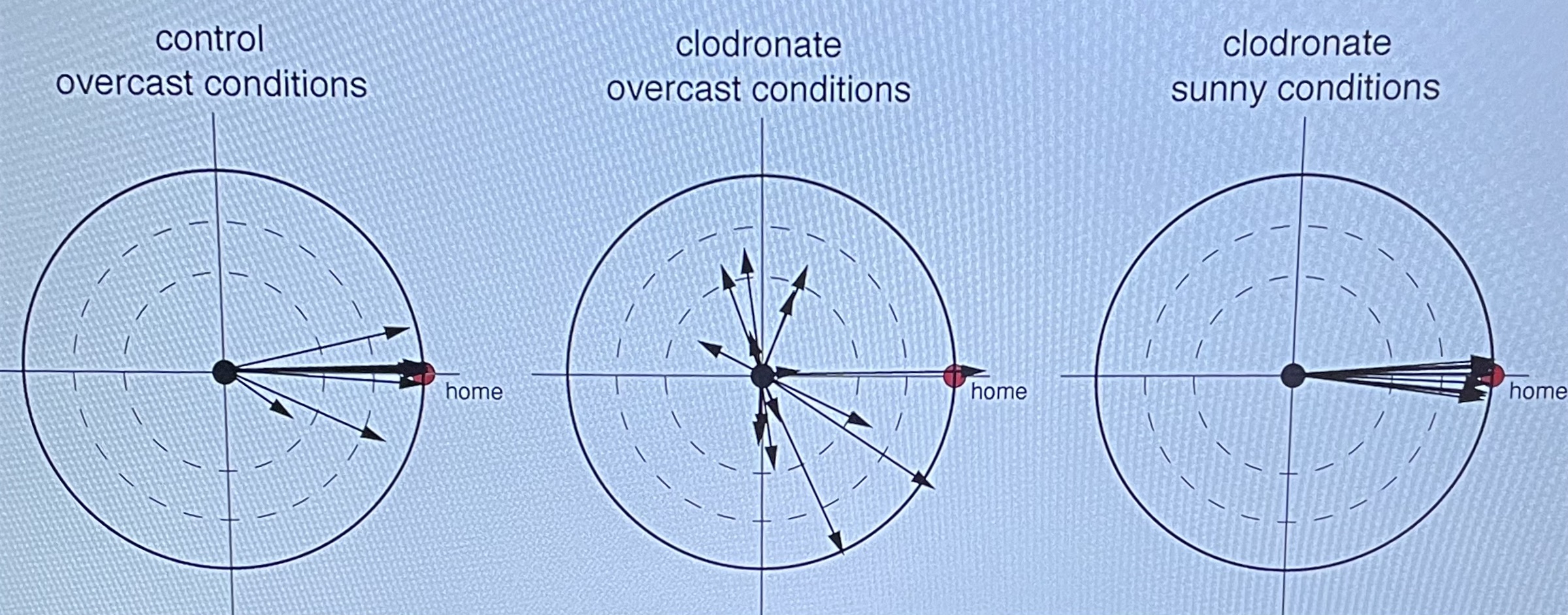
Discussion. “Together,” the researchers say “these findings indicated that pigeons can sense magnetic direction independent of a purported visual (cryptochrome-mediated) magnetic sensing system and that macrophages are required for finding magnetic direction under conditions in which solar and landmark cues are unavailable.”
Furthermore, they posit, “ A strength of our model is its potential to also explain magnetoreception in animals that lack functional cryptochromes or operate in environments with little to no light, including bats and blind mole rats. Additionally, elasmobranchs such as sharks can detect variations in the geomagnetic field, and tiger sharks, blue sharks, and scalloped hammerhead sharks swim in straight lines over long distances, with the latter even orienting toward seamounts associated with geomagnetic anomalies.”
“Beyond magnetoreception,” they continue, “our findings contribute to a broader emerging concept: Tissue-resident macrophages can function as peripheral sensory cells, providing direct, biologically meaningful feedback to the brain.”
I also was impressed with Spiro and Drakesmith’s article title: “Getting Home in the Dark.” Wouldn’t you know, pigeons know the way. ds
© Dennis Simanaitis, SimanaitisSays.com, 2026

