
Simanaitis Says
On cars, old, new and future; science & technology; vintage airplanes, computer flight simulation of them; Sherlockiana; our English language; travel; and other stuff
PIGEON NAV PART 1
HOW DO PIGEONS PERFORM THEIR HOMING? “Getting Home in the Dark,” by Simon Spiro and Hal Drakesmith, Science, May 28, 2026, gives key points of the research report “Homing Pigeons Navigation Relies on Superparamagnetic Macrophages Under Overcast Conditions,” by Clivia Lisowski et al. in that same issue of Science.

Here, in Parts 1 and 2 today and tomorrow, are tidbits gleaned from these two articles, including an Editor’s Summary by Sacha Vignieri of the research. Indeed, a pair of Columba livia (rock pigeons) even made the cover.
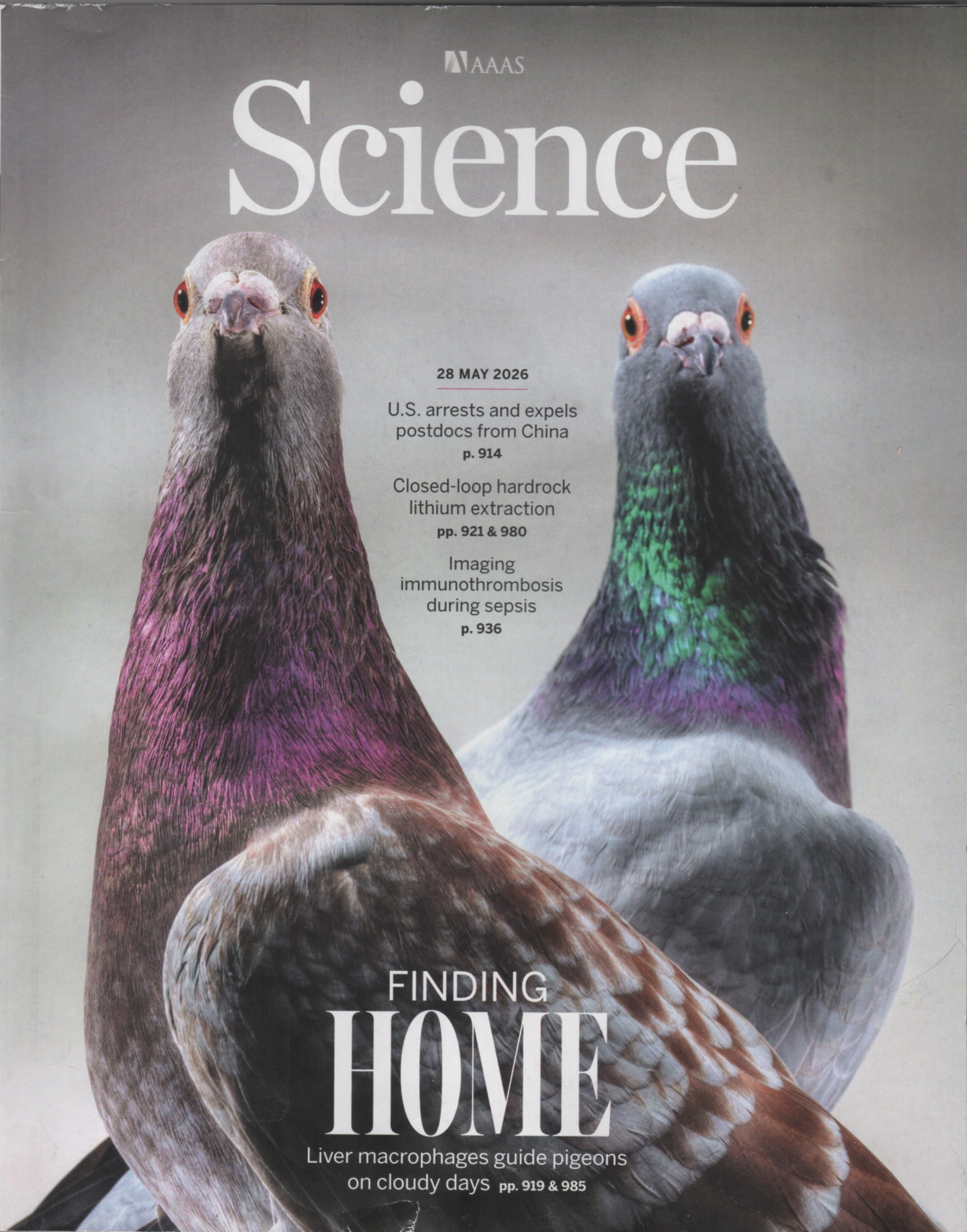
Background. Sacha Vignieri describes, “It has long been known that birds rely, at least in part, on magnetoreception to orient their movements. The mechanisms underlying this reception appear to be numerous and are still being discovered. Physiological connections have been found in the head, including the beak, eyes, and brain, but Lisowski et al. have now identified the presence of superparamagnetic macrophages in the liver (see the Perspective by Spiro and Drakesmith).”
Three Prevailing Hypotheses. Spiro and Drakesmith recount, “Three prevailing hypotheses exist for how animals sense Earth’s geomagnetic field: mechanically, through a compass-like pull on magnetic particles that is possibly associated with the trigeminal nerve (a large cranial nerve); biologically, by voltage-sensitive ion channels in cells that are activated by changes in the magnetic field; or through physical effects on retinal pigments that enable efficient detection of photons and signaling to the brain, although this can only operate in light. Each has supportive evidence, but none are universally considered to provide a full explanation of the phenomenon.”
The Role of Macrophages. The two continue, “Lisowski et al. built on previous work that reported white blood cells called macrophages as superparamagnetic because of their role in engulfing (phagocytosing) senescent red blood cells. Red blood cells contain iron, and superparamagnetism is found in small iron-containing particles that exhibit strong magnetization when exposed to an external magnetic field. Hypothesizing that such particles—likely the iron-storage protein ferritin—could be used for magnetoreception, Lisowski et al. screened a range of pigeon tissues for superparamagnetic properties using vibrating sample magnetometry. The liver and spleen gave the strongest magnetization signal, with minor signals in muscle and beak.”
Methodology. Lisowski and her colleagues describe in their Abstract, “Here, we used physical, morphological, functional, and genomic assays to identify the presence of superparamagnetic macrophages in the liver. We found that after macrophage depletion, pigeons flying under overcast conditions lacked their usual orientation capabilities. Orientation was unimpaired in birds without macrophages when the sun was visible, suggesting that this was their primary cue. We propose that in homing pigeons, superparamagnetic macrophages in the liver are required for finding magnetic direction.”
Tomorrow in Part 2, the researchers describe how pigeon liver provides a means of navigation and how they verified this.
© Dennis Simanaitis, SimanaitisSays.com, 2026


Besides directing pigeons toward their destination, do these macrophages also keep the birds in stable flight in instrument flying conditions? For example, human pilots can easily suffer spacial disorientation under IFR conditions. Just keeping the aircraft upright and level becomes a huge problem. How do pigeons (and other birds) accomplish that?
A good question, apparently not addressed in this research. The paper discusses pigeon homing paths, not their flight dynamics.—ds
Wonderful post
Thank you for your kind words.—ds