
Simanaitis Says
On cars, old, new and future; science & technology; vintage airplanes, computer flight simulation of them; Sherlockiana; our English language; travel; and other stuff
ECLECTIC ELECTRICS—17 YEARS AGO PART 2
I RECENCTLY UNEARTHED THIS BEVY OF BEVS (battery electric vehicles) from March 2009 R&T. Here in Part 2, we continue with these Eclectic Electrics, including one that’s the second-quickest car I’ve ever driven, even to this day.
The AC Link. As I recounted back in 2009, “some 3 1/2 of our seven participants trace technological heritage to AC Propulsion. (The eBox, Mini E and Wrightspeed are AC Propulsion-powered; the honorific 1/2 acknowledges Tesla’s early proof-of-concept work.)”

And, indeed, think of AC as Alan Coconni, who along with Wally Rippel and Paul Carosa founded the firm in 1992. Wikipedia describes that it’s still in business specializing in alternating current-based drivetrain systems for electric vehicles. Wikipedia also offers details of Alan Coconni’s involvement with Elan Musk and Tesla’s founding partners.
Mitsubishi i MiEV. “The i (sans MiEV),” I recounted, “is a gasoline-fueled Kei car, a popular category of small car unique to the Japanese home market with restrictions on engine displacement and vehicle size.”
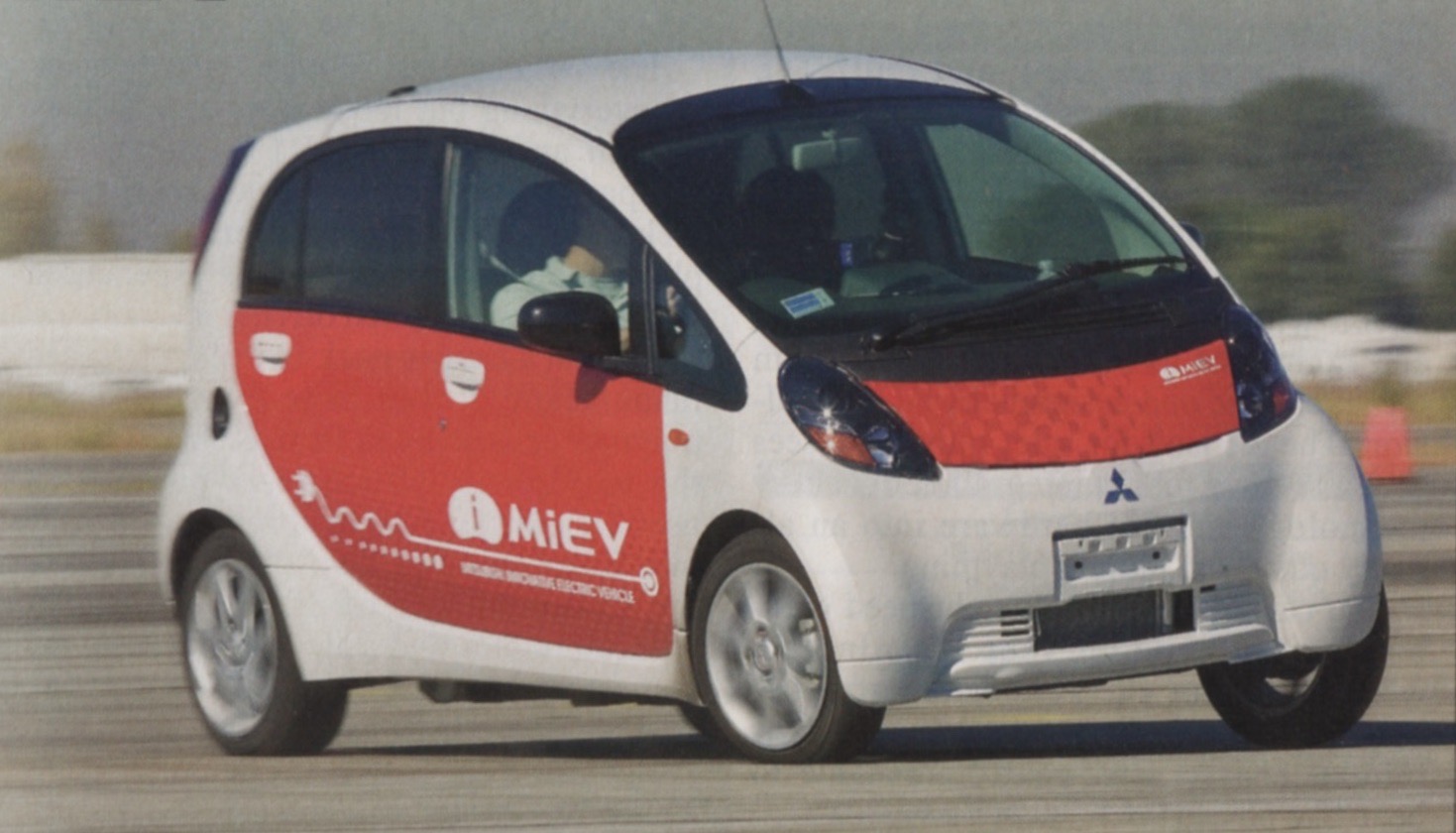
This and other images from R&T, March 2009.
“It’s quite a small car,” I noted, “dwarfed by a Mini and considerably larger, and more usable, than a Smart. In fact, the i MiEV will hold four of me, albeit my pair in the rear seat will hope the trip is a rather brief one.”
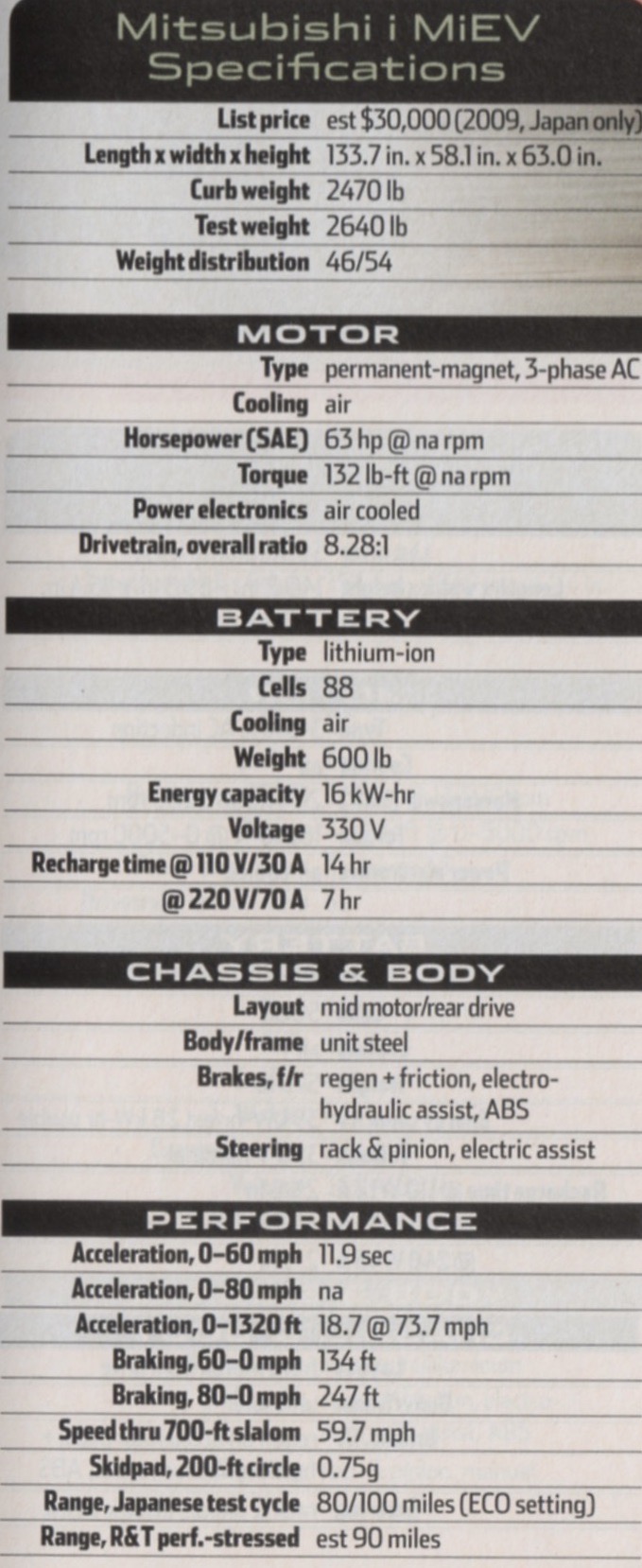
“The i MiEV offers its driver two modes of operation, normal and ECO. This latter reduces power [“quite amenable to ordinary city ventures”] to the point of extending range by some 10 percent…. And, should Mitsubishi decide to bring other i MiEVs to our shores, we could imagine one as a perfect city car for long-term evaluation of our own.”
Alas, the Kei’s miniscule size has hampered its crushable design and crashworthiness in meeting U.S. standards.
The Mini E and Dodge EV. R&T had no track testing of these two, only brief driving impressions.
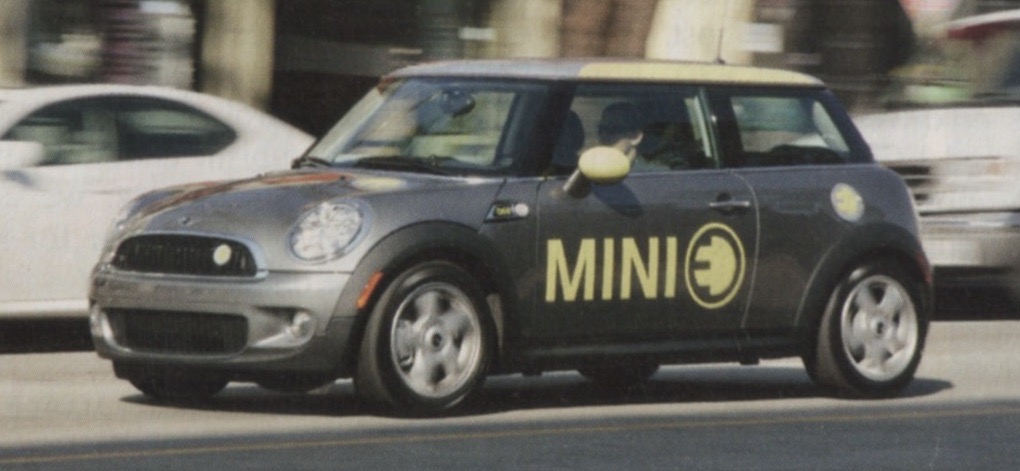
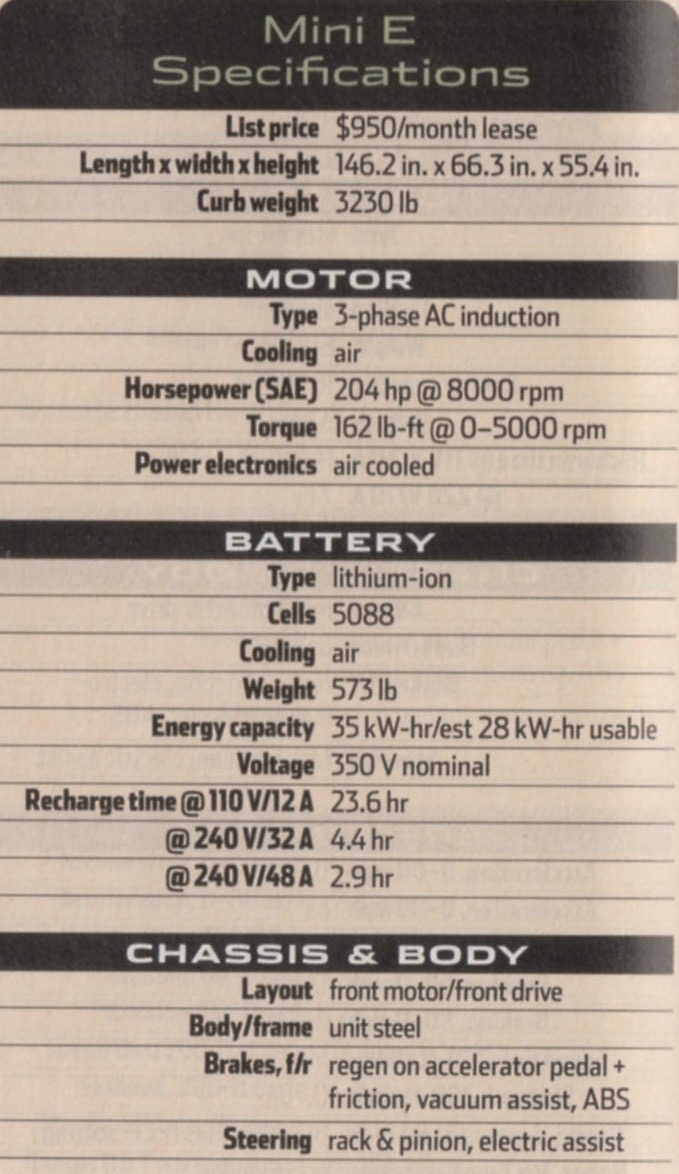
In driving the Mini E, Jonathan Elfalan reported, “Coming off the accelerator for the first time after heavy acceleration [0-60 in an estimated 8.5 seconds] will catch you by surprise as the regen braking is as aggressive as the AC Propulsion eBox in its Max setting.”
Jim Hall said of the Dodge EV, “Thanks to its Lotus Europa-based platform and low center of gravity (owing to the mid-mounted batteries), the Ram brand’s electric vehicle should appeal to the green set of Berkeley as it should to the green flag-waving crowd at the local autocross…. It appears chances are good that this electric will be available in limited numbers.”
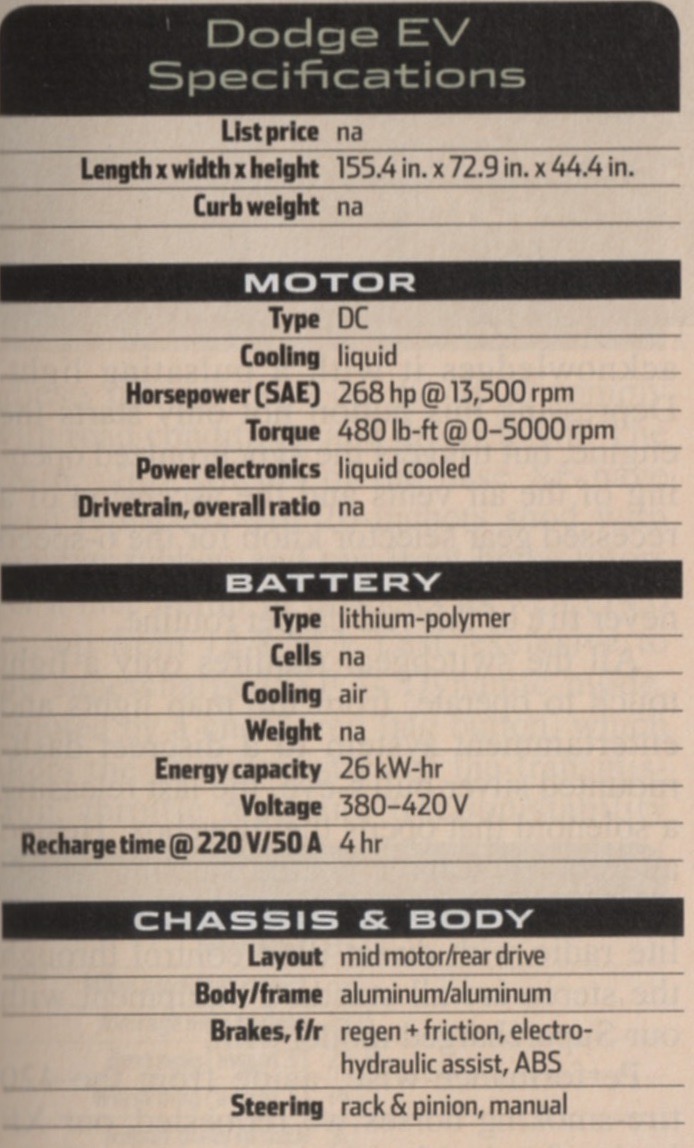
Sorry, not that good.
Wrightspeed 1. I’ve saved the most exciting for last: “New Zealander/Californian Ian Wright began with an Ariel Atom (think Lotus Seven with the unnecessary bits left off) and exchanged its conventional powertrain with an electric one designed by AC Propulsion.”
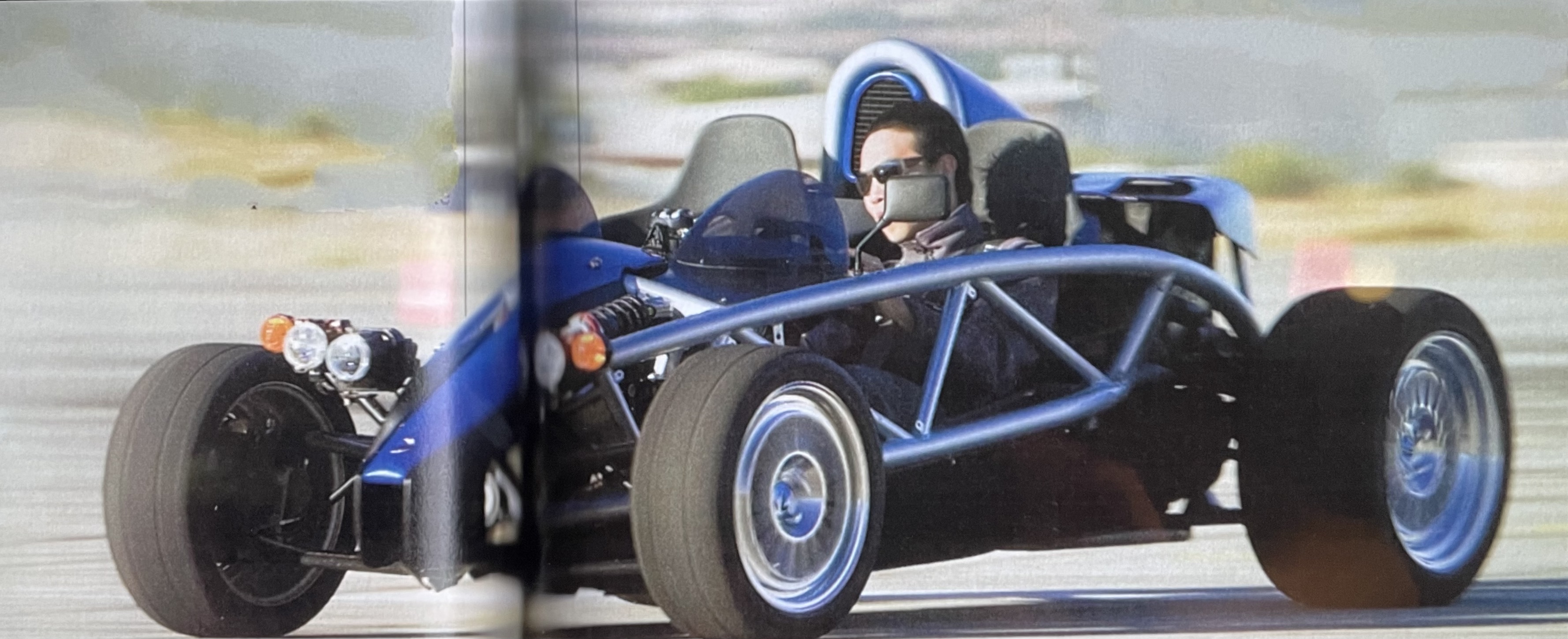
“The X1 isn’t for sale;” I lamented, “rather, Ian sees it as a test bed for his integration of battery technology and EV hardware into an already quick and nimble plaything.”
“The Wrightspeed’s Hoosier A6 tires,” we noted, “pick up everything but loose women, and they grip to an astounding 1.19g around our skidpad. Jonathan posted a quite credible 71.1 mph through the slalom.”
“You cannot drive the Wrightspeed without a giant smile on your face,” I enthused. “Indeed, were it not for the removable steering wheel, I couldn’t have driven it at all.(Its tubular chassis isn’t really amenable to bear-like physiques.)”
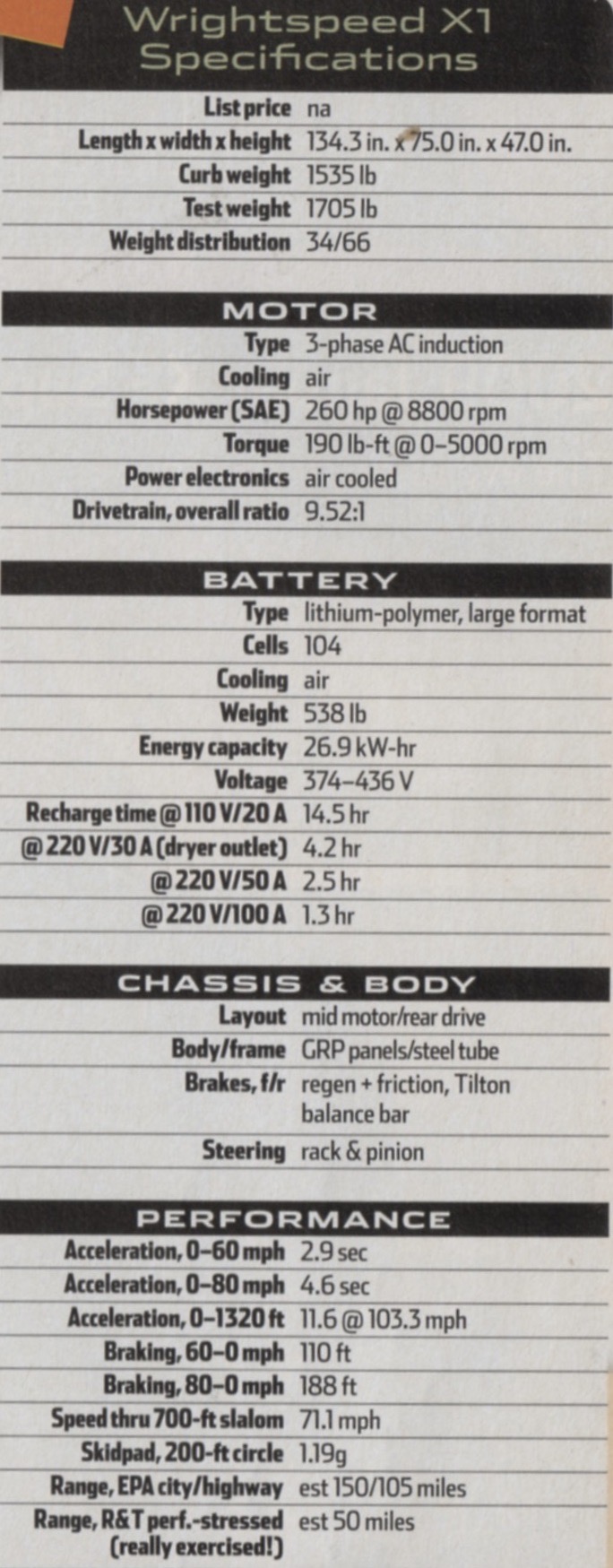
Of its peak torque I wrote, “One can argue editorially whether it’s ‘at 0 rpm’ or ‘from 0 rpm,’ but either way it’s right now!”
Again, talk about eclectic! ds
© Dennis Simanaitis, SimanaitisSays.com, 2026


In junior high, some of us much enjoyed slot car racing at the big, eight-lane public track circa 1964. It would seem slot-less examples larger than our 1/32nd and 1/24th-scale examples are at hand these many decades later.