
Simanaitis Says
On cars, old, new and future; science & technology; vintage airplanes, computer flight simulation of them; Sherlockiana; our English language; travel; and other stuff
EV NUTS AND BOLTS
NUTS ARE JUST NUTS. AND BOLTS, BOLTS, RIGHT? And, for once, I’m not talking about political nutballs or party defections.
Indeed, it turns out in this evolving world of EV transportation, SAE International Automotive Engineering, August 2026, describes “Fastener Specification for EVs: What Engineers Need to Know.” In truth, Patrick Faulkner, lead engineer at Accu U.K. offers more details than us non-engineers might seek. However, there are tidbits worthy of note the next time you pick up a screwdriver, socket wrench or—God forbid—a pair of pliers.

IC Fasteners vs Those for EVs. First, I must personally promote the abbreviation IC for Internal Combustion engine (as opposed to the hitherto ICE that got snatched by masked goons of Trump’s Gestapo).
One essential distinction between IC nuts and bolts and those in EVs is that IC engines reciprocate; EV motors spin. Think about it: An IC engine produces opposing forces of literally thousands of explosions per unit time (we rate them as “rpm”).
For IC vehicles, Patrick Faulkner recounts, “the main challenges—heat, vibration, and torque repeatability—are well understood, and the industry has decades of established solutions to draw from. By contrast, EVs introduce four additional constraints: high voltage, low-magnetic permeability, thermal-cycling resistance, and gram-level weight target.”
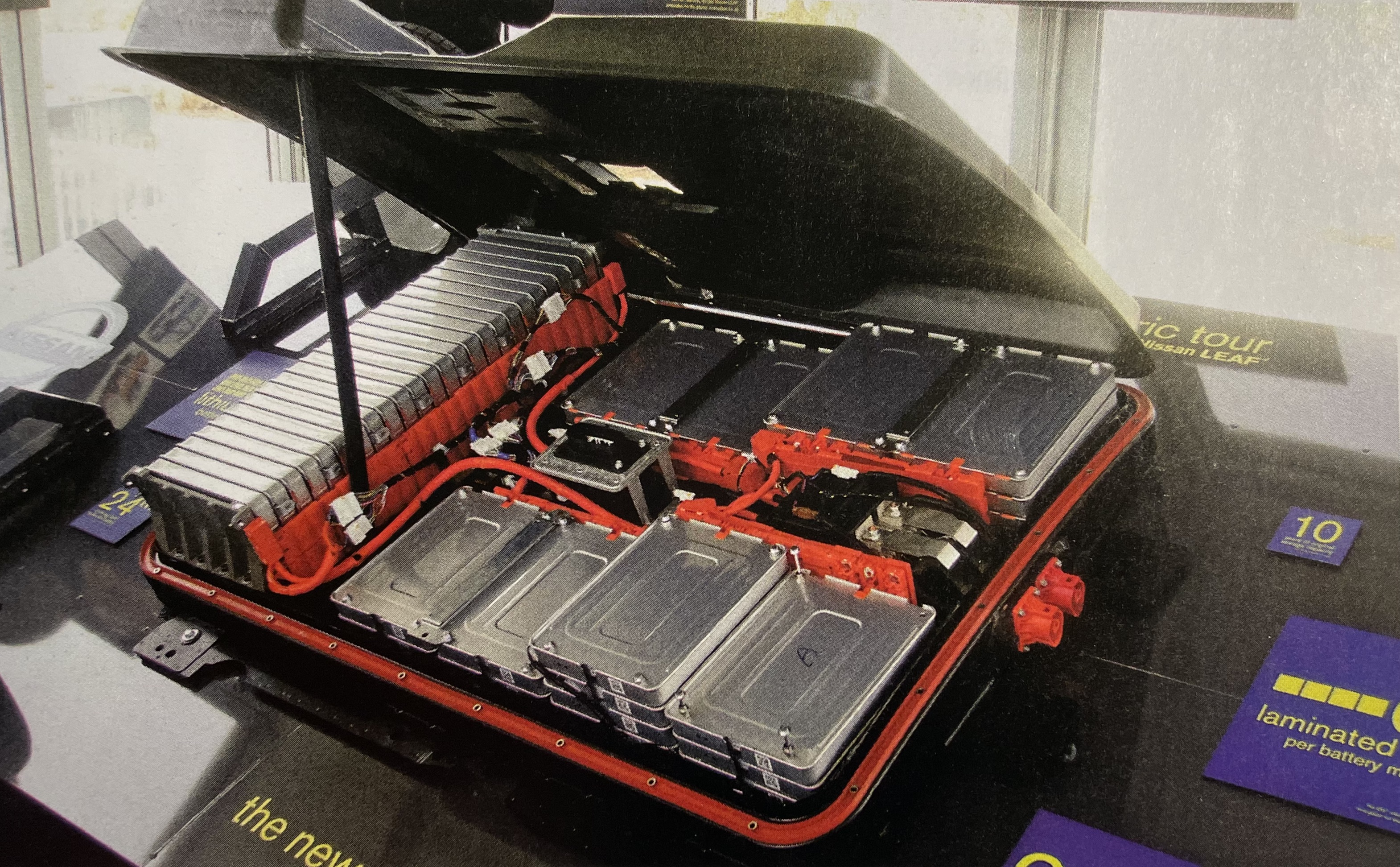
Battery Packs. Assemblies of battery packs must meet three mechanical demands: maintaining the correct compression on cells that swell during charging, providing electrical separation between live connections, and avoiding magnetic interference near the BMS (Battery Management System) and current sensors.
It’s a lot more complex than a simple IC head bolt and gasket.
Proximity to BMSs. Battery Maintenance Systems need special choices of nuts and bolts. Faulkner notes, “A4 (316 marine-grade) stainless steel is the standard choice due to its non-magnetic properties…. An important factor is to consider that austenitic stainless [having a particular face-centered cubic (FCC) crystal structure] is not automatically non-magnetic. Cold work during heading or rolling can raise permeability significantly and A2-grade material shifts more than A4 under the same mechanical stresses.”
How Tight to Twist? Faulkner notes that torque-only tightening is not the most reliable, as thread friction can vary depending upon plating and lubricant.
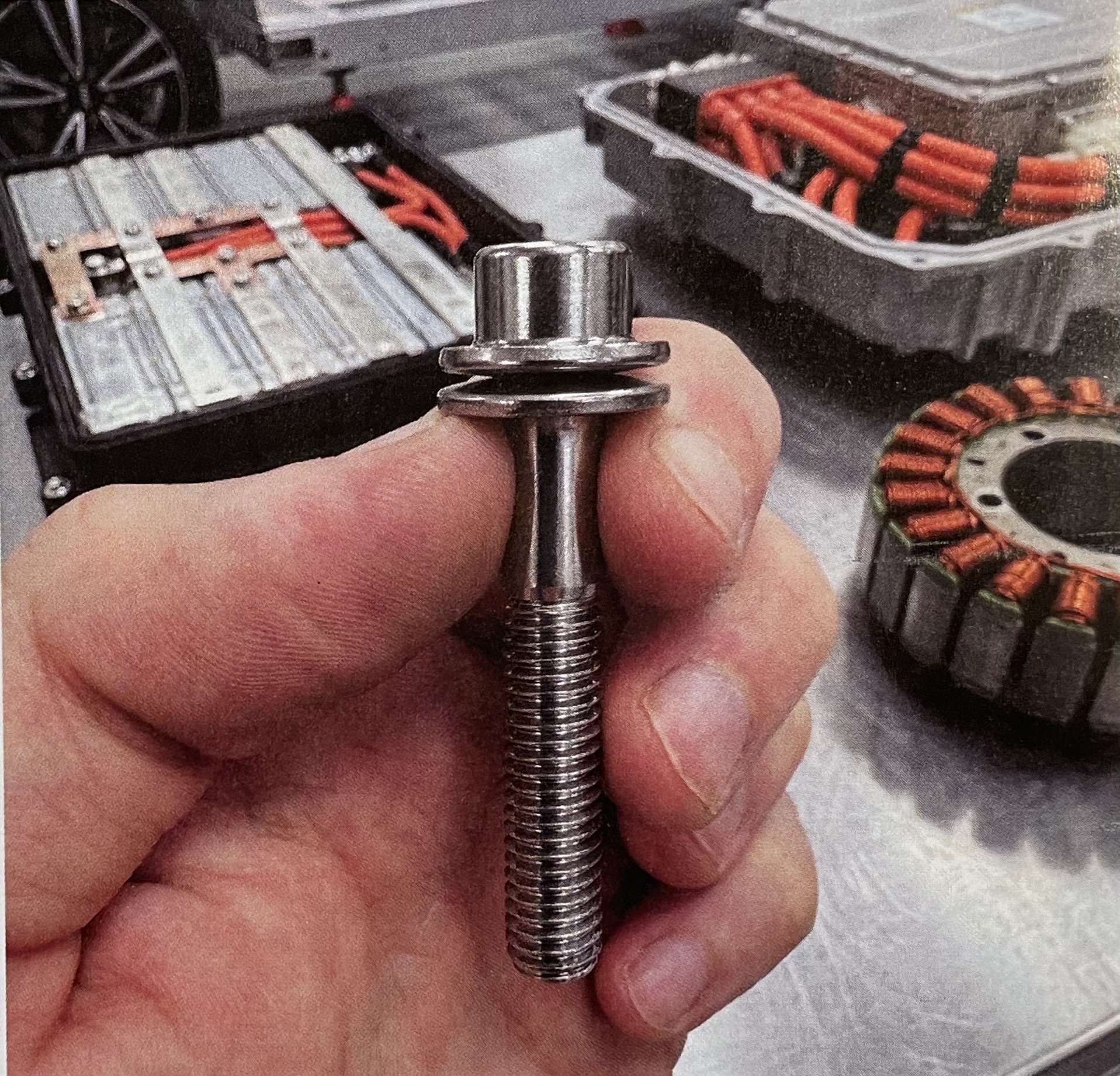
Shoulder Washers. A bolt’s washer isn’t just a traditional interface. Specific Nylon 66 shoulder washers offer two isolating surfaces. Faulkner describes, “There’s a flange beneath the bolt head that isolates it from the face of the conductor and, through the clearance hole, there is a sleeve that isolates the shank from the conductor bore.”
“These,” Faulkner notes, “are often positioned in busbar terminations, BMS mounts, and PCB fixings inside the high-voltage accumulator.” (Details are understandably left to the technical reader.)
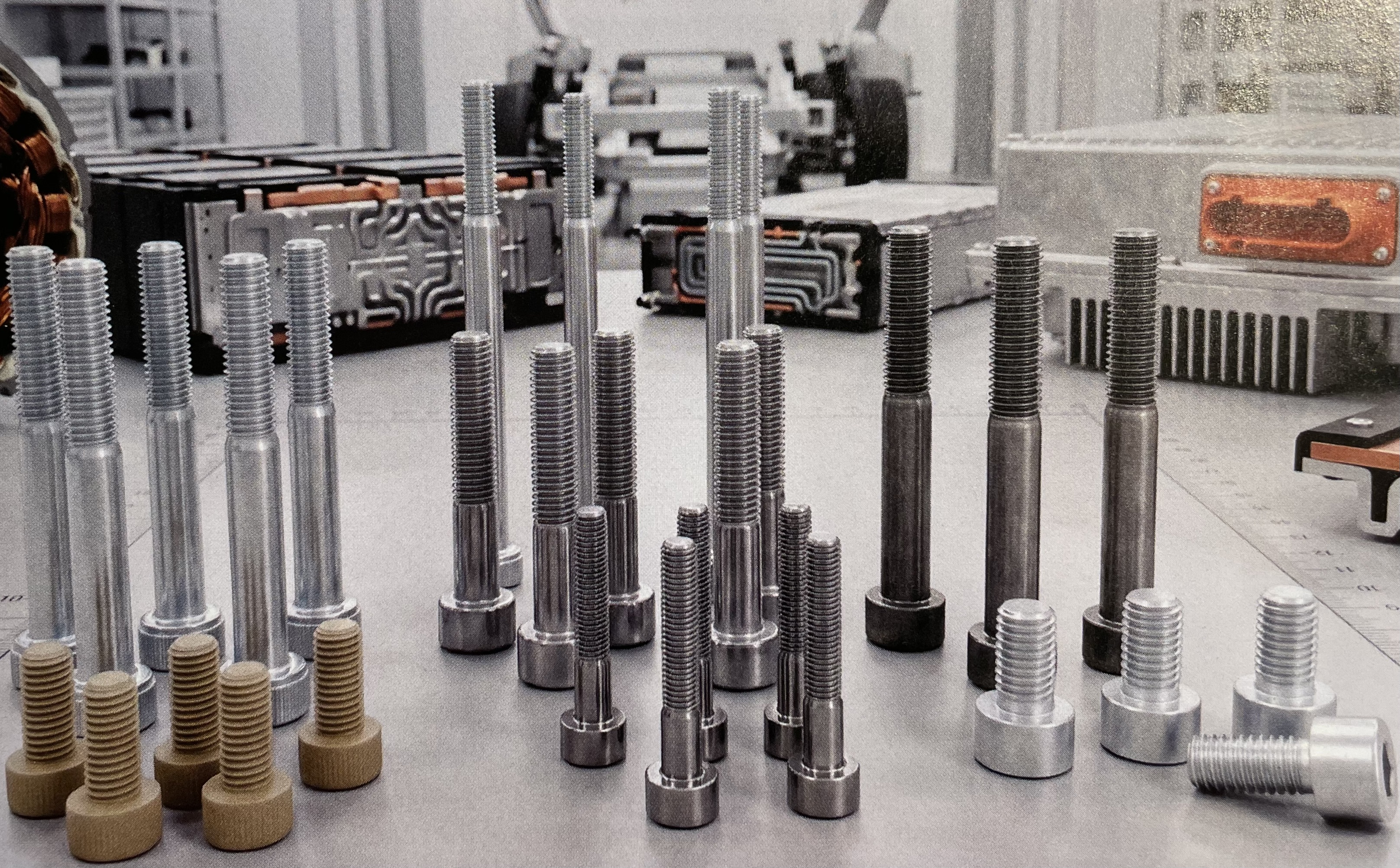
Galvanic Corrosion. Faulkner notes, “Aluminum and copper are only 0.5 V apart on the galvanic scale, so when moisture or road salt bridges the two metals, the aluminum acts as the anode and gradually corrodes, while the copper is unaffected as the cathode.”
“As a consequence,” he warns, “there is increasing contact resistance and localized heating, eventually leading to an open circuit.”
Opps.
Two recommended solutions: Keep aluminum and copper apart with tin or nickel plating on the bolt. Or isolate the fastener with a Nylon 66 shoulder washer (see above).
External Hardware. Faulkner observes, “EV charging infrastructure faces a challenging operating environment, due to UV exposure, rain, salt spray, freeze-thaw cycling, and mechanical impact across its expected 20-year surface life. Fastener selection here is as much about sealing the enclosure as it is about its tensile strength.”
It’s quite enough to make life of an IC sump bolt appear simple indeed. ds
© Dennis Simanaitis, SimanaitisSays.com, 2026


So I guess if you like small Chevys you can be nuts about Bolts?
Seriously, this was a good read for those of us with some interest in how things are actually put together. Thanks!
Illuminating read indeed. Was taught to reduce torque by at least 10% on oiled threads. The bit about copper eating aluminum critical. Thankfully, my octogenarian wheeled alter ego’s mainly iron and steel.
Infuriating that Bratman’s ICE Gestapo sullies even our I.C.
Thank you, Dr. Simanaitis.