
Simanaitis Says
On cars, old, new and future; science & technology; vintage airplanes, computer flight simulation of them; Sherlockiana; our English language; travel; and other stuff
EAST/WEST GERMAN DECRIMINALIZATION, DANIEL DEFOE’S PILLORYING, AND THE MISUNDERSTOOD MOLE
MY FREQUENT VISITS TO LONDON REVIEW OF BOOKS are encouraged by a simple truism: Its writing is so blessedly good! Even to the literary quality of its readers.

Here are examples gleaned from LRB Vol. 48 No. 14, August 13, 2026.
Easier in East Germany. LRB reader Patric Harting, Hong Kong, writes, “Rory Scothorne suggests that ‘until the 1980s homosexuality, divorce and abortion were probably easier in secular East Germany than in Labour Scotland’ (LRB, 4 June).”

“Indeed,” he notes, “the GDR had one of the highest divorce rates in the world, partly thanks to a 1950s law that abolished the duty of divorced men to financially support their ex-wives. However, this ultimately meant that East German women gained significant financial independence; eventually, women initiated the majority of divorces.”
Ha. That’ll show diese Schurken!
“In 1972,” Harting continues, “East Germany legalised abortion in the first trimester; it is still considered unconstitutional in Germany. In 1968 the GDR also decriminalised homosexual acts for people over eighteen, which the Federal Republic did not formally do until 1994.”
I’ve never thought of the GDR as a model of progressive action (what with the Stasi and all). Maybe I should rethink matters just a tad. Thanks, Mr. Harting, for your insights.
Pilloried. Mike Crabtree, London N12, recounts, “Colin Kidd mentions Daniel Defoe’s trial for seditious libel in 1703 (LRB, 9 July). Defoe’s punishment included time in the pillories at the Royal Exchange, Cheapside and Fleet Street.”
I hadn’t recognized the extent of pillories as a tool of punishment. (I hope Trump and his henchmen aren’t reading this! Or maybe not, knowing this full tale.)
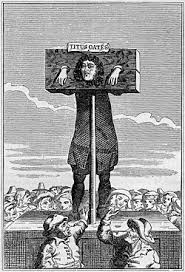
Crabtree continues, “It was not the public humiliation the authorities were hoping for. Instead of being bombarded with the usual missiles—rotten fruit and eggs, artichoke stalks and dead animals—Defoe was met with flowers and toasts to his health. The London mob had decided to side with the plucky dissenter rather than the indignant clergy.”

Defoe lived during the English Restoration (1660–1688), after the death of Oliver Cromwell. See “Oliver Cromwell—Puritan, Lord Protector, and a Real Piece of Work,” SimanaitisSays, November 28, 2018. Don’t confuse the Lord Protector (later exhumed, chained, and beheaded by his ex-Protectees) with Thomas (the good) Cromwell (Henry VIII’s fixer).
Crabtree celebrates Defoe’s business acumen: “Ever the hack, he turned the event to profit, with his supporters selling copies of his recently composed Hymn to the Pillory to the assembled throng.”
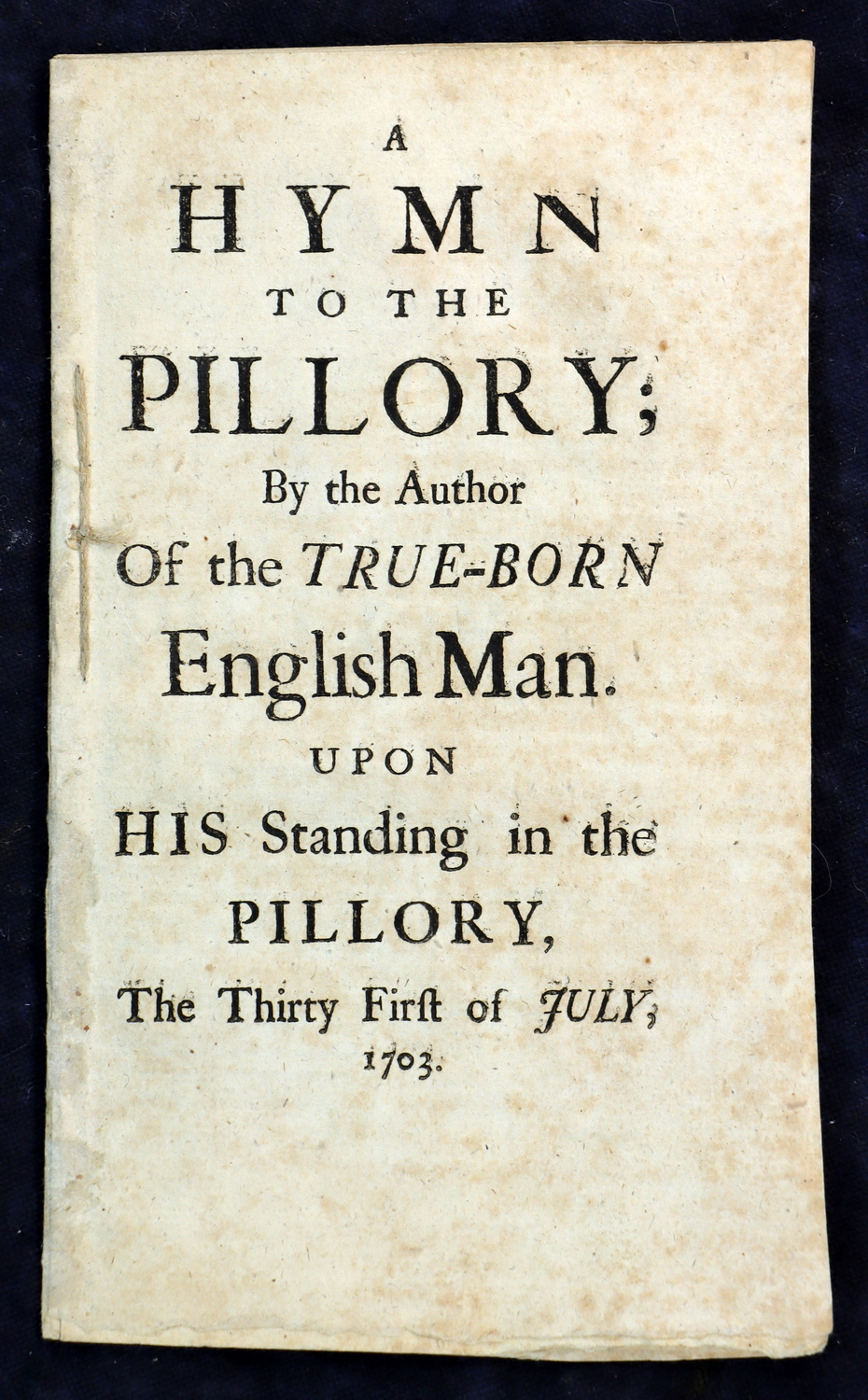
Image from AbeBooks.
You go, Dan!
What’s a Mole Anyway? Agnieszka Hodgson, London N1, recounts, “In his discussion of Einstein’s estimate of Avogadro’s number, Ray Monk writes that ‘a ‘mole’ of a gas is an amount equal to its atomic or molecular weight in grams: hydrogen has an atomic mass of 1, so a mole of hydrogen would be 1 gram; helium has an atomic mass of 4, so a mole of helium would be 4 grams etc’ (LRB, 23 July).”
However, Hodgson writes, “There’s a basic error here. A mole of helium, which is a monatomic gas (consisting of single atoms, each with an atomic mass of 4), does have a mass of 4 grams. And a mole of hydrogen atoms (atomic mass 1) would have a mass of 1 gram. However, hydrogen gas is made up of diatomic molecules (H2), so a mole of hydrogen gas has a mass of 2 grams.”
This clarifies a long-standing misunderstanding of mine, one dating back 55 years ago to Worcester Poly Chemistry and Physics.
Here is Hodgson’s discussion: “But all this talk of gases and masses confuses things. The point is that the mole is a unit of sheer quantity. Avogadro’s number is the number of distinct units in a single mole, and in principle it can be a mole of anything. A mole of helium comprises 6.022 x 10²³ atoms; a mole of hydrogen gas contains 6.022 x 10²³ molecules (and double that number, or 2 moles, of atoms); a mole of duck feathers is 6.022 x 10²³ duck feathers; and a mole of Ray Monks – well you get the idea.”
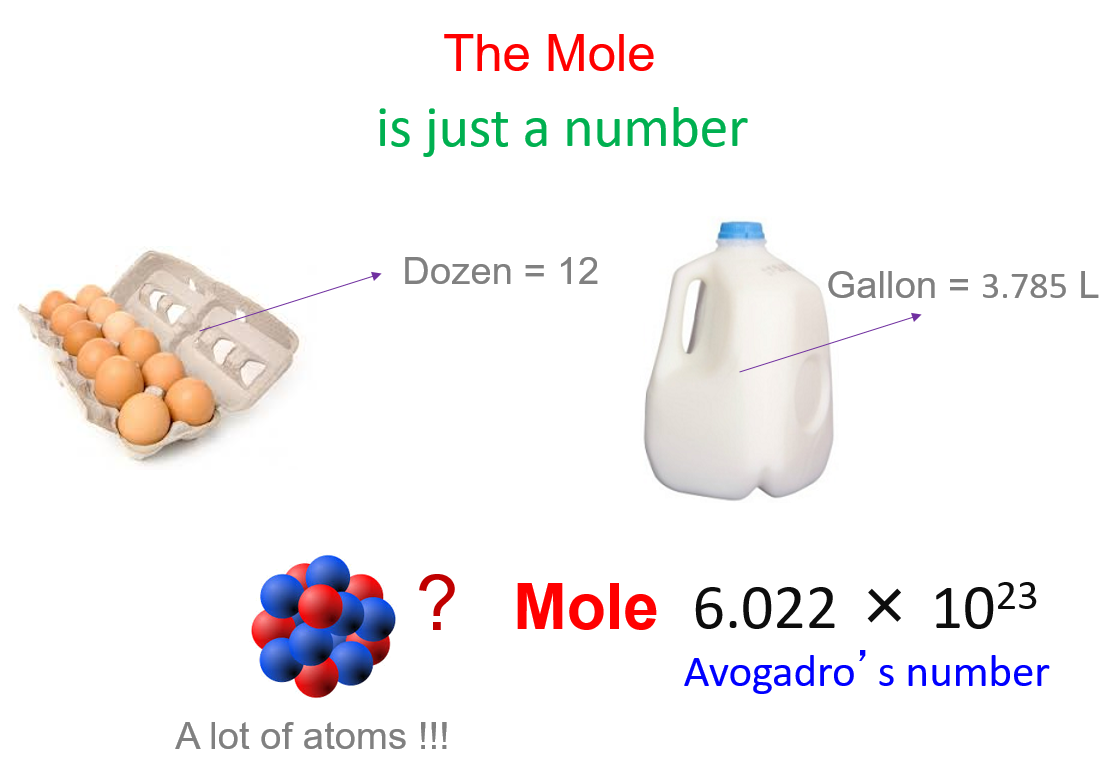
Thanks, Agnieszka Hodgson. Thanks, Chemistry Steps. Finally, I understand.
And thank you, London Review of Books, for continuing my education. ds
© Dennis Simanaitis, SimanaitisSays.com, 2026

