
Simanaitis Says
On cars, old, new and future; science & technology; vintage airplanes, computer flight simulation of them; Sherlockiana; our English language; travel; and other stuff
EUROPE’S LAST PAGANS PART 2
WE BEGAN GLEANING TIDBITS YESTERDAY from Diarmaid MacCulloch’s “Fighting Monks,” his LRB review of two books concerning the Baltic region’s delayed Christianity. Today, we pick up with a tale of knights preferring to do their crusades near home.
The Teutonic Knights. Dairmaid MacCullogh cites one of the two authors, Aleksander Pluskowski, as centering his story “on the rise and fall of one particular order of monastic crusaders from the 12th to the 16th centuries…. The Teutonic Knights made the most drastic adjustment of all the military orders: they staged a strategic withdrawal to their native Northern Europe to crusade for Christendom on its north-east frontier.”
None of this looting one’s way back and forth to the Levant.
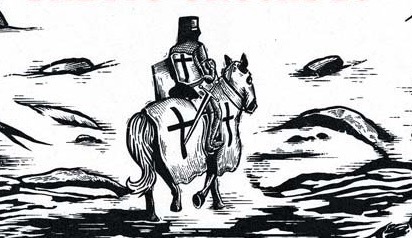
MacCulloch describes, “… with papal approval, they became military rulers of territories both in Prussia and in Livonia (a region largely represented by the modern Estonian and Latvian republics). The populations in these two regions were neither German nor at that stage Christian, but their territories provided convenient springboards for attacks on the powerful and sophisticated polity of Lithuania, whose rulers and nobility resisted any move to Christianity.”
MacCulloch observes, “The Teutonic Knights’ enterprise took three centuries to collapse under the weight of its own contradictions. The knights had many enemies besides those identified with the lively pre-Christian religious practice that was their official target…. In the 1170s, Pope Alexander III had issued a bull encouraging Scandinavians to launch Baltic crusades, using language that for the first time hinted that it was a sacred task to force people to become Christians.”
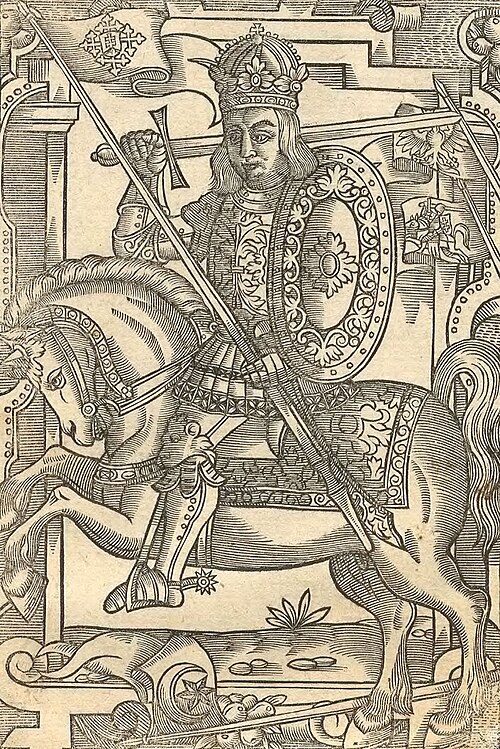
Along Comes Mindaugas (But Not For Long). MacCulloch recounts, “Amid all this was the pagan dynasty of Lithuania, which had grown adept in playing off Christian powers against one another. In 1251 Grand Duke Mindaugas of Lithuania tried to contain increasing harassment from the Teutonic Knights by converting to Christianity; he even began building a cathedral in his chief city, Vilnius. Although a suitably gratified Pope Innocent IV upgraded Mindaugas’s ducal title to that of king, the Christianising of Lithuania involved no wider programme of evangelism and it was followed within a decade by Mindaugas’s assassination.”
“His family,” MacCulloch describes, “seems to have contemptuously converted the cathedral into a roofless temple for traditional religion, open to the skies for the god of thunder…. The continuing vigour and political importance of the official Lithuanian cult was symbolised in 1338, when warring powers of all persuasions signed a treaty protecting Baltic trade routes. The signatories included Teutonic Knights from Livonia, vassals of the Orthodox duchy of Rus’ and envoys of the Lithuanian king, all sealing the deal with their respective religious rites.”
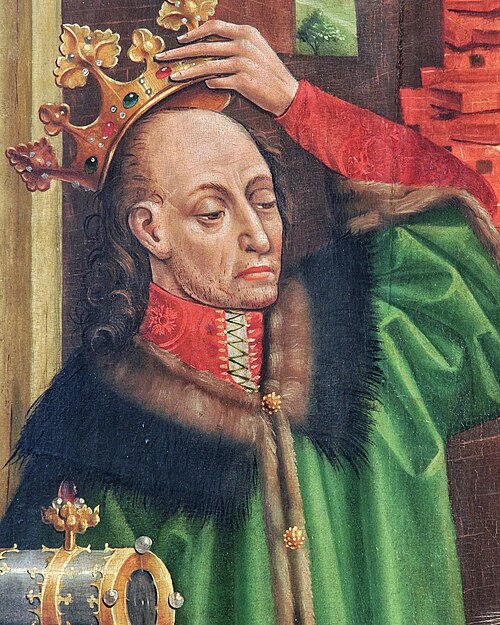
Don’t Forget Jogaila. Then MacCulloch describes, “A turning point for the region came in 1386-87, during the long and fruitful reign of Grand Duke Jogaila of Lithuania. If Paris was well worth a mass to King Henri IV, Jogaila both anticipated and surpassed Henri’s strategic cynicism: his conversion to Catholicism won him not only plaudits from Pope Urban VI, but a potential second realm, since Jogaila was now an eligible husband for Queen Jadwiga of Poland, descendant of the Piast dynasty.”
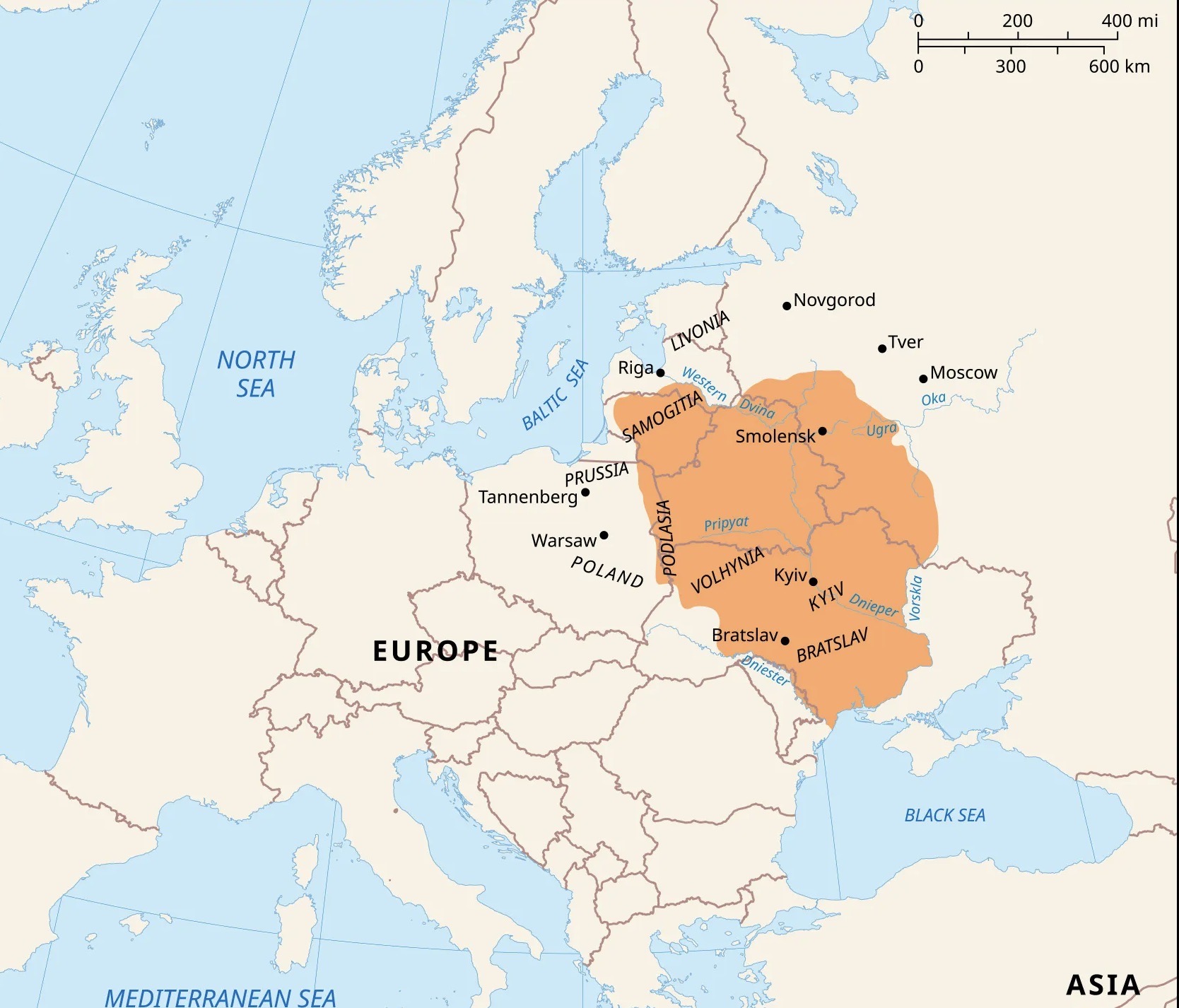
The Grand Duchy of Lithuania, 1396. Image from Britannica.
A New Superpower. “After Jadwiga’s death in 1399,” MacCulloch relates, “Jogaila succeeded as sole Polish ruler, suitably Polonised for his new subjects by his name acquired in Christian baptism, Władysław II Jagiełło. The resulting union turned Poland-Lithuania into one of the superpowers of late medieval Europe, a player alongside France and the Holy Roman Empire. Jogaila’s Lithuanian nobility observed these momentous events, brushed up their Polish small talk and readily followed their monarch’s entrance into the Catholic Church. Snakes and sacred fire ceased to be part of the devotional urban landscape in Vilnius, though no one made much official attempt to convert the population at large.”
Goodbye to Snakes, But Only Gradually. MacCulloch returns to author Young in exploring “the gradual but prolonged decline of non-Christian religion thereafter. Christian mission was hampered by the variety of contenders involved, Catholic, Protestant and Orthodox, whose mutual ill-will proved useful to those resisting conversion. Significantly, the major stage in the disintegration of ‘paganism’ came as Christendom itself began to dissolve in the 18th century.”
Rather More Recently. “Over the last two centuries,” MacCulloch observes, “both the Teutonic Knights and pre-Christian religion have enjoyed afterlives that it would be an understatement to describe as strenuous. In the battle to create national identities and nationalisms against a shifting background of northern European empires, contestants grabbed and misrepresented historic identities in a variety of conflicting narratives.”
Nazis; Then Moscow. MacCulloch recounts, “The Nazis took up these themes with enthusiasm, even as they murdered members of the surviving Teutonic Knights in Austria as part of their general war on the Catholic Church.” With the downfall of the Nazis, MacCulloch notes “Stalin’s calculated removal of Königsberg from the European map.”
“.… though,” MacCulloch observes, “it may also encourage the present population to look beyond the distorted version of the past presented to them by the authorities in Moscow.”
MacCulloch concludes, “After the barbarism and destruction in the eastern Baltic eighty years ago, these books conclude their stories with some fragile signs of hope. The European Union has encouraged participant nations to think of themselves in a broader and co-operative context. One symptom of this has been to turn archaeology away from bolstering crude national myths towards a genuine curiosity about the variety of the Baltic past…. Anglophone readers are doubly blessed with this pair of illuminating introductions to a region of Europe still unfamiliar to many. Young and Pluskowski reopen major questions not simply about religious history but about how history can be weaponised for good or ill.”
A cogent theme to ponder these days. ds
© Dennis Simanaitis, SimanaitisSays, 2026

