
Simanaitis Says
On cars, old, new and future; science & technology; vintage airplanes, computer flight simulation of them; Sherlockiana; our English language; travel; and other stuff
EUROPE’S LAST PAGANS PART 1
I AM A FIRM BELIEVER IN THE SEPARATION OF CHURCH AND STATE. In fact, to quote an early wit, I liken myself to a flying buttress: I support Holy Mother the Church, but from without. This may be part of my Lithuanian heritage, for I have long recognized that the Baltic countries were the last Europeans to accept Christianity; this, as late as the 1600s.
Thus, it is understandable that I enjoy gleaning tidbits from “Fighting Monks,” by Diarmaid MacCulloch, London Review of Books, May 21, 2026.

Diarmaid MacCulloch is an emeritus professor of the history of the Church at Oxford and a fellow of St Cross College. His books include A History of Christianity: The First Three Thousand Years; Silence: A Christian History; Life of Thomas Cromwell; and Lower than the Angels: a History of Sex and Christianity.
Gee, how did I miss this last one? Lucy Wooding’s review was titled “Taking a Cold Bath: Chastity or Fornication?,” London Review of Books, March 6, 2025. LRB notes, “Christ himself made barely any pronouncements condemning sexuality. This has not stood in the way of Church authorities’ lavish condemnation of all sorts of human desire.”
Books Reviewed By MacCulloch. This time around, it’s a dual review: Silence of the Gods: The Untold History of Europe’s Last Pagan Peoples, by Francis Young, Cambridge University Press, 2025; and The Black Cross; A History of the Baltic Crusades, by Aleksander Pluskowski, Yale University Press, 2026.
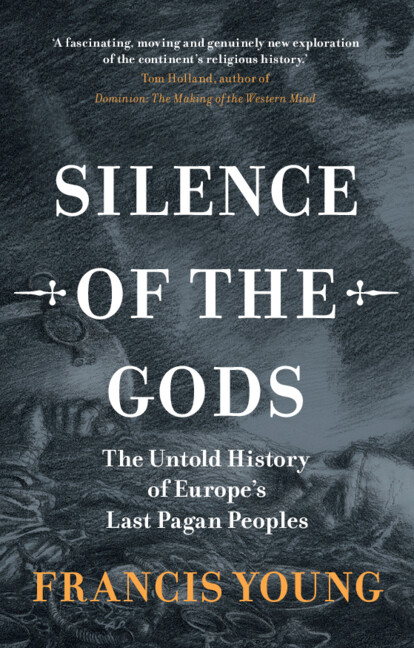

What follows, in Parts 1 and 2 today and tomorrow, are my gleanings of tidbits derived from MacCulloch’s LRB review of these two books.
Whatcha Think of Snakes? MacCulloch begins his review by citing Genesis 3:1—“the serpent was more subtil than any beast of the field which the Lord God has made.” He continues, “Jews and Christians have had a down on snakes ever since. By contrast, until at least the 17th century, the good folk of the Baltic region were notorious for cherishing specimens of the local snake population in their homes, keeping them well fed and watered…. Domestic and possibly sacred snakes were indications that centuries of diverse Christian missionary effort had made little impact on a substantial corner of the European continent.”
“Witchcraft”? “Eventually,” MacCulloch recounts, “the most dangerous label coined for such practices and practitioners became ‘witchcraft’ and that could result in Christian authorities executing people, often by burning at the stake. Such atrocities in Eastern and Northern Europe happened later than in the west of the continent: they were carried out in the 17th and even 18th centuries, interestingly skewed towards men rather than women.”
Referring to the Ancients. “After all,” MacCullogh notes, “snakes were associated with Asclepius, the classical god of medicine and healing. Christian elites of the north were prone to borrowing identities from the classical past, so Poles became Sarmatians, Swedes Goths and Russians (with no flattering intention) barbarian Scythians.”
“Pre-Christian” and “Creolisation.” MacCulloch relates, “After much careful discussion, Young opts for ‘pre-Christian’ or ‘unchristianised’ for the tangle of practices he illuminates across a plethora of cultures and language groups from Lapland to Lithuania…. Young usefully adopts the concept of ‘creolisation’ from another field of early modern Christian expansion. When Spaniards or Portuguese encountered civilisations in the Americas, the Indigenous people soon became adept at disguising or bringing up to date (creolising) ancient observances in ways calculated to slip past the attention of ecclesiastical authorities.”
A Variety of Familiar Monikers. MacCulloch recounts, “The Samogitian (Lithuanian) god of merchants, Markopollus, first mentioned in 16th-century documents, sounds suspiciously like a celebrated real-world merchant of Italy, Marco Polo, while by the 19th century, enterprising Latvians still involved in traditional religion had added a Mother of Tobacco to their traditional pantheon. Even in the 20th century in what is now the Russian republic of Mordovia, one of Europe’s most tenacious ‘pre-Christian’ cultures enthusiastically worshipped Nikulapaz, who is a version of that jolly Christmas saint St Nicholas, while the evil entity in the Mordvin pantheon is Shyaytan, not a million miles from that evil construct of Judaism and Christianity, Satan.”
Tomorrow MacCulloch introduces the Teutonic Knights, a new variant that would rather do their crusading locally than in the far-off Levant. ds
© Dennis Simanaitis, SimanaitisSays.com, 2026


Most of our nation’s founding fathers not Christian, but philosophically omnivorous theists, tho’ Jefferson and some of the Virginians proclaimed Anglicanism merely as such a prerequisite for land ownership. Google Washington’s, Adam’s, Franklin’s scoffs at religion.
Religion inevitable. An animist, as anyone wresting obstinate bolt from ancient barouche, but not above proclaiming Reformed Druidism if it gets me into the right clubs. Still a sucker for the yuletide poinsettias Episcopal service every couple years, despite the church existing merely as Henry VIII couldn’t get papal permission to lob off anymore women’s heads.
Some carols always resonate: https://www.youtube.com/watch?v=WBs-IoQvhBI&list=RDWBs-IoQvhBI&start_radio=1
Pingback: EUROPE’S LAST PAGANS PART 2 | Simanaitis Says
A Note to All Readers: Some have been having problems with Replying. I followed up with WordPress: Its Approval process is email-sensitive (that is, an initial Approval of a particular email name implies that further Replies should go through automatically). However, if a reader has more than one email (e.g. I have two), the yet-to-be-Approved email will have to be Approved before its Reply appears. No big problem.
However–my bad–among the categories of All, Approval, Unreplied, Spam, and Trashed, there’s another called Pending that I’ve been overlooking. Agg! I have now cleaned that one up (dating back randomly a couple/three years).
Let’s hope this clarifies the Reply capability.
And thanks sincerely for your readership.–ds