
Simanaitis Says
On cars, old, new and future; science & technology; vintage airplanes, computer flight simulation of them; Sherlockiana; our English language; travel; and other stuff
SCOUT THE SCAM!
THANKS TO ANNABELLE MILLER, AN AMBASSADOR GIRL SCOUT of Greater Los Angeles, “Scout the Scam” enriches our knowledge of three crucial things: A.I. images, cookies, and online scams.
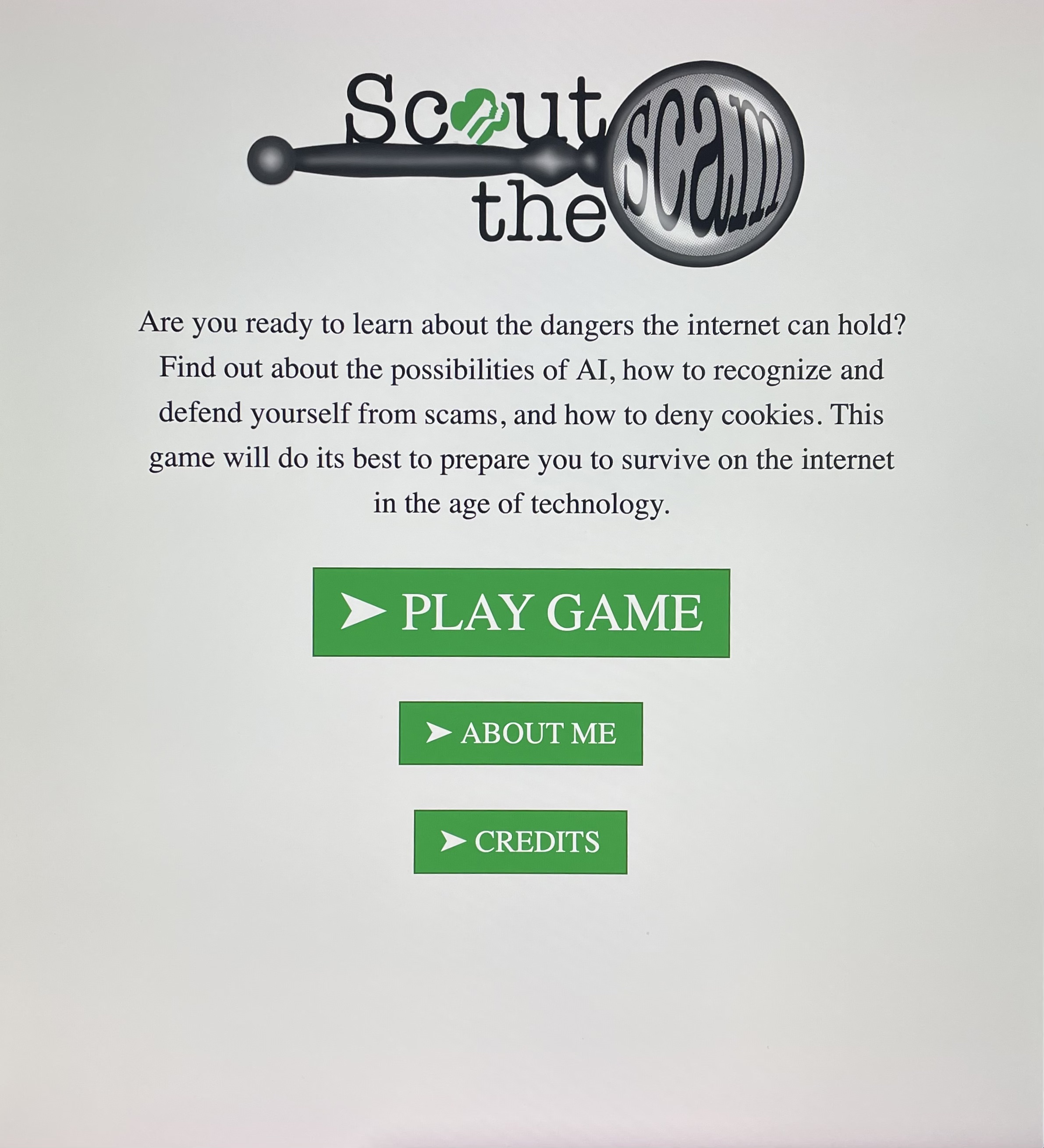
This and an image following from “Scout the Scam.” Give it a try!
Annabelle writes, “This game will do its best to prepare you to survive on the internet in the age of technology.” And immediately I’m impressed she didn’t split an infinitive with “to best prepare you.” Good for you, Annabelle!
Annabelle’s Sources: Significant D.I.Y Tools. Annabelle credits Twine, a non-linear story creation tool; Sugarcube, a free story format for Twine; and CCS (Computer and Communications Security) help from W3 Schools, which includes something I’d profit from learning: My HTML (Hyper Text Makeup Language) skills, meagre they be, are largely self-taught.
Annabelle also cites sources of the images used in the A.I. portion of the game (the practice of which I studiously learned here at SimanaitisSays). She acknowledges Google Fonts, code.org, and the F.B.I, (one of four citations, its scam information). AARP offers information on A.I. slop and Internet scams.
And Annabelle thanks fifteen associates, I’m guessing Girl Scout friends and adults.
Some Personal Observations on “Scout the Scam.” Don’t be put off by the nickname or age jazz. Note, unlike some online apps that come to mind, there’s no harvesting of email ids or the like. Age choices may vary the subsequent levels of response, but if so they’re subtle indeed.
Spoiler Alert: Readers (with good recall) of “The Ethics of Science: Naming and A.I.,” SimanaitisSays.com, January 5, 2023, get a freebie in one of the A.I. slop tests.

See also “Resisting A.I. Slop—AAAS Science’s View,” SimanaitisSays.com, January 24, 2026. Science’s H. Holden Thorp observes, “A.I. will allow the scientific community to do more if it picks the right ways to use it. The community needs to be careful and not be swept up by the hype surrounding every A.I. product.”

Also, BBC’s Amanda Ruggeri offers the SIFT strategy— Stop: Don’t just immediately share a post. Investigate: “Do an independent web search. Find better coverage. And Trace the item to its original context. As Thorp stresses, it’s important to identify data and where it came from.
Text Message Tactics. Annabelle stresses a technique that’s saved me several times: Go to an official website, not just the one in the message. The latter might just be a means of scamming personal information.
And don’t be frightened by the message. Annabelle offers the Three Rs: Rest Research Rethink.
This once saved me from attempted takeover of my computer, one with an apparently stuck screen and a strident claim of control. Rebooting without touching anything but the Off switch thwarted the attack.
Poor Syntax, Spelling, and Grammar. Scammers are notorious for not knowing the difference between “its” and “it’s.” Once again, a check with an official channel will help. (Though, alas, not all are as articulate as Annabelle.)
Who’s (Whose) URL? A Uniform Resource Locator is the unique address identifying a specific resource on the Internet. In “http://simanaitissays.com” for example, “http” stands for “hypertext transfer protocol,” how a web browser interprets the resource. Here, “simanaitissays.com” is the root domain. Its TLD, top-level domain, identifies the website category: commercial .com, organization .org, education .edu, government .gov, and so on. Its SLD, second-level domain, identifies its registered name.
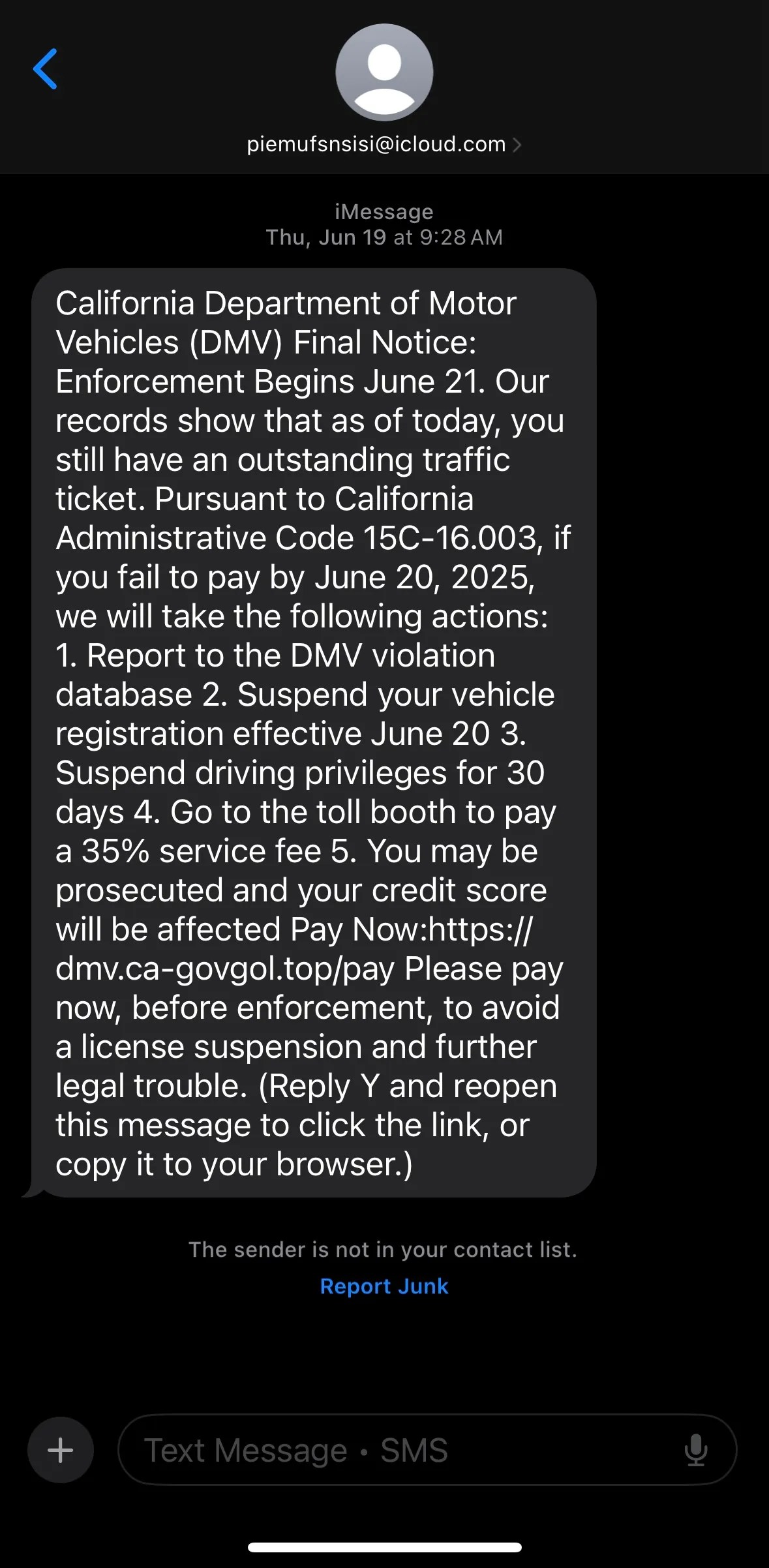
In assessing messages, I’m especially suspicious of when the URL mismatches the alleged messenger. For example, here a warning from “the DMV” threatens about a phony traffic ticket—yet has an obscure url piemufsnsis@icloud.com.
You’d not fall for it after enriching your knowledge with Scout the Scam. Thanks, Annabelle. ds
© Dennis Simanaitis, SimanaitisSays.com, 2026


Dennis, good advice, especially for the young and the elderly, who are frequent targets for scams. I live in a senior community and have persuaded the powers that be to hold small seminars on how to avoid internet scams. Email service providers seem less than bothered to allow such crime to thrive. Perhaps you can point us toward methods of reporting scams to an agency who will actually do something about them.