
Simanaitis Says
On cars, old, new and future; science & technology; vintage airplanes, computer flight simulation of them; Sherlockiana; our English language; travel; and other stuff
A LENTEN WORKAROUND—AND A BREAKFAST TREAT PART 1
I MISSED NATIONAL PRETZEL DAY (APRL 26), though in a sense I celebrate it daily. Sarah Pruitt gave details in “The Pretzel: A Twisted History,” History, May 27, 2025. Here, in Parts 1 and 2 today and tomorrow, I glean tidbits from her article, together with my usual Internet sleuthing—and I recount my everyday breakfast.
A Workaround for Lent. Sarah Pruitt describes, “The Catholic Church played a leading role in the early history of the pretzel. In the seventh century, the church dictated stricter rules governing fasting and abstinence during Lent than it does today. Pretzels, made of a simple mixture of water, flour and salt, were an ideal food to consume during Lent, when all types of meat, dairy and eggs were prohibited.”
Pretzel Etymology. Wikipedia cites, “According to some scholars and various sources, the most popular story is that the pretzel was made in 610 AD by an Italian monk when he decided to make a special treat to help motivate his students to keep on learning. He rolled out a few strips of dough and crossed them to try and resemble two hands praying, and after he baked it, the pretzel was born.” He called them pretiola, “little rewards.”
Wikipedia continues, “The German name ‘Brezel’ may derive also from Latin bracellus (a medieval term for ‘bracelet’), or bracchiola (‘little arms’).”
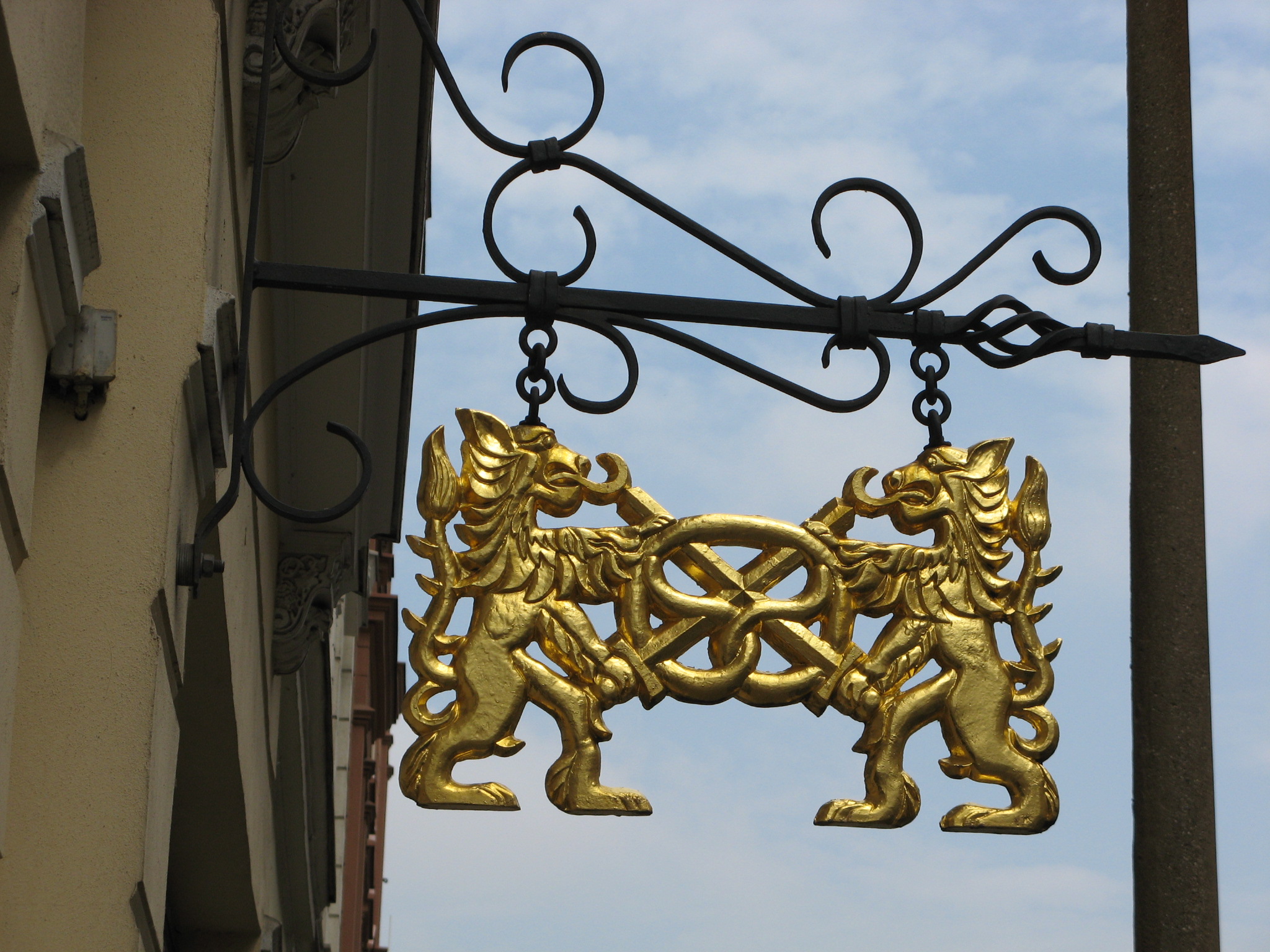
Image by Abubiju via Wikipedia.
Medieval Guilds. “The pretzel,” Wikipedia observes, “has been in use as an emblem of bakers and formerly their guilds in southern German areas since at least the 12th century. A 12th-century illustration of the banquet of Queen Esther and King Ahasuerus in the Hortus deliciarum from the Alsace region (today France) may contain the earliest depiction of a pretzel.”
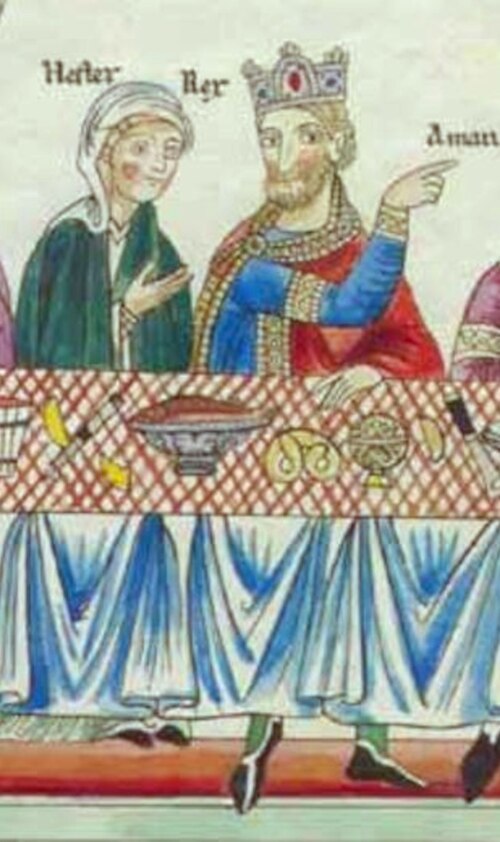
Queen Esther and King Ahasuerus enjoy a familiar shape in the 12th century. Image from Herrad of Landsberg via Wikipedia.
Eternal Devotion and Good Luck. History’s Pruitt describes, “By the 17th century, the interlocking loops of the pretzel had come to symbolize undying love as well. Pretzel legend has it that in 1614 in Switzerland, royal couples used a pretzel in their wedding ceremonies (similar to how a wishbone might be used today) to seal the bond of matrimony, and that this custom may have been the origin of the phrase ‘tying the knot.’ In Germany—the country and people most associated with the pretzel throughout history—17th-century children wore pretzel necklaces on New Year’s to symbolize good luck and prosperity for the coming year.”
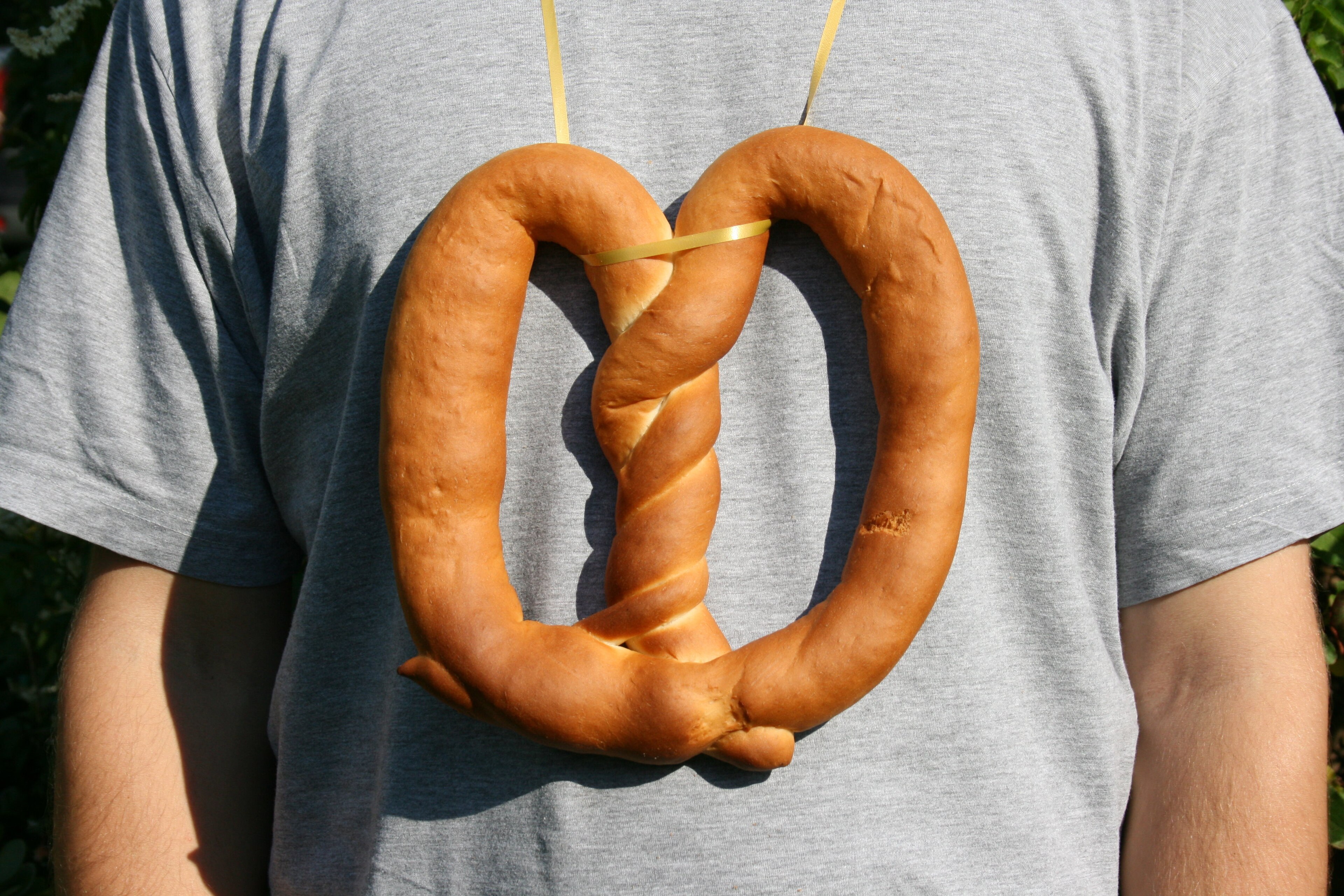
Yum. A good luck pretzel from Burg (Bergisches Land). Image by Frank Vincentz via Wikipedia.
Pennsylvania—Pretzel’s National Home. Pruitt posits, “When did pretzels make their way to America? One rumor has it that the doughy knots came over on the Mayflower, and were used by the Pilgrims for trade with the Native Americans they met in the New World.”
Perhaps, she remarks, “German immigrants certainly brought pretzels with them when they began settling in Pennsylvania around 1710. In 1861, Julius Sturgis founded one of the first commercial pretzel bakeries in the town of Lititz in Lancaster County, Pennsylvania.”
Regular readers (with long memories) of SimanaitisSays may recall Lititz from “1920 Road-O-Plane,” March 1, 2017, and “A Mother Lode of Nuggets,” May 26, 2015.
Tomorrow in Part 2, we’ll learn about pretzel twisting, the Maillard effect, and how I compose an everyday breakfast. ds
© Dennis Simanaitis, SimanaitisSays.com, 2026


I love pretzels, especially the big fat ones no one stocks anymore .
I don’t understand why not, they certainly sold out quickly .
-Nate