
Simanaitis Says
On cars, old, new and future; science & technology; vintage airplanes, computer flight simulation of them; Sherlockiana; our English language; travel; and other stuff
1934 ALFA ROMEO 2.3 MILLE MIGLIA: SALON (AND ROAD TEST, SORTA)
“THIS CAR TURNS OUT TO BE THE FIFTH ALFA ROMEO PASSENGER CAR which appeared on R&T’s cover,” the magazine recounted in September 1958. (Indeed, R&T Vol. 1 No. 1, July 1947, also featured an Alfa, though that one was a Tipo 158 Alfetta Grand Prix machine.)
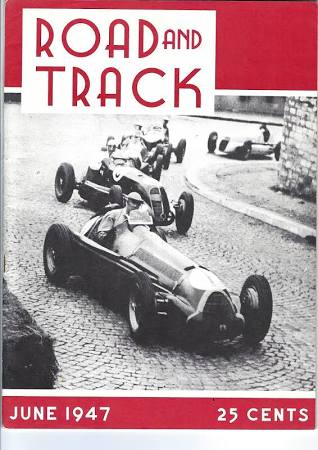
Above, R&T, Vol. 1 No. 1; below, Vol. 10, No. 1.
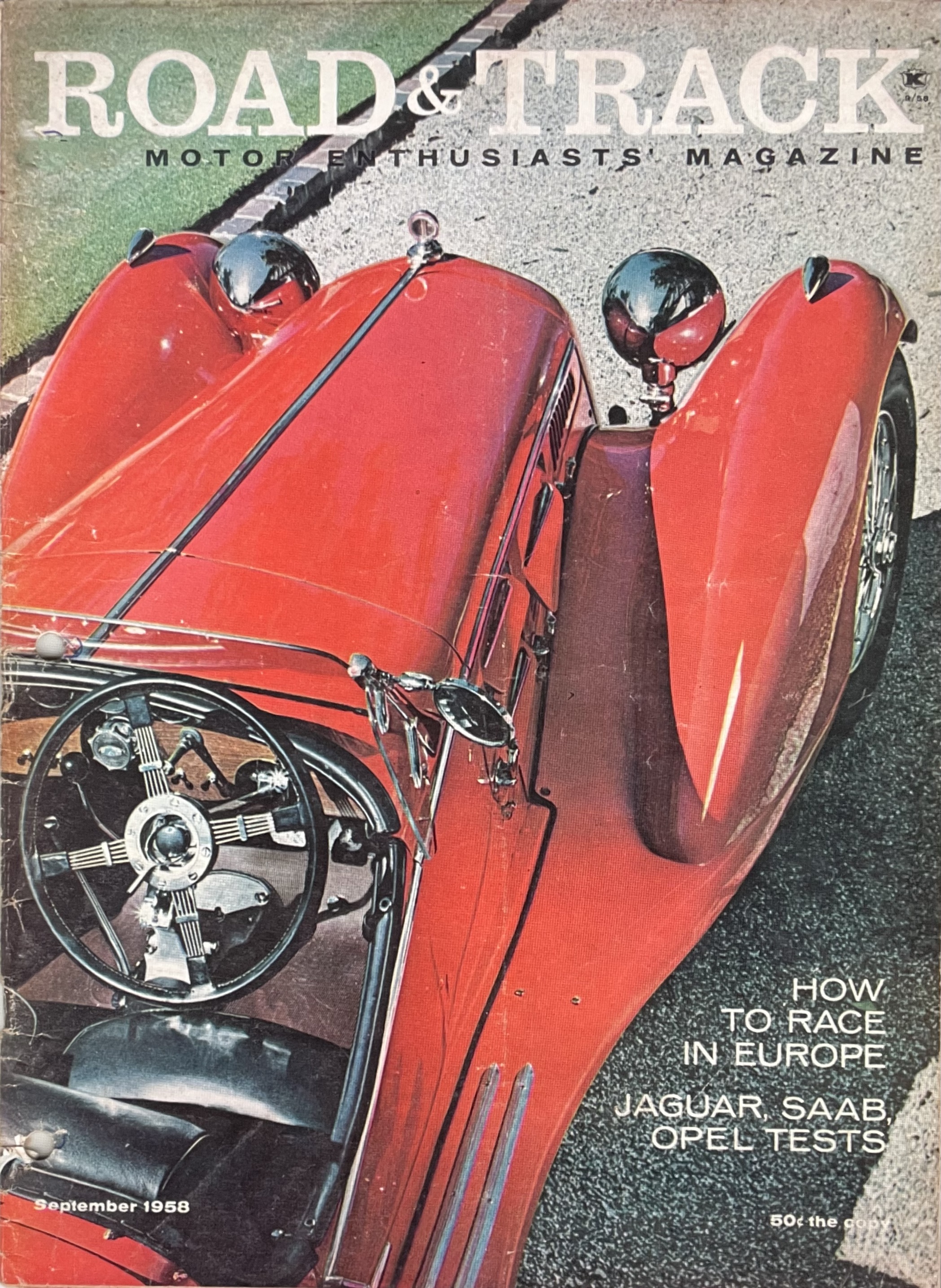
The 1934 Alfa 2.3 Mille Miglia was September 1958’s Salon feature and also the 20th R&T Classic Test. The latter series were road tests, sorta: “not an actual test of the car in question,” the magazine described, “but the data presented are an accurate synthesis of material published during the time the car was produced.”
Here are tidbits gleaned from this Salon as well as Classic Test.

Contrasting Marque Enthusiasts. R&T recounts, “Perhaps the words of Ken Purdy in Kings of the Road best sum up the Alfa situation: ‘The 32nd degree Bugatti addict, he who had made the pilgrimage to Molshiem, who wears his Bugatti Owners’ Club lapel badge pinned to his pajamas at night, and who would never visit New York without having dinner at the restaurant Le Gourmet owned by René Dreyfus, a former team driver for Le Patron—this man, or mayhap, woman, for some females are more fanatic than the males, recognizes no peers among the owners of lesser machinery.’ ”
“ ‘That is understood,’ ” R&T continued with the Purdy narrative, “ ‘The MG boys are, to him, just that: downy-faced, ear-wet, unformed youths. The Mercedes-Benz devotees, with their prattle about the neck-snapping acceleraton of the 38-250’s and the orgiastic blower scream of the 540-K’s, are set down as mere vulgarians. The Rolls-Royce is for old ladies, the vintage Bentley for truck drivers… But a Bugattiste, even an advanced Bugattiste, will talk to an Alfa Romeo owner on terms of near equality.’ ”
This, by the way, is a fine example of why so many of us treasured the words of Ken Purdy. Wikipedia observes, “his Kings of the Road, published in 1952, is still a landmark.” Especially if it’s autographed by Stirling Moss.
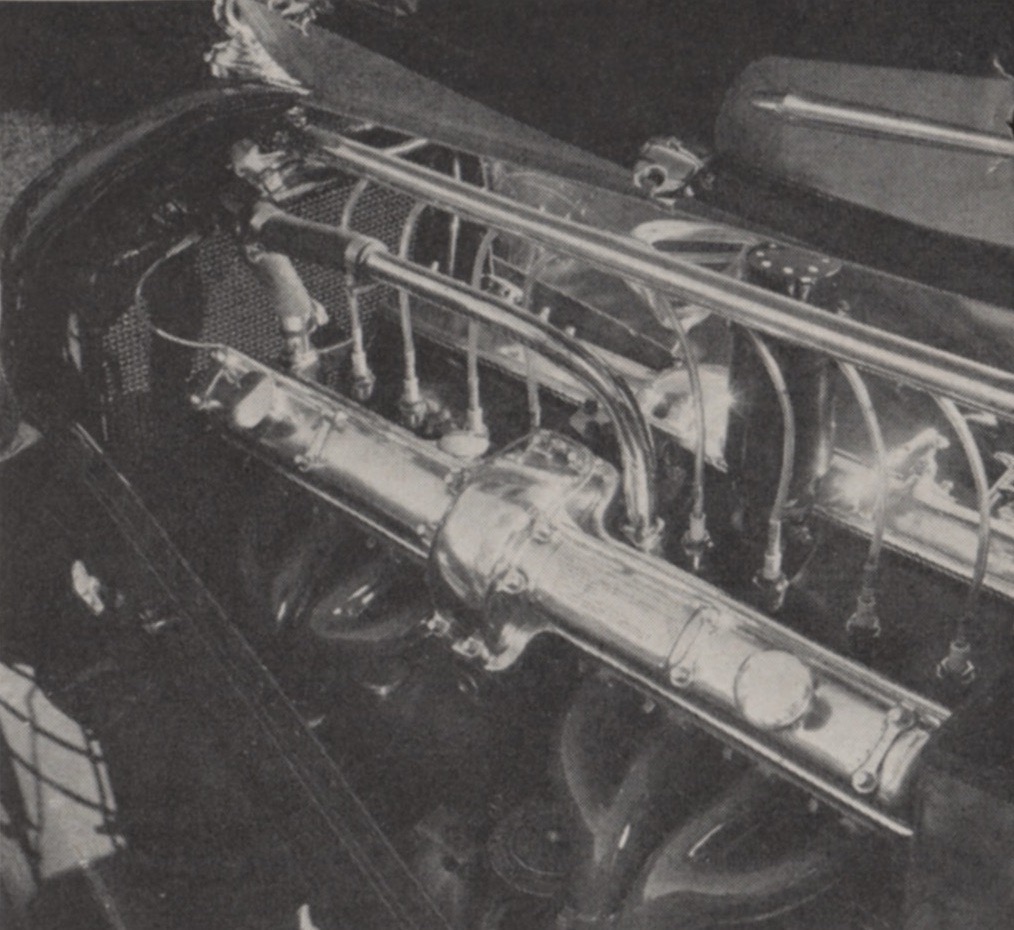
Above, the 2.3 seen from the left side; below, from the right.

Derived from the Monza. R&T noted, “The 2.3 sports car was derived from the 1931 Monza type, a Grand Prix car whose engine was an enlargement of the 2-liter P-2 of 1924–29. The unique feature of this powerplant was the use of what amounted to two 4-cylinder engines mounted on a common crankcase.”
Indeed, this concept was to reappear in the Mercedes-Benz W196 Grand Prix car.
A Crashbox 4-Speed. “The gearbox,” R&T described, “was a straight crash affair, typical of the era and quite sturdy. The upper 3 ratios were closely spaced, which facilitated shifting despite the lack of such artificial aids as synchromesh. Professional drivers in those days took great pride in their ability to shift either up or down without touching the clutch pedal, even during the stress of long-distance road racing.”

“But,” R&T noted, “this was more by necessity than choice: the clutch throwout bearing would not stand up to its job if used continuously.”
R&T’s Assessment of Performance: “July 1938. Although production of the straight-8 2.3 Alfa Romeo ceased production in the fall of 1933, there are still many enthusiasts of the famous marque who firmly believe that it is much more desirable than the current 2.9.”
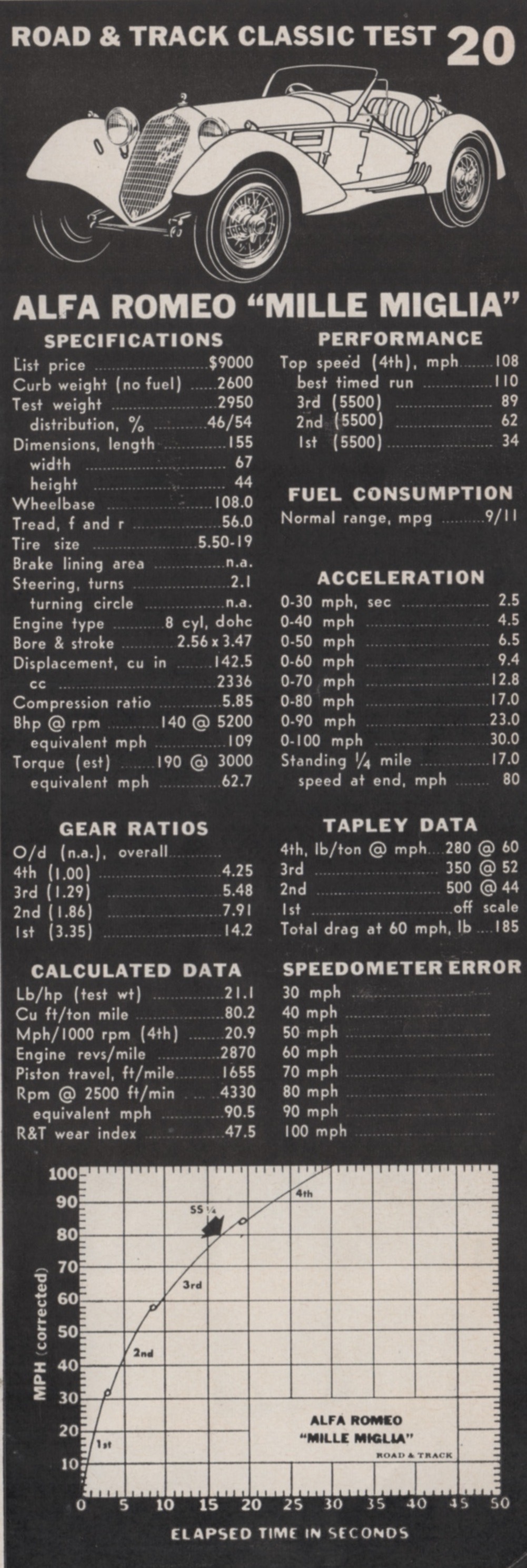
“To our way of thinking,” R&T wrote, “there is much to justify the claim that the 2.3 was the better car: It is lighter and easier to handle, somewhat more tractable, and performs nearly as well as the 2904-cubic-centimeter model.”

Excessive Brake Torque Windup. R&T described, “When the brakes (15.75-inch drums) are applied hard at 80 or 90 miles per hour, the front end sets up such a clatter that one’s teeth tend to vibrate in sympathy, if not in sheer fright. Examination of the front end shows that despite very short (22-inch) and stiff semi-elliptic springs, there is inadequate provision for brake torque windup.”
Agg.
Quick, Though Noisy. “The recommended limit is 5200 rpm,” R&T notes, “but this figure can be exceeded: using only 1st and 2nd only, it is possible to reach 60 mph in only 8.5 sec (9.4 is quoted in the data panel, based on the 5200-rpm limit).”

“The Alfa is not a gentleman’s carriage,” the magazine observes. “At full throttle the noise is almost terrifying; in fact, the Roots blower scream can scarcely be distinguished. Gear noise is there too, but like the blower it is only noticeable when dawdling along.”
R&T’s Contemporary Summary: “Considering the price and the performance available, the heavy fuel consumption is not too serious and a tank capacity of 30 gallons gives a cruising range of about 300 miles. And we can think of no more enjoyable method of covering it than in this snarling red Italian roadster.”
It’s clear that Alfisti just wanna have fun, perhaps waving in return to the occasional Bugattiste. ds
© Dennis Simanaitis, SimanaitisSays.com, 2025
 Simanaitis Says
Something there is about such straight eights, which expanding on Purdy’s perspective, Ralph Stein preferred over the Bugattis with which he, too, was enamored, inline sixes and straight eights being the only engines having perfect inherent balance, V-12s and V-16s only more of the same with the firing impulses halved for less crankpin loading.
Some of us autoholics have no interest in racing beyond the technology, but would love to wormhole or time machine to the Le Mans pits of the ’30s and see such machines administered by pros speaking their language.
But really, only 10 mpg? Certainly not if driven for pleasure, even fast, on open country road?
Dear Dennis Simanaitis, Ian Bamsey (Race Engine Technology) is considering a book on V-6 engines at Le Mans and asked if I might be prepared to contribute a piece on Lancia engines and race cars in the 1950s. Since they were products created under the Italian engineer Vittorio Jano [or Viktor János to give him his birth name], although Francisco de Virgilio and Ettore Zaccone Mina did the detailed engine design and development, I thought by way of preparation I might see if there was anything on Jano in one of the ‘Dennis Simanaitis Says’ pieces, even though from past experience I knew this might prove to be a dangerous foray, enticing me, as occurred, to proceed to spend an entire morning going from one piece to another, through the range of your contributions, looking at any that caught my fancy, even though most had nothing to do with Jano or Lancia, with some not even about cars. But far from being an unproductive excursion, and it was of course a pleasure trip, and there was one piece that caught my interest and was actually related to the subject that brought me to your site; this was the one relating to Jano, ‘Alfa Romeo 2.3 Mille Miglia Salon (And Road Test Sort Of)’. And while it was useful, it is the introduction to this piece that has prompted me to write to you now. It reads, as you will recall: “Contrasting Marque Enthusiasts. R&T recounts, “Perhaps the words of Ken Purdy in Kings of the Road best sum up the Alfa situation: ‘The 32nd degree Bugatti addict, he who had made the pilgrimage to Molshiem [sic], who wears his Bugatti Owners’ Club lapel badge pinned to his pajamas at night, and who would never visit New York without having dinner at the restaurant Le Gourmet [?Le Chanteclair from 1953 on] owned by René Dreyfus, a former team driver for Le Patron—this man, or mayhap, a woman, for some females are more fanatic than the males, recognizes no peers among the owners of lesser machinery.’ ” “ ‘That is understood,’ ” R&T continued with the Purdy narrative, “ ‘The MG boys are, to him, just that: downy-faced, ear-wet, unformed youths. The Mercedes-Benz devotees, with their prattle about the neck-snapping acceleration of the 38-250’s and the orgiastic blower scream of the 540-K’s, are set down as mere vulgarians. The Rolls-Royce is for old ladies, the vintage Bentley for truck drivers… But a Bugattiste, even an advanced Bugattiste, will talk to an Alfa Romeo owner on terms of near equality.’” This brought back memories that have lain dormant for nearly seventy years but might interest you. Ken Purdy’s son Geoffrey was at my school, a year or two ahead of me. He was not somebody that I or most students liked. He had a chip on his shoulder, probably from feeling he could not live up to his father’s fame and masochism. Does this sound familiar? Can you think of anyone in the news who might have suffered similarly, lacking paternal affection and respect, and would turn his insecurity ultimately into tyrannical behaviour? As you probably know, Ken Purdy was not only a famous writer, but reputedly the highest paid writer in America. This in an age when magazines paid big money for stories and pieces. Ken Purdy presented himself as a ‘man’s man’ to use a phrase of the day, writing in Argosy and Esquire and other men’s magazines, a would-be ‘sportsman’ to use another term of the time, Briggs Cunningham being the exemplar, racing sports cars at Le Mans or a 12 Meter yacht in the America’s Cup. Here I should add, Geoff had some birth defect, I’ve forgotten what exactly, but it had some limiting effect in sports, and this added to his sense of disappointing his father and bitterness which he took out on others, younger boys whom he sought to browbeat or intimidate. He was “a nasty piece of work” as one of my schoolmates, unprompted, put it recently. But my concern today is not with a schoolboy but with his father and an incident involving him. At my school then, attendance at meals was compulsory and rigidly organized: we dined in a large dining room with about 20-25 rectangular tables, each of which would have a master at the head, maybe his wife as well, and then about five boys on each side with an additional boy acting as the waiter for the table (all boys did this; there was a rota). We boys were assigned to a table, a different one every two weeks so that the mix of boys would change fortnightly during a school year with every boy getting to sit at a different table for two weeks and meet a different teacher in the school as well as getting to know most of the other boys. One of the tables, the one in the centre of the dining room, was the Headmaster’s, occupied by Phillips Stevens in my day, whose wife Sarah attended most every dinner, and occasionally a guest would also be seated at the Headmaster’s table. Once, when I was about 13 or 14, and assigned to the Headmaster’s table for a two week period, Ken Purdy appeared as the Headmaster’s guest one evening, and by chance, probably because I was a younger boy, I was shoved towards the head of the table by the older boys since those next or near to the guest were expected to engage in polite conversation and the older boys preferred to talk about girls or sports, etc. beyond the hearing of the adults. As a result, I was seated almost opposite Ken Purdy. Pure coincidence. And it was also a pure coincidence that of the 300 or so boys in the school, I was one deeply interested in motor racing or sports cars, and studied their history and specifications. You will remember how boys in their early years can hoover up and absorb huge amounts of information. Not only had I read Ken Purdy’s Kings of the Road, but had assiduously studied Lawrence Pomeroy’s two volume technical work, The Grand Prix Car, memorized parts of Piero Taruffi’s The Technique of Motor Racing, as well as read a raft of other motoring books and devoured car magazines, SCI and R&T, etc., even Hot Rod. All this is by way of introduction to the conversation I had with Ken Purdy. Since neither the Headmaster nor Mrs Stevens knew anything about sports cars, could not have told you whether Bugatti or Borsalino made hats or cars, the conversation at the table quickly became a two person affair with me more than holding up my end. You will also remember that boys of 13/14, even generally well mannered ones, do not always have good sense or are able to grasp when to limit expressions or put boundaries on their speech. Much of the emphasis in our classrooms was to speak up and challenge opinions, aggressively debate ideas, and this is what I proceeded to do at this dinner. As I suspected from reading The Kings of the Road and came to appreciate in our conversation, Ken Purdy actually knew little about cars, their mechanics or the engineering that went into one, and I started challenging him about why he expounded so gushingly about Bugattis when they were comparatively poorly designed. Following Pomeroy and others, I went into the inferior cylinder head construction of Ettore Bugatti’s famed Type 35, its valve gear design, cooling deficiencies; I compared these unfavourably with those of Duesenberg or Alfa Romeo or Mercedes. I contrasted Bugatti with Jano and Porsche and Miller, whose cylinder head design Bugatti eventually would copy, etc. I had Purdy on the run and I knew it, and didn’t think it wrong that he was being given some stick. This was the time, you will recall, of Catcher in the Rye and like Holden Caulfield, we didn’t have time for phonies or the pretentiousness of adults. I was aware that Ken Purdy was getting uncomfortable but didn’t care, though the Headmaster at some point realized that Purdy was getting annoyed , and so he at last intervened and more or less told me to shut up and moved the conversation to some other topic. It may not have been one of my finer moments, but I knew Ken Purdy was something of a bullshiter, a poseur, an arrogant bastard, as indeed his comments on other marques and their owners is clear in the intro to the Alfa piece. He may have been a fine writer, but he was not the heavyweight, the motoring mensch that he liked to have people think he was. Later in life when living in England, I wrote for Motor Sport for a while when Bill Boddy was the editor and got to know him. Here was somebody of that age who really did know about cars, could write as well, but did so without pretension and open mindedness, humility and generosity. There is a coda to this tale. After looking at the Alfa piece I found one on the Bugatti that Ken Purdy owned. It had an interesting history. It was a Type 35, a 2-litre car made in 1926, though its early history seems unknown. Originally it was naturally aspirated, but in 1939/40, when it was owned by an American, Bill Fleischmann, he had it brought up to supercharged specifications. Now here is another coincidence. When I was at university one of my friends was the nephew of Bill Fleischmann and one summer I hitchhiked out to Wyoming and ended up getting a job on the ranch that Bill Fleischman owned. I would see him most every day, since we ranch hands all had lunch with Bill five days a week so he could hear how the ranch work was progressing and at times he would organize some joint ranch activities, like a shooting contest on the 4th of July (which I won). At that time, alas, I didn’t know about Bill Fleischmann’s ownership of a Bugatti, one that Ken Purdy would buy, though I did learn he was interested in high performance cars. He owned a Chrysler 300F which had a 375 hp 6.75-litre engine.À la recherche du temps perdu. But back to Jano, which was where I started. If you know of anything on Jano, please let me know. There is a short piece in Automobile Design: Great Designers and their Work, but that’s about all I know of, no autobiography or biography, as far as I can tell, even in Italian? (or Hungarian?), not that I could read the latter, but maybe you know more. This reminds me that in my meandering excursion on your site, I stopped and read the piece on the Fiat 508, which I enjoyed and agree that your Italian word to describe it is a fine choice. And thanks once more for your site. I hesitate to ask if there is a ‘search’ function to identify a topic, car or person, etc., since I always get pleasure scrolling my way through, even though I end up spending hours doing so, though it might be useful. Best regards, David Hebb