
Simanaitis Says
On cars, old, new and future; science & technology; vintage airplanes, computer flight simulation of them; Sherlockiana; our English language; travel; and other stuff
HERE’S LOOKIN’ ATCHA
DANIEL CLERY REPORTS “NASA’S ROMAN TELESCOPE Readies a Sweeping View of the Universe,” AAAS Science, August 26, 2026: “With a view 100 times larger than Hubble,” Clery recounts, “the observatory will survey the cosmos for distant worlds and clues to dark energy.”
Here are tidbits gleaned from his report.

AN L2 Perch. Clery describes, “Arriving 5 years after NASA’s giant infrared observatory JWST, the 2.4-meter telescope will find vast numbers of intriguing targets that JWST can scrutinize later in detail. From its perch at L2, a gravitationally balanced point 1.5 million kilometers away from Earth, Roman will produce “wonderful science and will provide some great inputs for JWST,” says astrophysicist Garth Illingworth of the University of California (UC), Santa Cruz.”
I note that, perhaps reacting to James Webb’s “Lavender Scare” involvement, Science and other publications pushed back by calling the space telescope named in his honor merely the JWST. Good for them!
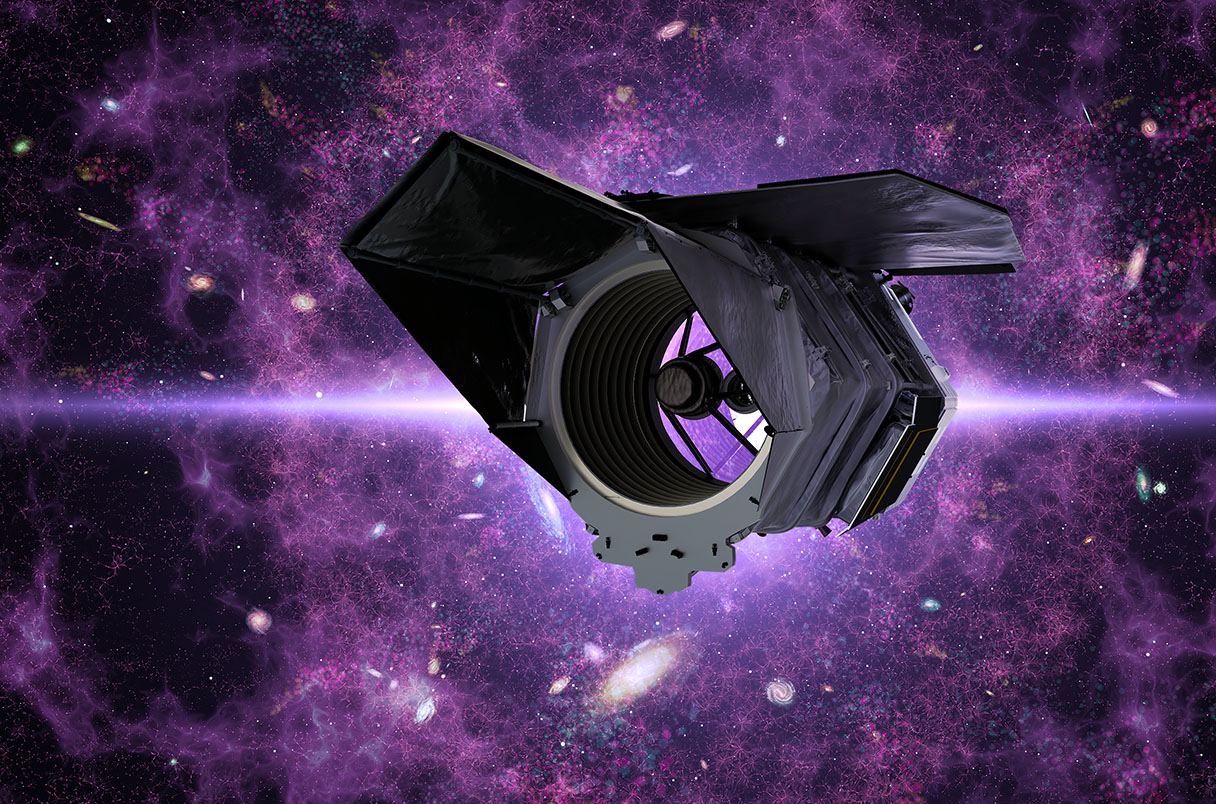
Three Large Surveys. Clery recounts, “Much of its first 5 years will be spent on three large surveys: one focusing on supernovae, another on cosmology, and the third on exoplanets The first two projects aim to pin down dark energy, the mysterious driver of the universe’s accelerating expansion.”
“The task,” he says, “has taken on greater urgency after a ground-based survey found hints last year that the force may have changed over cosmic history rather than remain constant, as predicted by cosmology’s standard model.”
Of course, such occasional revaluation of hypothesis is fundamental to science.
Supernovae Searches. Clery recounts, “Current measurements rely on fewer than 2000 supernovae closer to the Milky Way. ‘It’s a massive jump,’ says Rebekkah Hounsell of the University of Maryland, Baltimore County, co-leader of the supernova survey.”
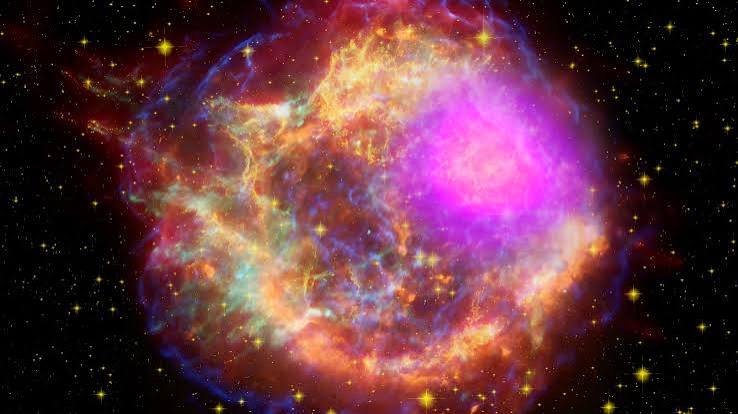
“More clues, Clery relates, “will come from the cosmology survey, which will map more than 1 billion galaxies probing across cosmic time.”
And note thinking in terms of a space-time continuum: Light from distant galaxies has taken considerable time to reach here.
“It will also gauge subtle changes in the shapes of the galaxies caused by the gravitational pull of dark matter, the invisible cosmic ingredient that makes up most of the universe,” Clery notes.
Just as astronomers in 1919 employed bending light to confirm Relativity Theory.
Exoplanet Transiting. Clery recounts, “Probing dark energy will require years of data gathering, but the exoplanet census should generate more immediate results.” And headlines…. Just who’s out there anyway??
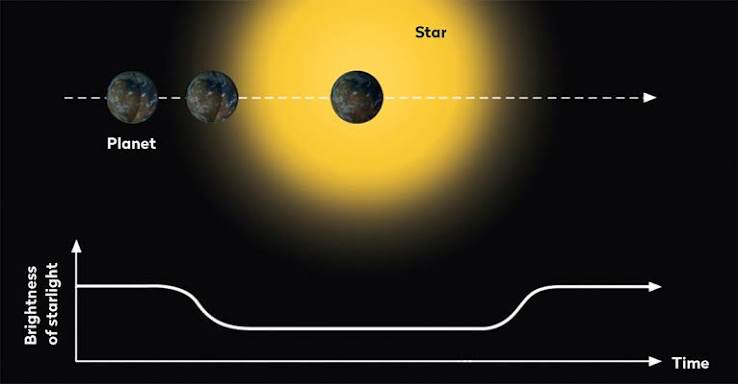
“Most of the roughly 6000 known exoplanets,” Clery explains, “have been detected when they transit, or pass in front of their host star, temporarily dimming the starlight. Roman is expected to find 100,000 new transiting exoplanets.”
But there are scads of other possible exos the size and orbit of which preclude their transiting id.
Gravitational Microlensing. What a neat technique: “This occurs when a foreground star passes in front of a distant background star and the nearer star’s gravity acts as a lens, briefly magnifying the more distant star’s light.” Clery describes.
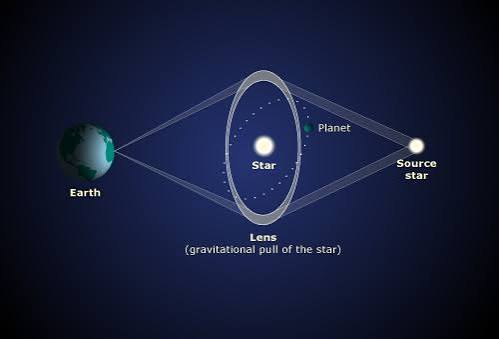
A Double Blip. “If the foreground star hosts a planet,” Clery notes, “it too can act as a lens, producing a characteristic double blip in the brightening.”
“This little-used technique,” he says, “could reveal about 2500 planets that would otherwise be invisible, including ones smaller than Mars and farther from their stars.”
Celebrating Nancy Grace Roman. The honoree of this new telescope is Nancy Grace Roman.
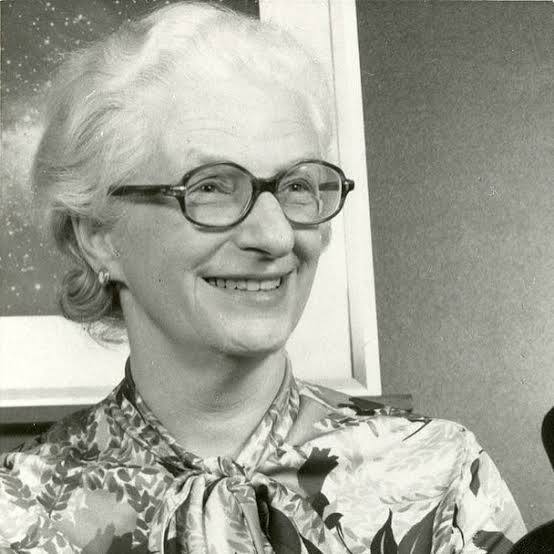
Nancy Grace Roman, 1925–2018, one of “the visionary founders of the U.S. civilian space program,” known to many as the “Mother of Hubble.” Images from American Association of University Women.
Her mom and dad were, respectively a music teacher and a physicist/mathematician. Nancy’s youth and even undergraduate education at Swarthmore were confronted with misogynous misdirection. Fortunately, more enlightened sorts at the University of Chicago and other institutions eventually appreciated her talents; she received a Ph.D. in astronomy in 1949.
Wikipedia recounts, “Roman arrived at NASA in late February 1959 as Head of Observational Astronomy. She quickly inherited a broad program which included the Orbiting Solar Observatories and geodesy and relativity. In early 1960, Roman became the first astronomer in the position of Chief of Astronomy in NASA’s Office of Space Science, setting up the initial program; she was also the first woman to hold an executive position at the space agency.”
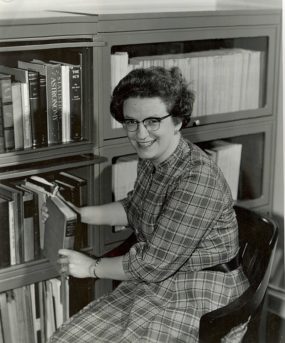
Women “Computers.” Not to disparage their many achievements, but Nancy’s career was a far cry from the era of “women computers.” And a farther cry indeed from James Webb’s anti-LGBTQ+ purges.
Go, Nancy Grace Roman Space Telescope! Continue the good work, JWST! ds
© Dennis Simanaitis, SimanaitisSays.com, 2026

