
Simanaitis Says
On cars, old, new and future; science & technology; vintage airplanes, computer flight simulation of them; Sherlockiana; our English language; travel; and other stuff
ON THE VERNE BRAND PART 1
RAYMOND N. MACKINZIE OBSERVES, “By the last decades of the 19th century, Jules Verne was less a writer than a brand—one carefully cultivated by his publisher, Pierre-Jules Hetzel—promising a specific mixture of scientific plausibility, adventure and moral instruction.” This, from MacKenzie’s “Platinum Noses,” London Review of Books, July 9, 2026, a review of Journey to the Moon, by Jules Verne, translated by David Coward with William Butcher.

Already In My Annotated Collection? Uh, no. Among my 35 annotated editions are two Jules Vernes: Twenty Thousand Leagues under the Sea, 1976; and From the Earth to the Moon, 1978; both with commentary by Walter James Miller.
So what of Journey to the Moon? A new translation of From the Earth to the Moon? No, not exactly, though this is one of the tidbits, here in Parts 1 and 2 today and tomorrow, gleaned from MacKenzie’s LRB article. There’s personal bibliophilic fun as well.
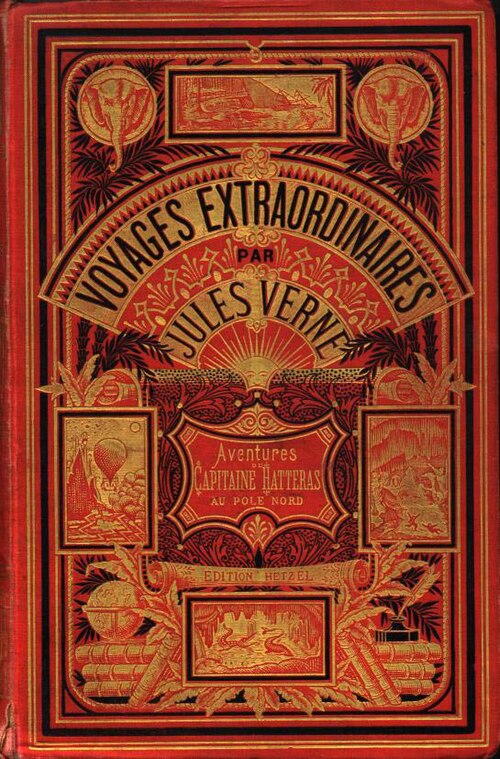
Verne, the Brand. MacKenzie explains, “From the mid-1860s, Hetzel did not simply publish Verne; he curated him. Les Voyages extraordinaires appeared in a uniform format—distinctive bindings, illustrations, series numbering, prefatory material—that acted as a guarantee. Few writers could match Verne in sales or in spin-offs, including the hugely successful theatre productions. After its publication in 1873, Around the World in Eighty Days became one of the most frequently staged adventure spectacles of the late 19th century, selling out in Paris, London and New York.”

Indeed, 73 years later, Around the World was a musical with book by Orson Welles and music and lyrics by Cole Porter. This immensely complex production opened on Broadway in May 1946 but closed after only 75 performances.
After initially buying into the Welles/Porter project, Mike Todd pulled out and turned to framing his own spectacular Around the World in 80 Days.
Verne, the Author? MacKenzie notes, “Popular success did not, however, translate to literary prestige. Verne was largely ignored by Zola and the Naturalists, or treated with disdain when they did bother to notice him. For them, science meant determinism, heredity, pathology; not techno-optimist speculation. Verne’s science involves heroic inventors, awe-inspiring machines and encyclopedic exposition; this kind of material didn’t register at all as ‘literary’ science. Zola called Verne a ‘vulgariser’, adding that if his books sold well, so did ‘dictionaries and parish prayer books’, and they had ‘no importance whatsoever’.”

MacKenzie recounts, “Verne had a long-standing wish to be elected to the Académie Française, but despite the efforts of his friend Alexandre Dumas fils, the honour never came. Verne was categorised as a children’s writer or an adventure writer—not a serious novelist.”
Tomorrow in Part 2, we’ll learn how this children’s/adventure writer did just fine, thank you. ds
© Dennis Simanaitis, SimanaitisSays.com, 2026


Jules Verne was a refreshing anomaly. To think he was already envisioning nuclear power, 20,000 Leagues Under the Sea, when we were still fighting the bloodbath of the Civil War, which only replaced slavery with a century of Jim Crow and lynchings. Verne might’ve been among the few who could see improvements in mechanized cotton ginning rendering the warehousing of slaves cost prohibitive by the 1870s.
Consider Paris in the 1860s: Monet, Renoir, Bizet, Debussy, the engineering breakthroughs, already internal combustion engines powering factory machines, Louis Pasteur’s germ theory, fostering modern microbiology, surgical anesthesia; ether and chloroform in surgeries while soldiers in our bloody Civil War were given rum and held down with a stick to bite on.
The bloodiest war in US history, two percent of the population dying, nearly as many soldiers perishing in captivity as killed in the entire Vietnam War.
Jules Verne gave the world hope.
Consider: https://reportwire.org/15-jules-verne-predictions-that-actually-came-true/
Thank you Jules and Dennis!
Today, we yet have hope, even as we suffer the worldwide backsliding of Trump and his friends Putin, Kim Jong Un, Viktor Orban (the latter recently replaced by a more hopeful Peter Magyar.)