
Simanaitis Says
On cars, old, new and future; science & technology; vintage airplanes, computer flight simulation of them; Sherlockiana; our English language; travel; and other stuff
LEAPIN’ AERIAL AQUABOTS! PART 2
YESTERDAY WE ACKNOWLEDGED THE CHALLENGE of studying aerial-aquatic birds and, thus, the idea of devising a robotic equivalent. Today in Part 2 we continue with “Leaping Out Of The Water: Aerial-aquatic Locomotion With Flapping Wings,” by Raphael Zuffery et al.
Designing the Aerial Aquabot. “To test these hypotheses,” Zuffrey and his colleagues recount, “we designed a 250-g flapping-wing robot to match the shape and locomotion of diving birds. The robot consists of a slender fuselage, two symmetric membrane wings, and an actuated tail. The fuselage design can be fitted with diverse wings and tails. The robot is untethered, waterproof, and contains electronics for wirelessly setting wing-flapping frequencies and control parameters for the tail elevator angle.”
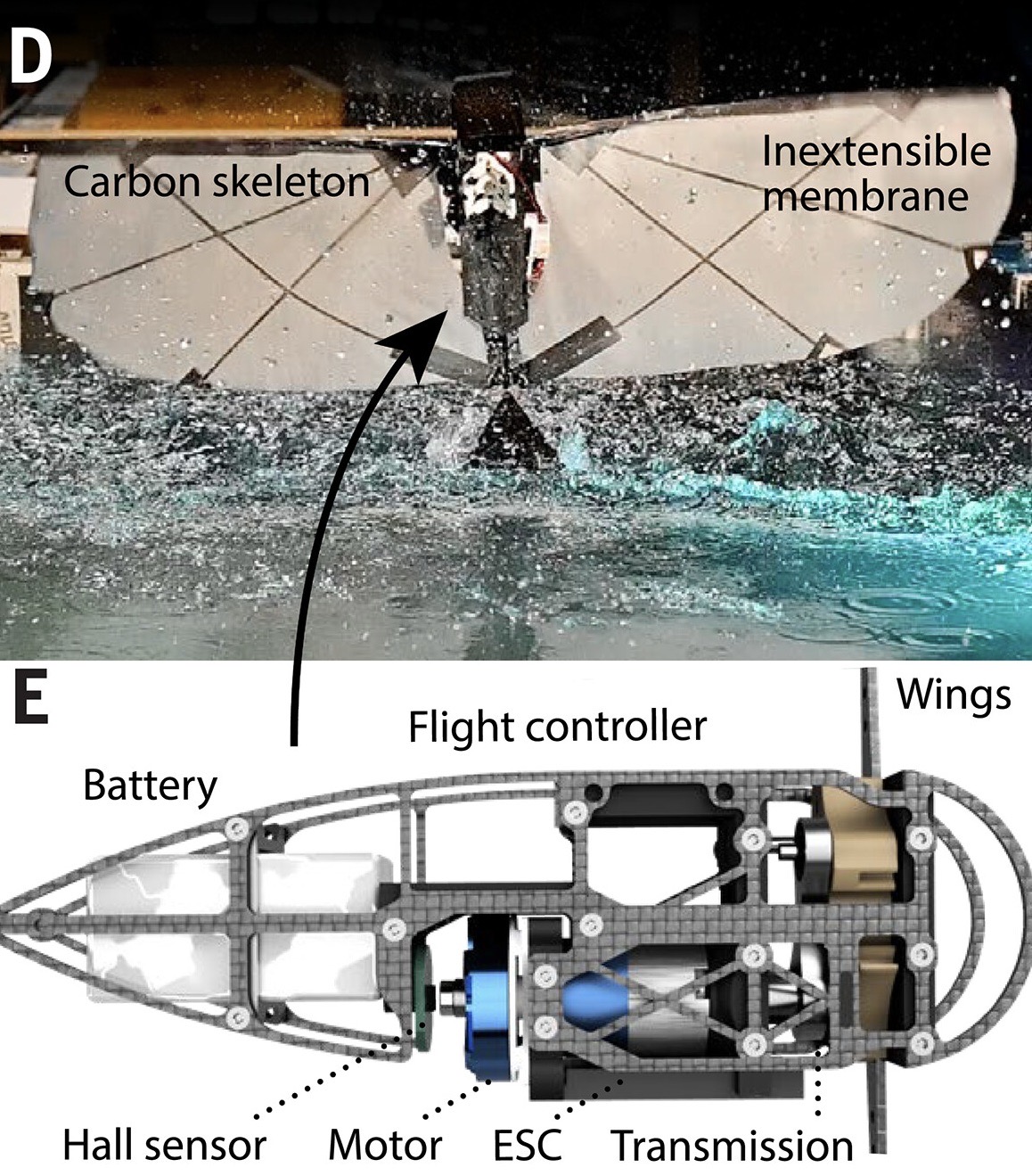
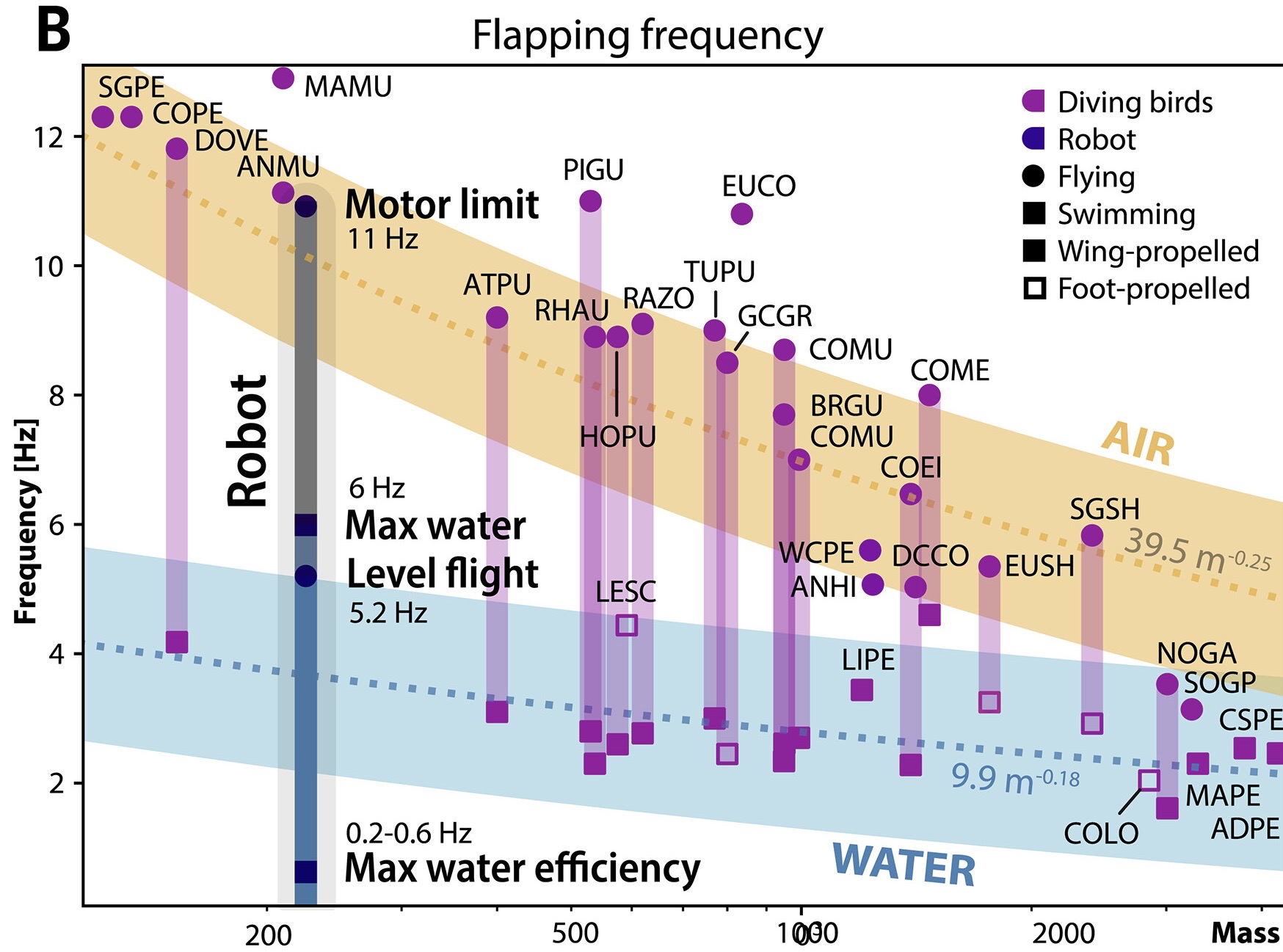
Flexibility Mimics Nature’s Wing Folding. The researchers describe, “Similar to diving birds, the robot can vary flapping frequency from a range of 0.1 to 6 Hz in water to a range of 5.2 to 11 Hz in air. Rather than replicating a complex wing-folding mechanism to reduce load under water, we used flexible wings. Passive wing bending reduces the effective wing travel, which results in a reduction of wing-tip vertical velocity and load.”
“The robot’s wings,” they explain, “are three to four orders of magnitude more flexible than birds’ wings (estimated from bird skeleton stiffness analysis). As a result, they can operate underwater at frequencies up to 6 Hz, which is substantially higher than the 0.85-Hz limit allowed by rigid wings and higher than the flapping frequencies required for cruising flight (5.2 Hz). Finally, we designed the robot to be neutrally buoyant so that it does not require additional energy to generate a downward force in water as birds do.”
The Aerial Aquabot’s Performance. “In summary,” Zuffrey and his colleagues relate, “the medium wing size with medium stiffness could generate sufficient force in air for flight while maximizing swimming velocity and thus represents a good compromise for aerial-aquatic locomotion. We tested this wing configuration in indoor untethered flights and measured a flight speed average of 6.3 m/s. On the basis of the measured power and speed values, on a single charge, this robot could fly for 6 km at 20° angle of attack and at 6-Hz flapping frequency or swim horizontally for 2 km at 1-Hz flapping frequency.”
Plunging for Fish. In one of several analyses, Zuffrey et al. recount, “Aquatic birds plunge-dive into the water to hunt fish. To replicate this maneuver, the robot (medium stiffness wing) was launched at 5 m/s, flew across the tank, and entered the water. During this transition, the robot displayed a rapid deceleration from 5 to 0.5 m/s, corresponding to an impact force of ~60 g. Our experiments revealed that regardless of the wing stroke angle at impact and independently of whether the wings were flapping, the robot was able to successfully transition to the water and start swimming with the wings.”
Lifting Off. Researchers describe, “The robot was equipped with a short tail and medium-stiffness wings with a superhydrophobic coating similar to the oil-based water repellent of many diving birds. The robot was positioned at 20 cm under the water surface on a fixture with a longitudinal angle that could be manually regulated. The robot left the fixture by flapping the wings and moved toward the water surface at the preset angle. The egression maneuver lasted <1 s. The fuselage emerged first (0.3 s), followed by the wing trailing edge (0.8 s), and eventually the tail until the whole robot was airborne (1 s). The robot required eight to 10 strokes to lift off from the surface. Analysis of 11 egression tests in a lake and 15 additional egression tests in an indoor tank at 55° to 80° (in 5° steps) from a deeper starting point clearly revealed the role of the egress angle for a successful transition. In both conditions, at angles <55°, the tail produced a pitch-down torque that prevented the robot from fully exiting the water surface.”
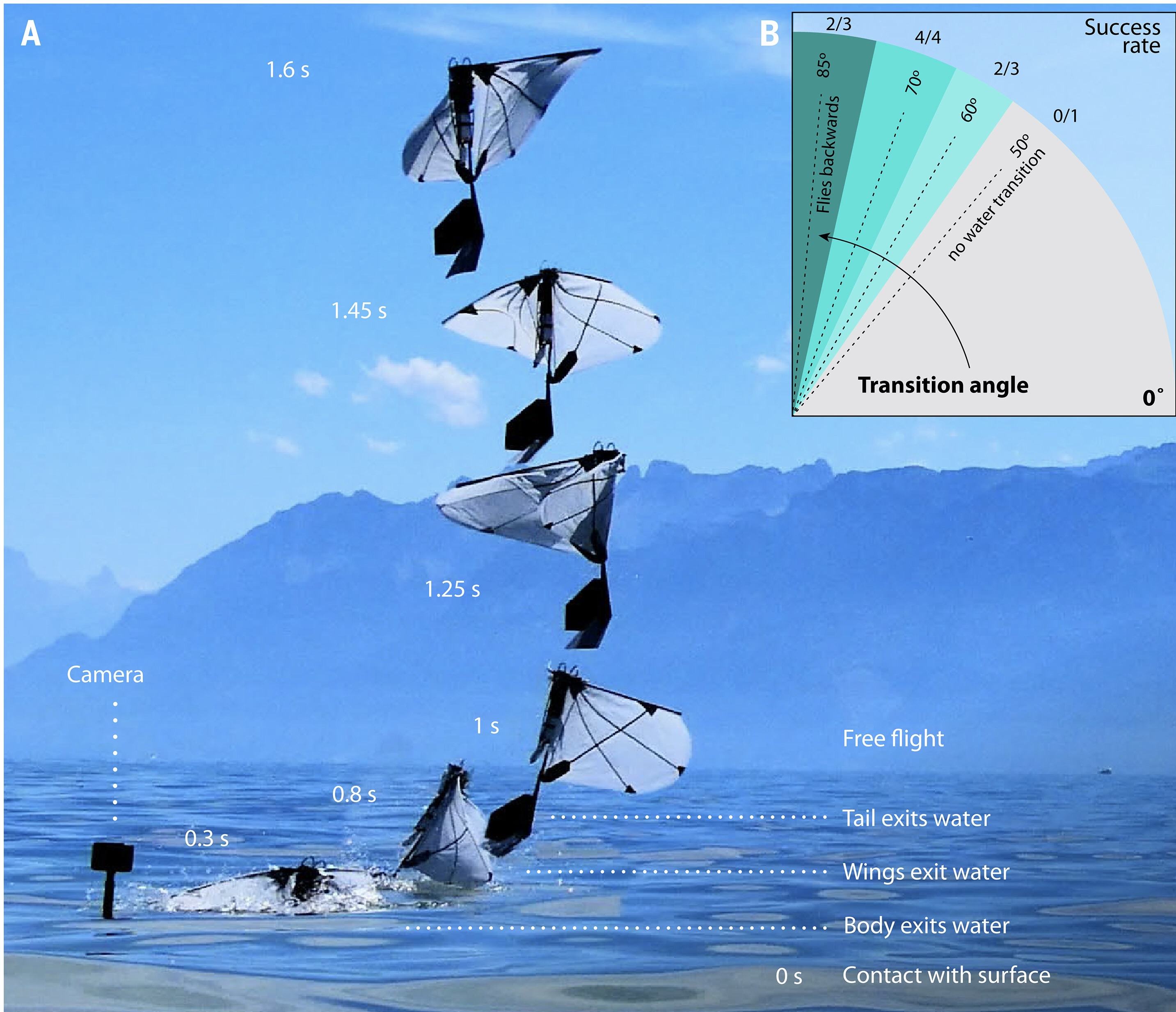
How Necessary Are Duck Feet? “Most diving birds,” the researchers observe, “use their legs in combination with flapping wings to paddle and take off on a horizontal trajectory (0°). However, our robot could exit the water surface without legs (at angles of 70°) in a manner similar to aquatic birds with low wing loading, such as kingfishers and dippers. Both animals can escape the water surface approximately vertically without using their feet.”
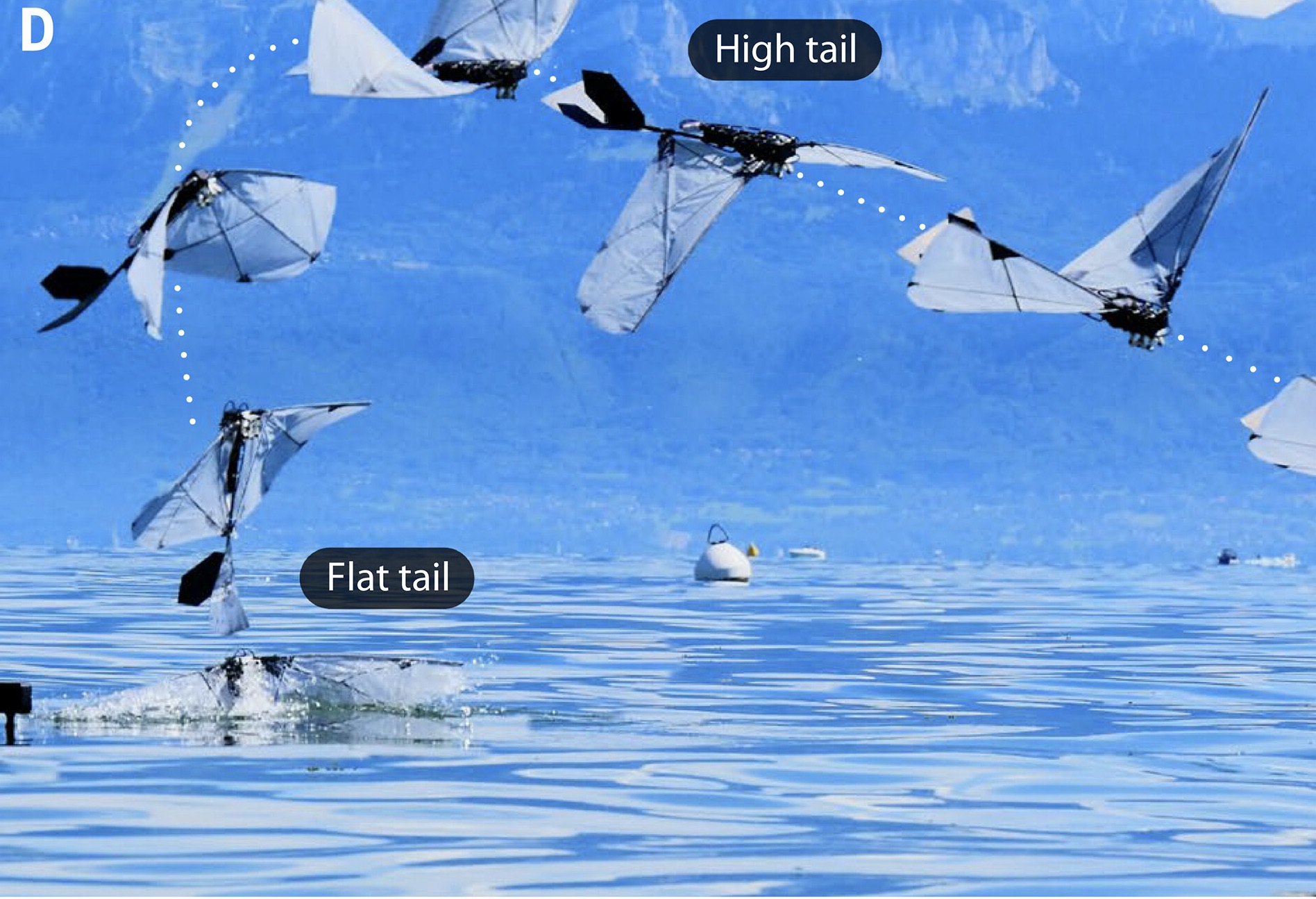
“Taken together,” the researchers say, “our results indicate that although water egression is possible by flapping wings without the help of legs, it is a power-intensive maneuver that may not be available to diving birds with relatively high wing loadings.”
They conclude, “In addition to shedding light on the morphological and behavioral adaptation of aerial-aquatic animals, the design principles described here lay the foundation for a class of robots that can be used for limnology, oceanography, marine ecosystem monitoring, and coastal management.”
The paper adds, “Detailed instructions for reproducing the robot, including component lists, are provided in the supplementary materials.”

The researchers are principally with the Laboratory of Intelligent Systems, EPFL, Lausanne, Switzerland, (two, also at MIT; one with the Salish Sea Research Center, Northwest Indian College, Bellingham, Washington). They note their work was supported by a Marie Skłodowska-Curie Actions Fellowship (part of the European Commission) and by a Swiss National Science Foundation grant. ds
© Dennis Simanaitis, SimanaitisSays.com, 2026

