
Simanaitis Says
On cars, old, new and future; science & technology; vintage airplanes, computer flight simulation of them; Sherlockiana; our English language; travel; and other stuff
LEAPIN’ AERIAL AQUABOTS! PART 1
“DIVING BIRDS,” SCIENCE’S MARC S. LAVINE SUMMARIZES, “transition between flying through the air and navigating through water by flapping, but the mechanisms by which different species try to do this efficiently is challenging to study.” But aquatic flying robots can reveal some of their secrets.
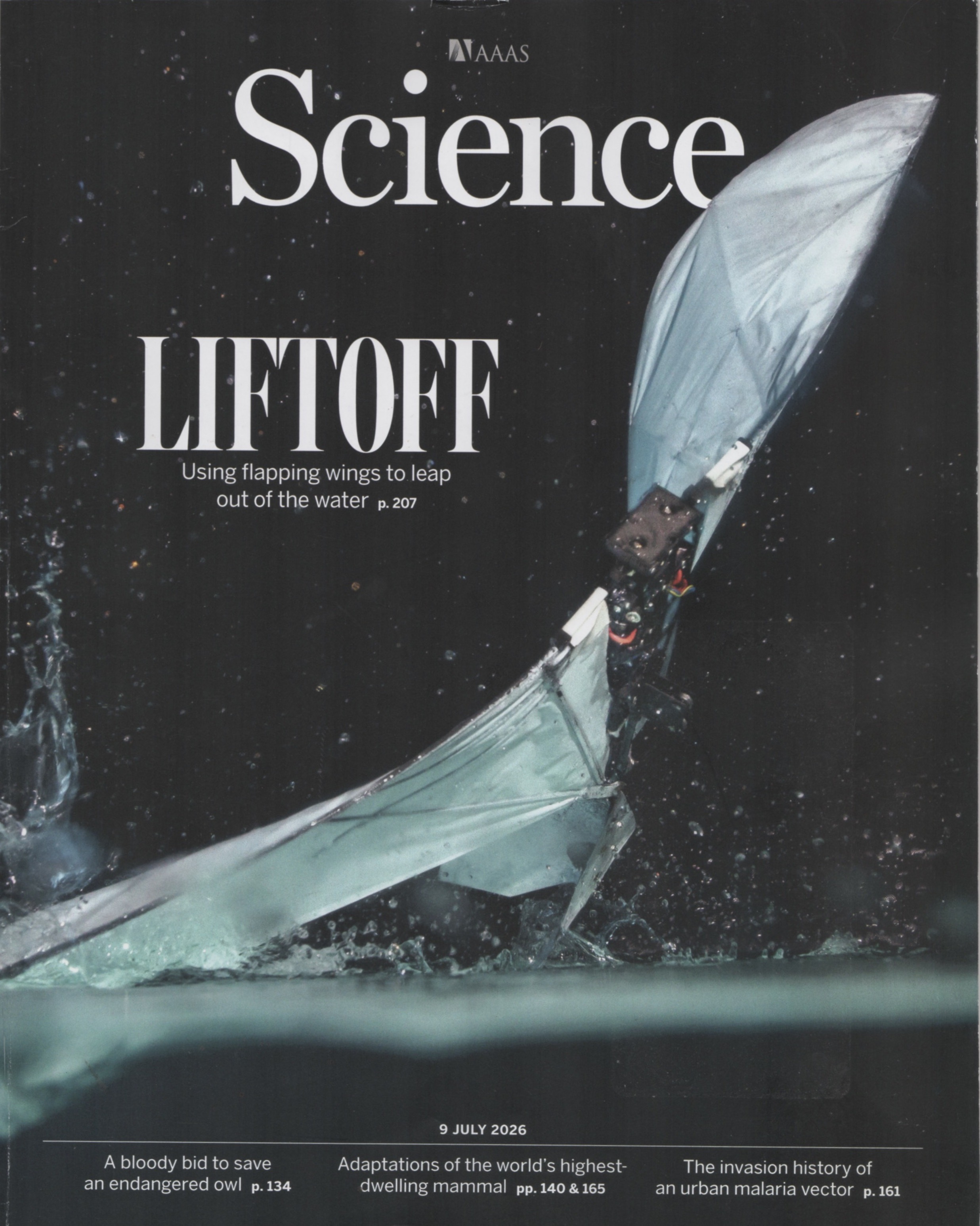
Details of this are offered by Raphael Zuffrey et al. in “Leaping Out Of The Water: Aerial-aquatic Locomotion With Flapping Wings,” Science, July 9, 2026. Here, in Parts 1 and 2 today and tomorrow, are tidbits gleaned from their research as well as from its Editor’s Summary by Marc S. Lavine.
The Challenge. In their Abstract, Zuffrey and his colleagues observe, “There are close to 100 species of birds capable of extending their flight to the underwater world. When wing-propelled diving birds move through water, they display similar flapping kinematics as used in flight but reduce flapping frequency and wing area. The three-order-of-magnitude difference between air and water density results in large variations in wing torque and velocity required for propulsion, but it is unclear what design trade-offs and physical adaptations are necessary to operate across these largely different conditions. Furthermore, it is unclear whether the transition from water to air can be accomplished solely by flapping the wings or if additional propulsion from the feet is required.”
“Addressing these questions with animal experiments,” the researchers note, “is difficult because of our limited ability to direct their behavior, making systematic observation difficult. Computer simulations offer only limited insight because modeling the large fluid-induced deformations caused by flapping locomotion and the transition between water and air remains challenging.”
Enter the Aerial Aquabot. Zuffrey and his colleagues write, “Self-propelled robotic models are a powerful tool for addressing these questions because they are subject to the same physical laws as animals but can be systematically modified and programmed to explore a wider range of design and control parameters than is possible with animal experiments, including behaviors that animals do not naturally display (e.g., flapping wings at very low or very high frequencies). We developed flapping-wing aerial-aquatic vehicles that can fly in the air, swim under water, and transition between the two media.”
Fabrication. The researchers describe, “We designed, prototyped, and characterized these robots to study how the wing frequency should change between media, what mechanical adaptation is required to reduce wing load in water, what efficiency and speed of locomotion are possible despite the requirement to satisfy aerial and underwater constraints in a single system, and the conditions for transitioning between the two media.”
Birds Do It…. “Aerial-aquatic locomotion,” the researchers recount, “brings contrasting requirements that must be jointly addressed as birds engage in four distinct phases: plunge diving (when the bird enters the water), aquatic locomotion (when they are fully submerged), water egress (when they transition to aerial flight), and aerial flight (when they are fully airborne).”
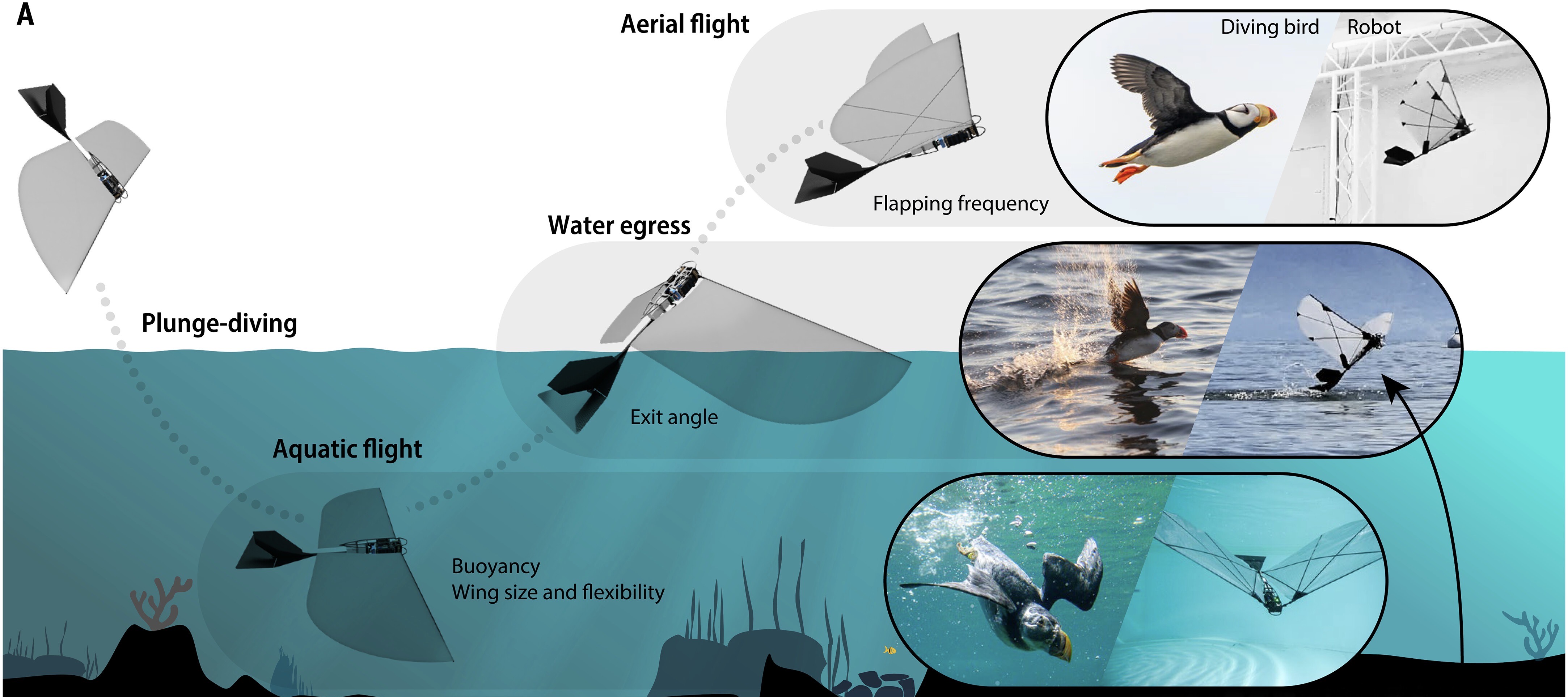
But How? Zuffrey and his colleagues recognize that actual wing flapping frequencies play a role between airborne and aquatic behavior. However birds’ frequency change of a 2-to-4 factor is considerably less than the theoretical Reynolds number 12-fold factor moving from water to air. The researchers posit, “This deviation from isometric scaling likely arises because birds can effectively reduce wing excursion in water by wing morphing. Finally, when fully submerged, much of diving birds’ energy goes toward generating a downward force with their wings to counteract buoyancy forces.”
Tomorrow in Part 2, Zuffrey and his colleagues build and test an aerial aquabot. We also learn an interesting lesson in science funding.
© Dennis Simanaitis, SimanaitisSays.com, 2026

