
Simanaitis Says
On cars, old, new and future; science & technology; vintage airplanes, computer flight simulation of them; Sherlockiana; our English language; travel; and other stuff
MATHS, MUSIC—AND ACROSTICS
FULL DISCLOSURE: I HAVE A PH.D. IN MATHEMATICS, which the British charmingly refer to as “maths.” But I confess to only a vague understanding of musical composition. And, with an example given anon here, acrostics hold a special place in my heart. Yet, with my mixed intellectual quirks, I was fascinated by Peter Phillips’ “What the Maths Mean,” London Review of Books, May 7, 2026. It’s a review of the book Composers in the Middle Ages, edited by Anne-Zoé Rillon-Marne and Gaël Saint-Cricq.
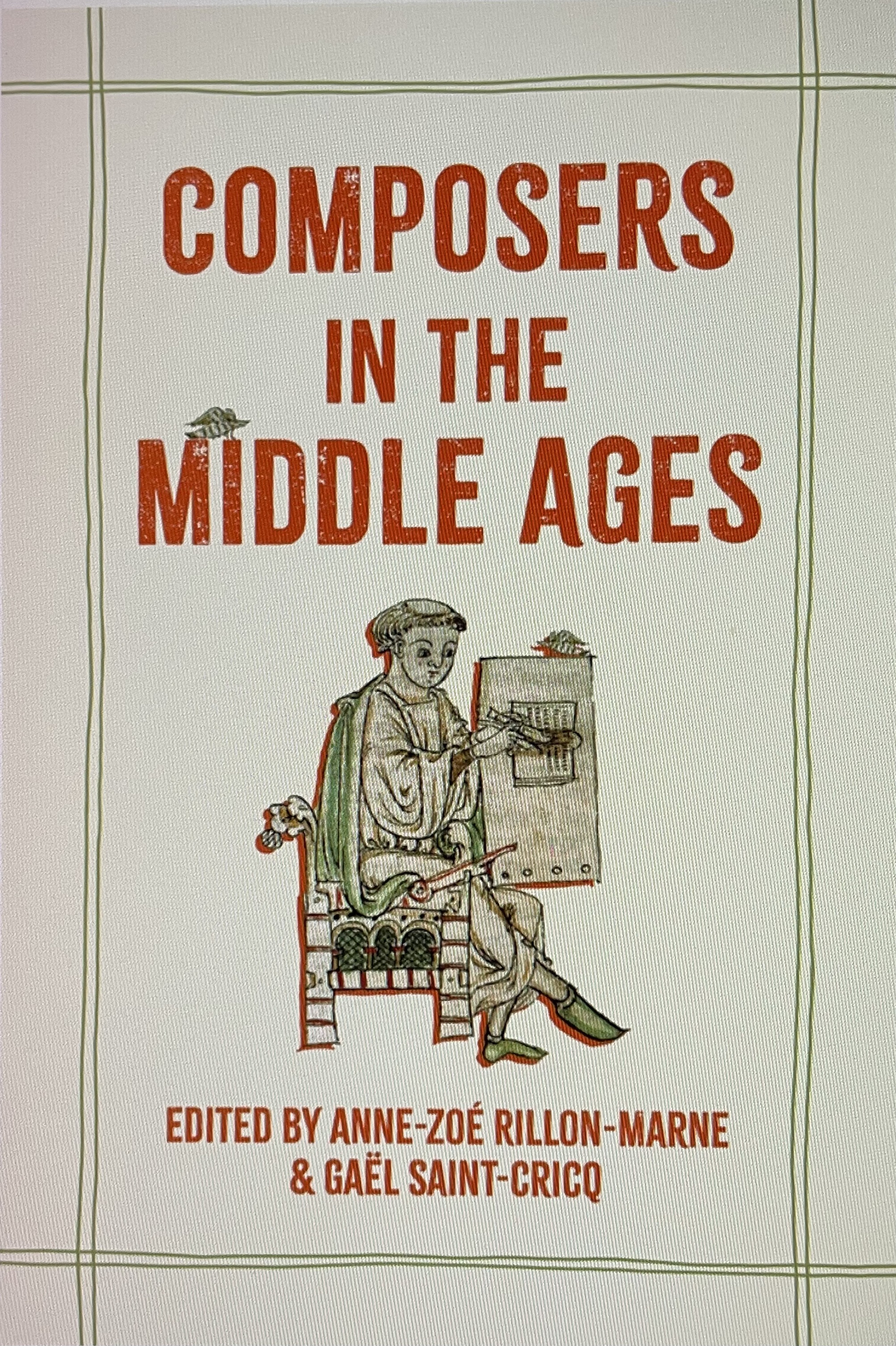
Identifying Composers. IndieBound observes, “The modern concept of the individual composer is central to accounts of Western music, and continues to represent a critical field of research in musicology. However, this approach cannot be straightforwardly transposed to the Middle Ages, as it does not reflect the complex creative realities of medieval composition, and conflicts with the evidence from extant sources and documentation.”
That is, we’re all familiar with “The Three B’s,” Bach, Beethoven, and Brahms. And maybe you share my favorite 20th-century Adams, Bernstein, and Copland. However, it’s only occasionally that I’ve identified composers of the Middle Ages: recently Herrad of Landsberg and her emerging polyphony. And it takes a bit more digging to come up with Hildegard von Bingen cited in “What is Classical Music?,” SimanaitisSays, June 25, 2025.

Collaborative Efforts. Phillips describes in his LRB review, “The creative milieu of the Middle Ages was collaborative, with poets also working as musicians and singers.… Mark Everist [one of the book’s contributors] lists the various competencies that might contribute to the creation of a musical work in this period as ‘writing poetry, creating monophonic music, creating polyphonic music, writing down music of all sorts, singing, writing down words, writing new words to old music and old words to new music, and assimilating pre-existing music and poetry to new contexts.”
A Timeline, Sorta. Phillips recounts an “… anonymous chant tradition ran roughly from the sixth century until the first named composers—Hildegard of Bingen, Peter Abelard and Héloïse d’Argenteuil—of the early 1100s. Then, during the later 12th century, a group of composers working in Paris, including Léonin and Pérotin (the only two whose names survive), wrote the first polyphony, a transcending moment in the history of Western music. They were followed by Philippe de Vitry and Guillaume de Machaut, whose music, in all its astonishing complexity, eventually fed into the early Renaissance.”
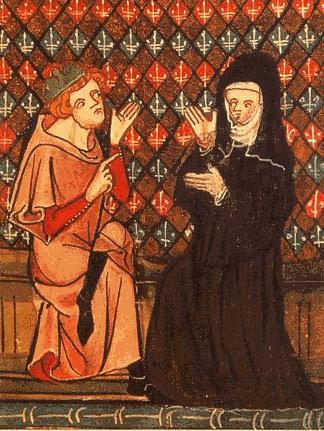
Peter Abelard, 1079–1142, French polymath, teacher (and lover) of his brilliant student and eventual wife, Héloïse d’Argenteuil. Image from a manuscript of the Roman de la Rose (14th century).
Abelard And Hildegarde (Not Heloise This Time). “Abelard was the most sought-after theologian and public debater of the 12th century,” Phillips relates. “Hildegard was content to be known as an abbess and a polymath, concerned not only with music but also with medicine, both as a writer and as a practitioner.”
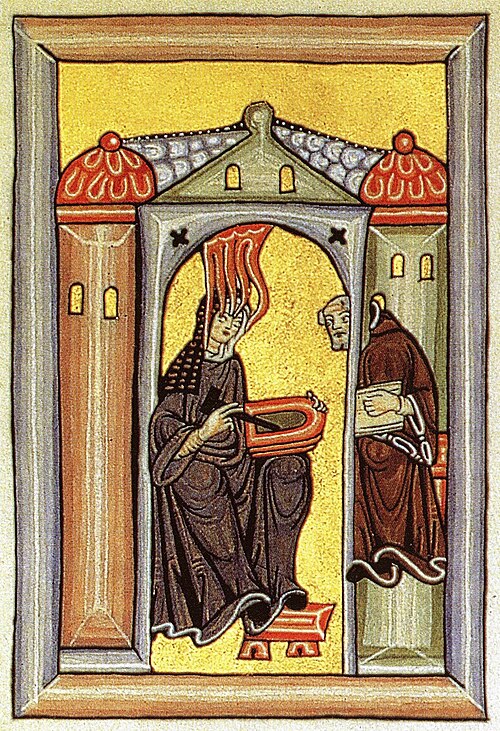
Hildegard of Bingen, c. 1098–1179, German Benedictine abbess and polymath. Image from Hildegard’s Scivias showing her receiving a vision and dictating to teacher Volmar.
“She was unusual,” Philips notes, “in openly acknowledging the existence of inspiration in her music, so bringing her part way towards the world of the 19th-century composer and qualifying medieval composers for entry into Scholes’s Companion [The Oxford Companion to Music, 10th Edition], though with the inconvenient proviso that she thought composition attributable only to God. In the opening of Scivias (1151), she writes: ‘I spoke and wrote these things not by the invention of my heart or that of any other person, but as by the secret mysteries of God I heard and received them in the heavenly places.’ Hildegard died at the age of 81, having written more music than any other identifiable writer of the time.”
On Acrostics. “It wasn’t until 1400,” Phillips describes, “that composers were regularly named in the sources. But this doesn’t mean there aren’t clues, not least in the music itself, as the tradition of introducing acrostics into texts to identify people—composers, lovers and wives, sponsoring monarchs and aristocrats—bears witness.”
An acrostic, by the way, is a literary device in which the first letters of each line (or paragraph) spell out a word or phrase. I close this essay today with one of my own.
Name That Composer, Sorta. Phillips continues, “A motet from 1373, ‘Ferre solet’, not only gives the name of the composer, encoded in the first letter of various lines in the poetry (‘johannes vavassoris’), but by the same process, elaborately concealed, we find the words ‘anno domini millesimo trecentesimo septuagesimo tercio fecit istum motetum’ (‘he made this motet in the year of our Lord 1373’).”
And Phillips notes, “The most elaborate acrostic of all, said to be the longest in Western literature, is contained in Boccaccio’s Amorosa visione (c.1342), which in its completed form consists of fifty canti of poetry in terza rima. The initial letters of each terza rima create three complete sonnets, the first of which ends: ‘giovanni e di boccaccio da certaldo’. It also refers to Boccaccio’s presumed lover, Maria d’Aquino, whose name is ciphered through an additional acrostic (the initial letters of the odd-numbered lines), creating an acrostic within an acrostic. There are plenty of names in this repertoire if you know where to look.”
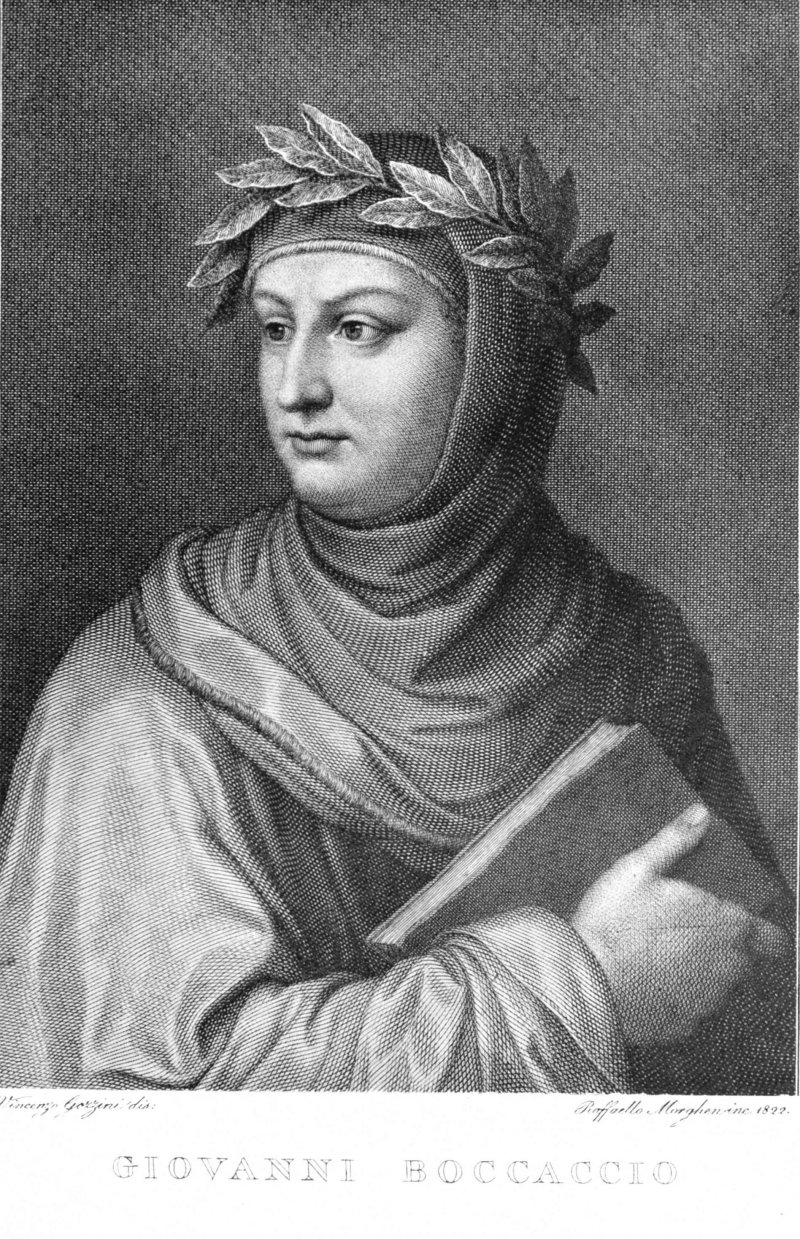
Giovanni Boccaccio, 1313-1375, Italian writer, poet, and apparent whiz at acrostics.
“This,” Phillips observes, “was a culture that delighted in codes, hidden patterns and mathematical complexity.”
My (Unused) Acrostic. In the waning days of R&T’s “brand move” away from Newport Beach, I thought about initiating my last “Tech Tidbits” column with words forming a left-hand column read vertically as “Rosebud” (the significance of which is described in “Media Shoes Squirm—Again.”). I deferred from employing this cheap shot. ds
© Dennis Simanaitis, SimanaitisSays.com, 2026.


Regrarding your Reference to ‘Rosebud’: I got it, but had to look it up in your previous piece anyway – and (re?)learned what it was really about. All I remembered of the movie was dropping of the crystal with the rose in it.
The unintended-acceleration part of the previous piece was interesting too. At one point, somebody made a similar claim about Toyotas, especially the Prius for some reason. Toyota did a recall to check and upgrade the latches securing the driver’s floor mat, to prevent it from sliding and jamming the accelerator. However, the Prius (I still have one) also cuts the power if you apply the brake, and in any case has nowhere near enough power to overwhelm even a tentatively applied brake. Oh, and it *is* possible in Toyota hybrids to shift into neutral while in motion (was it only those of us raised on stick shifts who think of things like that?). The Toyota recall was probably based on a settlement to avoid a trial. I admire Audi for sticking to its guns, but from a business standpoint their decision sucked.
My source for this is Barbara Leaming’s book, Orson Welles: A Biography.–ds