
Simanaitis Says
On cars, old, new and future; science & technology; vintage airplanes, computer flight simulation of them; Sherlockiana; our English language; travel; and other stuff
HEARING OURSELVES IN OPERA PART 1
THIS TOPIC PARAPHRASES THE CONCLUDING CHAPTER TITLE of Simon Banks’ book Opera: The Autobiography of the Western World.

Opera: The Autobiography of the Western World, by Simon Banks, Troubador Publishing, 2022.
In “Hearing Ourselves in History (1945-2000),” Simon Banks recounts, “In the 18th century, opera staged the lives of major figures from the ancient world in a positive and affirmative way. After 1805, opera staged the lives of figures from recent European history in a negative and polemical way. In the later 19th century, opera focussed on the plight of marginalised people. Faced with the escalating violence of the 20th century, opera composers retreated into their own private worlds.”
“But the external world had kept on going,” he writes. “The dilemmas of Boris Godunov and King Philip II seemed irrelevant in the face of nuclear weapons, polarising ideological and military conflicts between capitalism and communism, and escalating international terrorism emanating from the Middle East.”
Banks discusses three operas of John Adams, Nixon in China, 1987; The Death of Klinghoffer, 1991; and Doctor Atomic, 2005. Here in Parts 1 and 2 today and tomorrow are tidbits, accompanied by personal observations.
History, Live on TV. “Meeting the Chinese Prime Minister on the tarmac at Beijing Airport,” Banks writes, “Richard Nixon in Nixon in China is thrilled that their handshake is being watched around the world.” Adams has him sing, “Though we spoke quietly the eyes and ears of history/ Caught every gesture and every word, transforming us as we transfixed/ Made history.”

Chou Enlai greets Richard and Pat Nixon upon arrival in Beijing on February 21, 1972. The U.S. entourage had previously landed in Shanghai earlier that day. This and following image from Opera: The Autobiography of the Western World.
My Recollections. I was fascinated by the Metropolitan Opera’s HD Theater presentation of Nixon in China. I recall an aged but still capable Mao and his trio of young-lady care givers, one of whom attends to the Chairman’s special needs, another ends up sleeping with Kissinger.
And there’s The Red Detachment of Women revolutionary ballet devised by Mao’s wife, Chiang Ch’ing. In its “Whip! Whip! Whip!” dance, a crude lookalike of Kissinger does the whipping. And in the final Act, each of the ensemble shares inner thoughts, with Chou asking whether anything they did was good.
Our post-Watergate thoughts on Nixon only sharpen this.
“When Does a Crime Becomes History?” Banks describes, “In the final part of Wagner’s Ring Cycle, which originally had the title Siegfrieds Tod (‘Siegfried’s death’), the hero is a man who has recently set out to see more of the world. Without warning he is murdered, unexpectedly caught up in a bitter conflict of entrenched hatred stretching back generations.”
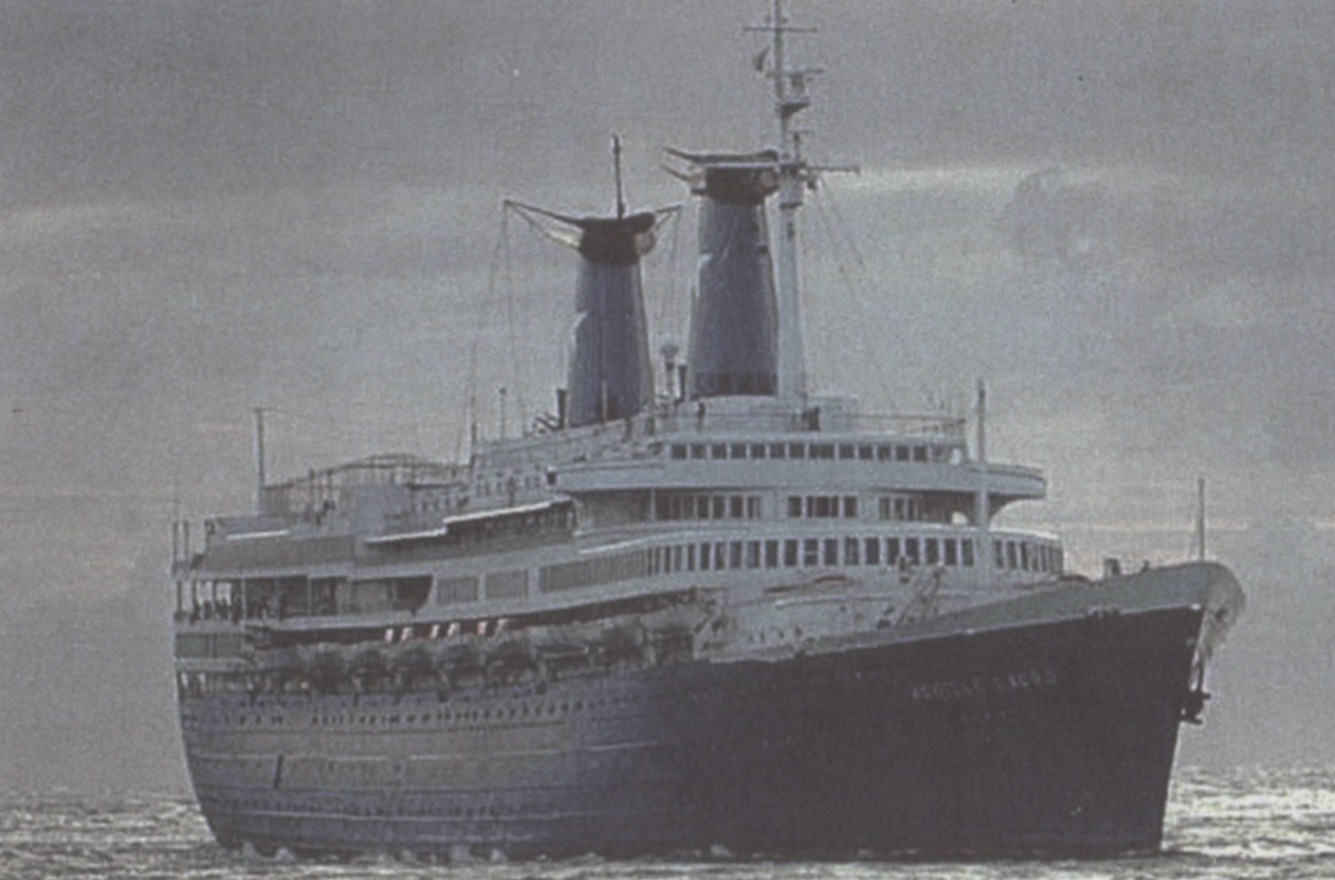
The cruise ship Achille Lauro, setting for John Adam’s opera The Death of Klinghoffer.
“In 1985,” Banks continues, “the disabled Jewish-American Leon Klinghoffer was holidaying on the cruise ship Achille Lauro in the eastern Mediterranean. With almost no warning he was murdered, expectedly caught up in a bitter conflict of entrenched hatred stretching back generations.”
A Palestinian Point. Banks expands on this: “Hagen, Siegfried’s murderer, is an embittered inheritor of old enmities who, alone in stage in Act 1, broods darkly on revenge. In Act 1 of The Death of Klinghoffer the Palestinians brood on the historic injustices that fuel their hatred of Israel: ‘My father’s house was razed in 1948 when the Israelis passed over our street.”
“Like many operas,” Banks says, “the plot involved a crime: but here, the crime was a very recent one. Emotions were still raw, and the search for justice was still ongoing.”
Banks observes, “Nobody complained when Wagner gave voice to Hagen’s grievances, but many were outraged when Adams gave voice to Palestinian terrorists at the opening of The Death of Klinghoffer.”
Tomorrow in Part 2, I dip my oar in these troubled Mediterranean waters, touch on nuclear destruction, and even recount a recent trip back into the Rhine. ds
© Dennis Simanaitis, SimanaitisSays.com, 2025
 Simanaitis Says