
Simanaitis Says
On cars, old, new and future; science & technology; vintage airplanes, computer flight simulation of them; Sherlockiana; our English language; travel; and other stuff
FROM MOTHER EARTH TO YOUR CAR’S TANK; SLEUTHING ADDED PART 1
IT’S QUITE THE COMPLEX TRIP from Mother Earth’s petroleum resources to the fuel tank of your car, the diesel truck delivering your goods, or the airliner transporting you one place or another. And, by definition, fuel prices rocket upward and come down through molasses, these days seemingly at the erratic whims of Trump and his warrior mates.
Excellent insights are gained from Molly Boigon’s “Fluctuating Fuel Costs: How Refiners, Retailers, and Regulators Set the Price at the Pump,” Automotive News, April 8, 2026. Here, in Parts 1 and 2 today and tomorrow, are tidbits gleaned from this article, together with my usual Internet sleuthing. Indeed, this time around my sleuthing raises some differences of opinion, sorta.

Crude Origins. “Over millions of years,” Boigon describes, “ancient organisms died and mixed with sediment. The buried organisms were compressed under significant pressure and underwent a chemical transformation that rearranged molecules into a solid substance. That solid substance was buried even deeper by successive layers of sediment and was exposed to the Earth’s internal heat, breaking it down into liquid hydrocarbons. Another physical process brought that liquid, crude oil, into oil reservoirs below rock.”
Boigon continues, “Oil companies extract the oil from those reservoirs for further refinement into different products, including gasoline. The primary ingredient in crude oil is microscopic marine organisms that captured sunlight via photosynthesis.”
A good point, Molly: That is, contrary to the “Dinosaurs died for us” adage, it’s more like algae having done so.
Supply and Demand. Boigon cites Stanford University’s Maksim Sonin: “There are two main components that drive global oil prices. The first is a fundamental supply and demand balance: How much oil are institutions producing, and how much oil are people consuming?”
She continues, “The U.S. and OPEC are two significant influences because they produce the bulk of the world’s oil supply. Geopolitical events and weather can also impact the global supply.”

A Pause for Some Sleuthing. Wikipedia lists countries by their proven oil reserves. It’s generally conceded that, assessed in 2021 per the U.S. Energy Information Administration, Venezuela’s 303.6 billion barrels puts it first; Saudi Arabia’s 261.6 bb, second; Canada’s 168.1 bb, third. The U.S.’s 60.5 bb ranks beneath Iran (208.6 bb), Iraq (145.0 bb), and others.
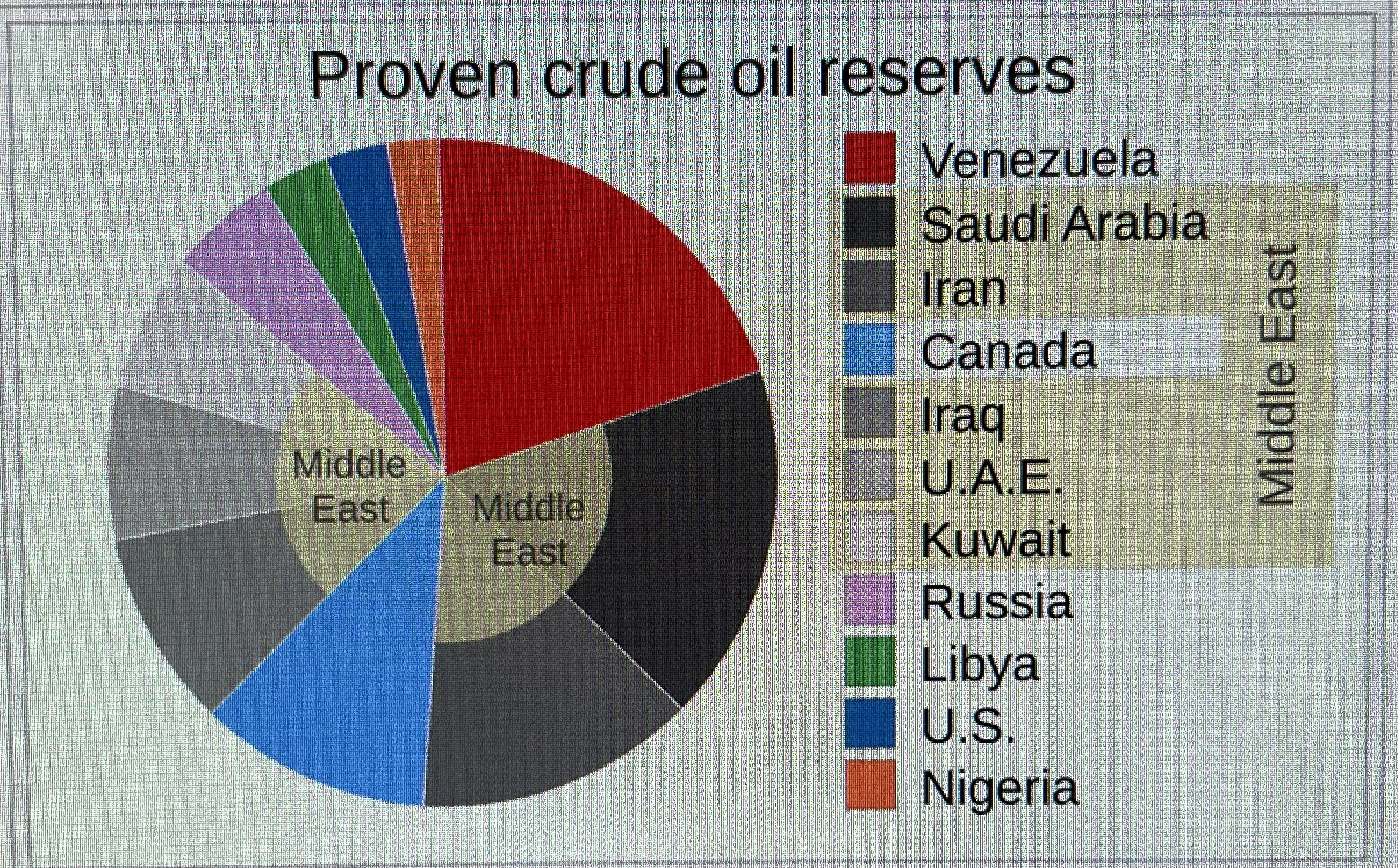
Image by RCraig09 from Wikipedia.
Wikipedia notes, “Some statistics on this page are disputed and controversial—different sources (like OPEC, CIA World Factbook and oil companies) give different figures. Some of the differences reflect the different types of oil included. Different estimates may or may not include oil shale, mined oil sands, or natural gas liquids.”

U.S. Imports. And whilst we’re sleuthing, let’s identify U.S. petroleum imports and whence they come. The best source for this is the U.S. E.I.A. The following are collected from 2025 data; a full list includes the 12 Organization of Petroleum Exporting Countries (OPEC) plus an amazing 125 other entities. (Among the latter, Kinshasa, Congo: 1,689 thousand barrels; U.S. Virgin Islands: 910 thousand barrels; Lithuania: 2,487 thousand barrels.) Here’s the top of the list.
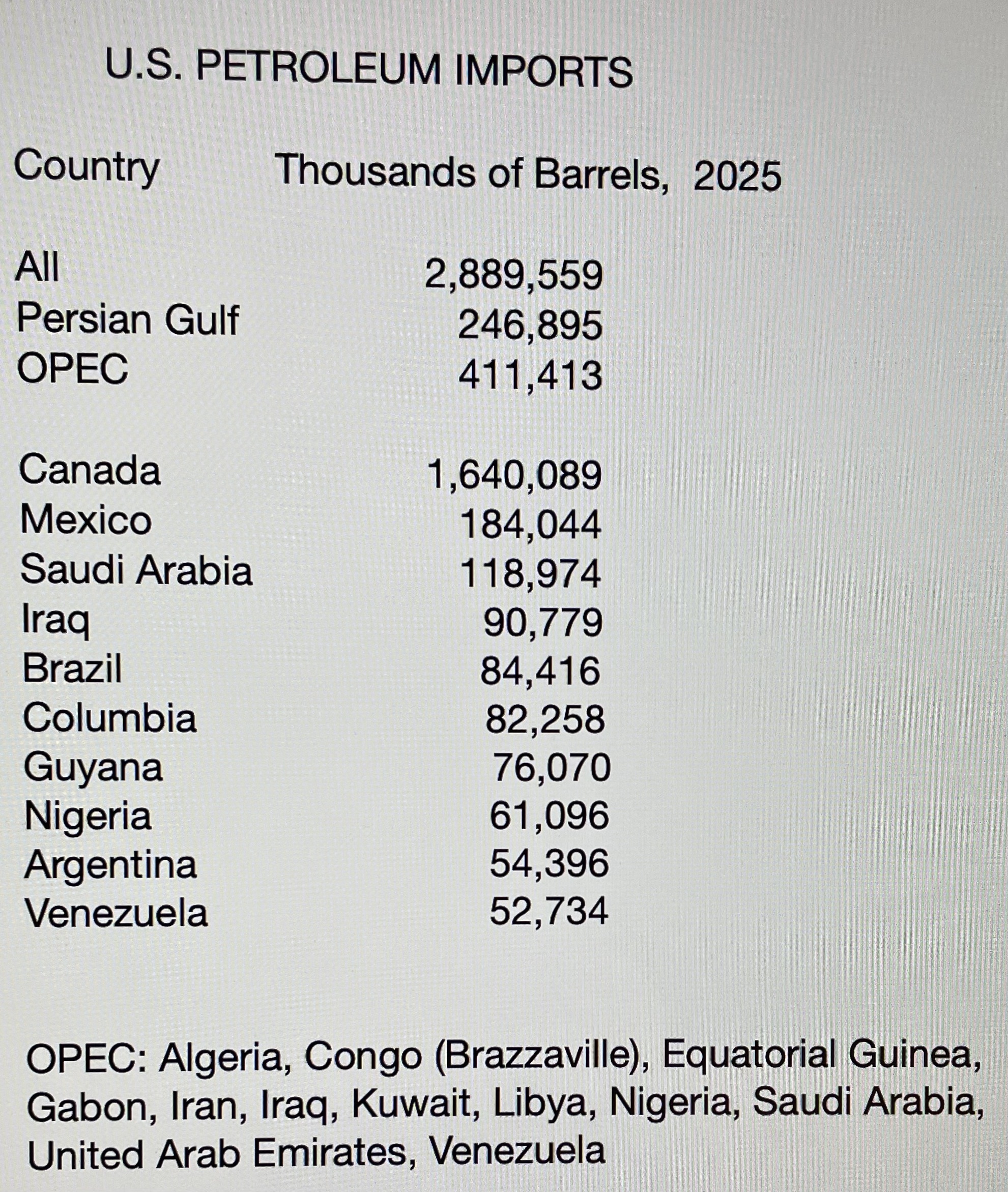
Source: U.S. Energy Information Administration.
Tidbits A’Plenty. Topping the list are what used to be our friendly neighbors (until Trump came along): Canada, at 56.8 percent of our imports, and Mexico, at 6.4 percent.
With the exception of third-place Saudi Arabia (4.1 percent), the rest of the top 10 are all little eggs in a particularly mixed basket, each 3 percent or considerably less. Note, the Maduro kidnapping may have been influenced by a crucial 1.8 percent of our total petroleum imports.
Even the dreaded Persian Gulf these days accounts for only 8.5 percent; all of OPEC, 14.2 percent.
Back to Boigon: Jogging the Market. “The second factor,” Boigon notes, “is excitement in the markets, what Sonin likened to adrenaline. ‘That’s how markets perceive all of these disruption risks [and] geopolitical risks,’ he said.”
Boigon observes, “This is part of the reason oil prices increased so quickly and significantly in the immediate aftermath of the Strait of Hormuz closure. The fact that oil is traded on a global market also means that even exporters face price impacts.”
Tomorrow in Part 2, we’ll continue Boigon’s analyses—as well as my sleuthing fun. ds
© Dennis Simanaitis, SimanaitisSays.com, 2026


Canada’s proven reserves of 167 billion barrels would put us in 4th place, behind Iran, as shown on the pie chart. The 167 number is for oil sands, with another 4-5 billion barrels of conventional lighter reserves, bringing us to about 171 billion barrels.
The total estimated reserves are estimated to be between 1.8 to 2 trillion barrels. Most of this is determined to not currently be economically recoverable with current known methods, but with advanced recovery techniques, such as SAGD or CSS which use steam injection to reduce the viscosity of the bitumen allowing pumping, estimated recoverable reserves are over 300 billion barrels. While there are benefits to steam injection over mining, there are environmental concerns with this technique, such as the volume (and source) of water used.
Thank you, both!
Meanwhile, looking down the road, might we take hope in:
Price will surely decline as market expands.