
Simanaitis Says
On cars, old, new and future; science & technology; vintage airplanes, computer flight simulation of them; Sherlockiana; our English language; travel; and other stuff
RAFFLES—A SINGAPORE HOTEL, A HOLMES INVERSION PART 2
YESTERDAY, OUR FIRST RAFFLES TIDBITS were about a fabled Singapore hotel. Today we focus on A.J. Raffles, a sorta fictional anti-Holmes—but, indeed, with an intimate connection: E.W. Hornung, author of the A.J. Raffles tales, was the brother-in-law of Sir Arthur Conan Doyle.
A Note on Holmes’ Literary Agent. Regular readers of SimanaitisSays will grant my Sherlockian penchant of identifying Doyle as Dr. John H. Watson’s literary agent. See “Conan Doyle’s Other Client: Brigadier Gerard,” April 26, 2020; and “Conan Doyle (Literary Agent)—Motoring Enthusiast,” October 15, 2020. You’re welcomed to continue along with this eccentric view.
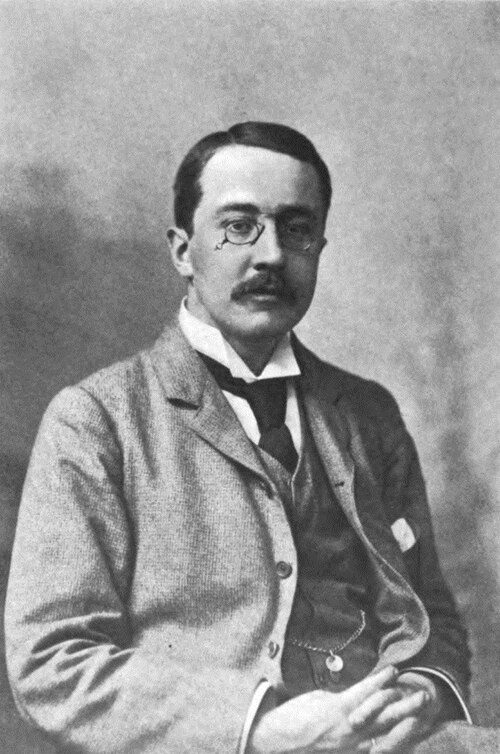
Ernest William Hornung, 1866–1921, English author and poet known for writing the A. J. Raffles series of stories about a gentleman thief in late 19th-century London. Image by Elliot & Fry from Wikipedia.
The Hornung/Doyle Romance. Completely legit—on a visit to Portugal E.W. Hornung met Doyle’s sister, Constance Aimée Monica. “Connie,” as she was known, was described as “being attractive with pre-Raphaelite looks…”
Wikipedia continues, “By December 1892, when Hornung, Doyle and [Jerome K.] Jerome visited the Black Museum at Scotland Yard, Hornung and Connie were engaged, and in 1893 Hornung dedicated his second novel, Tiny Luttrell, ‘to C.A.M.D.’ ”
E.W. and Connie were married on 27 September 1893. Wikipedia continues, “The Hornungs had a son, Arthur Oscar, in 1895; while his first name was from Doyle, who was also Arthur’s godfather, the boy’s middle name was probably after Doyle and Hornung’s mutual friend Oscar Wilde….”
A Brief Joint Playwriting Career. Wikipedia recounts, “In 1894 Doyle and Hornung began work on a play for Henry Irving, on the subject of boxing during the Regency; Doyle was initially eager and paid Hornung £50 as a down payment before he withdrew after the first act had been written: the work was never completed.”
A.J. Raffles Appears. In 1898, Hornung introduced A.J. Raffles to Cassell’s Magazine‘s readers. By then, Holmes and Watson were already well known from 1887’s A Study in Scarlet followed by tales in The Strand Magazine beginning with “A Scandal in Bohemia” in 1891. Wikipedia cites, “It has been suggested that Raffles’s name may have been inspired by the title of Doyle’s 1891 novel The Doings of Raffles Haw.”
Raffles and Harry “Bunny” Manders. Wikipedia cites “Raffles and his partner-in-crime (and former school fag) Bunny Manders being the criminal counterparts to Holmes and Dr. Watson—although Rowland [in the Oxford Dictionary of National Biography] writes that Raffles and Manders ‘were also fictionalized versions of Wilde and Bosie’ (Wilde’s lover, Lord Alfred Douglas) and he dedicated the stories to his brother-in-law: ‘To A.C.D. This form of flattery.’ ”
Doyle apparently had mixed feelings. Wikipedia quotes him: “There are few finer examples of short-story writing in our language than these, though I confess I think they are rather dangerous in their suggestion. I told him so before he put pen to paper, and the result has, I fear, borne me out. You must not make the criminal the hero.”
A literary agent knows best, eh?
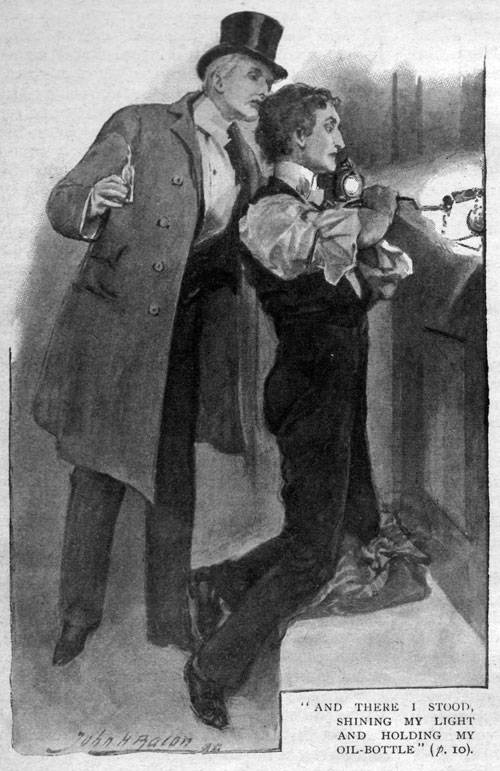
Raffles (right) lock-picking with Bunny’s assistance. Illustration by John H. Bacon (1898) from Wikipedia.
Raffles’ M.O. Wikipedia observes, “Raffles is, in many ways, an inversion of Holmes—he is a ‘gentleman thief,’ living at the Albany, a prestigious address in London, also rents an art studio as his own fence after jobs, playing cricket as a gentleman (or ‘amateur’) for the Gentlemen of England and supporting himself by carrying out ingenious burglaries. He is called the ‘Amateur Cracksman’ and often, at first, differentiates between him and the ‘professors’—professional criminals from the lower classes.”
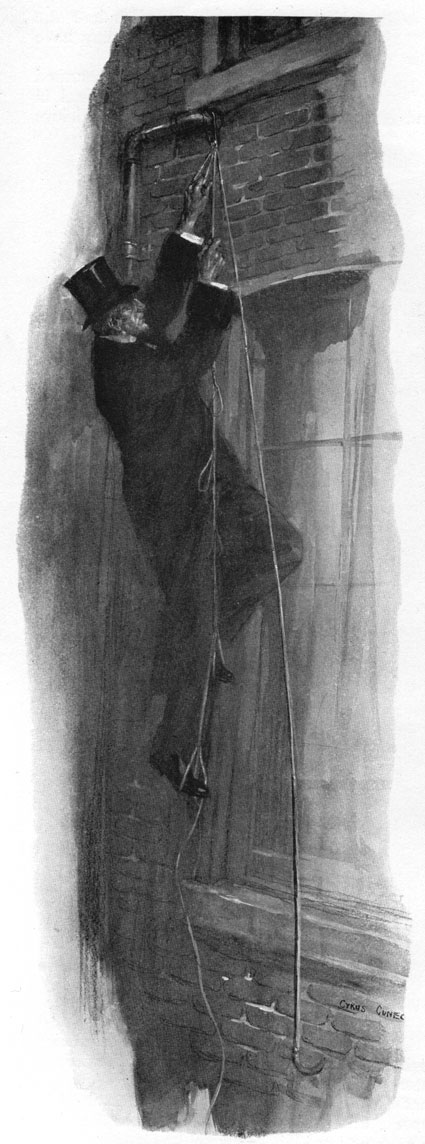
Raffles and his rope ladder. Illustration by Cyrus Cuneo (1905) from Wikipedia.
Wikipedia observes, “Raffles is adept at using burglary tools such as hand drills and skeleton keys. He also uses more unusual tools of his own invention, including a rope-ladder which can be concealed under his waistcoat and hooked up with a telescopic walking-stick, and a small velvet bag designed to silence the sound of filing a skeleton key.”
Raffles’ Ethics, Sorta. Wikipedia recounts, “Raffles is cynical about society, and is aware that his social position depends upon his status as a cricketer. At one point, he comments ‘we can’t all be moralists, and the distribution of wealth is all wrong anyway.’ He does have scruples, despite his profession—he will not steal from his host, and will not kill to accomplish a burglary…. He tells Bunny that he would settle down permanently if he could just make a big enough haul. He is also very patriotic.”
Admirable Behavior in Being a Fence. Wikipedia relates, “In a late story, he steals a gold cup from the British Museum on impulse: when challenged by Bunny as to how he will dispose of it, he posts it to the Queen as a Diamond Jubilee present. In ‘The Field of Philippi’, he steals money from a tight-fisted Old Boy and donates it all to their former school, partly to spite the man. His last crime, committed just before he goes off to the Boer War, is to steal a collection of memorabilia of his crimes from New Scotland Yard‘s Black Museum.”
Raffles’ Death(s)…. Like his anti-anti-hero Holmes, Raffles has a hiatus: In “The Gift of the Emperor,” Raffles and Bunny are cornered on an ocean liner. Raffles jumps overboard; Bunny gets eighteen months’ stir. This time around, Raffles survives to a hiatus in Italy and later returns to England to continue his career in disguise.
“In December 1899,” Wikipedia recounts, “Raffles and Bunny become interested in the Boer War…. In 1900, they decide to volunteer for service in the war, leaving England in February and enlisting in South Africa. Six months after first taking an interest in the war, Raffles is killed in battle. Bunny, wounded in battle, eventually returns to England and writes about his adventures with Raffles.”
Maybe having Doyle serve as his literary agent?
But “Killed in Battle”? Or, just as Holmes supposedly perished at Reichenbach Fall, and Raffles overboard…. ds
© Dennis Simanaitis, SimanaitisSays.com, 2026

