
Simanaitis Says
On cars, old, new and future; science & technology; vintage airplanes, computer flight simulation of them; Sherlockiana; our English language; travel; and other stuff
STORING STUFF FOR MILLENNIA
HITTING THE “SAVE” BUTTON instills perhaps misplaced confidence. True, the stuff continues to exist somewhere or other. But can it be easily retrieved? And for how long?
Robert F. Service addresses this in “This Glass Wafer Could Back Up Your Phone—And Last 10,000 Years,” AAAS Science, February 18, 2026. I mean, how many cat pictures do I really need?
Service recounts, “Demand for long-term data storage is exploding, whether it’s for cellphone pictures or data from giant telescopes or atom smashers. Worldwide, total installed data storage is expected to grow 10-fold by 2040, to more than 250 zettabytes, or 250 billion TB.”
I pause here to ponder that my iMac27 has a 1TB disk.
“Yet,” Service continues, “the dominant archive technologies are relatively short-lived and fragile. Magnetic tapes and hard disk drives typically decay within a decade. To keep data from being lost to time, they must be regularly overwritten or migrated to fresh archives, an expensive and time-consuming process.”
Indeed, to some extent SimanaitisSays has touched on this quandary: “The Very Large and the Very Small,” March 8, 2019; and “Can You Read Me a Floppy, Grandpa?,” May 21, 2021.
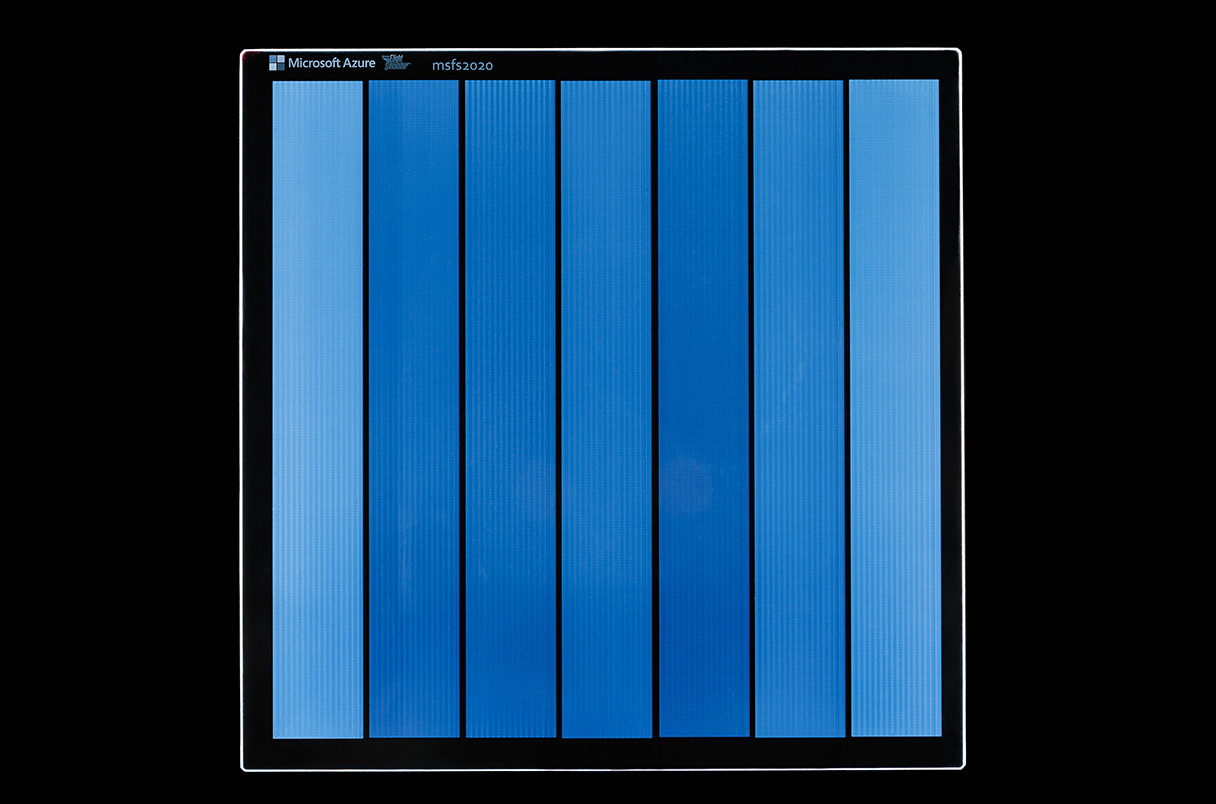
Sci-Fi Had It First. “Science fiction definitely saw this one coming,” recounts Service. “Writers for the Superman, Star Trek, and Mission Impossible franchises all dreamed up the idea of storing libraries of data in glass. Now, Microsoft researchers say they are bringing this vision closer to reality by storing nearly 2 terabytes (TB) of data—enough for hundreds of thousands of photos or hundreds of hours of video—in coaster-size plates of glass.” The new approach, described today in Nature, could archive data for thousands of years, simply and cheaply.
Laser Writing on Glass. The Microsoft Research Project Silica Team’s Abstract of “Laser Writing in Glass for Dense, Fast and Efficient Archival Data Storage,” Nature, February 18, 2026, describes “Long-term preservation of digital information is vital for safeguarding the knowledge of humanity for future generations. Existing archival storage solutions, such as magnetic tapes and hard disk drives, suffer from limited media lifespans that render them unsuitable for long-term data retention. Optical storage approaches, particularly laser writing in robust media such as glass, have emerged as promising alternatives with the potential for increased longevity.”

“Moreover,” researchers report, “we extend the storage ability to borosilicate glass, offering a lower-cost medium and reduced writing and reading complexity. Accelerated ageing tests on written voxels in borosilicate suggest data lifetimes exceeding 10,000 years.”
By the way, a “voxel” is a three-dimensional pixel.
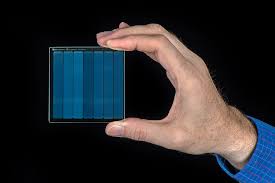
Service notes, “Glass… is cheap and abundant, and once data are stored, no energy is needed to preserve them. Perhaps most important, you can scratch, boil, or bake glass and the data remain intact. ‘It can survive benign neglect,’ says Richard Black, who heads Microsoft Research’s glass data storage effort, called Project Silica.”
We flight simmers are wont to say, “It’s not a game! It’s a simulation.” Harrumph.
Writing the Data. Service describes, “To write data, the researchers raster a laser back and forth across the glass, firing a train of pulses. As each pulse is absorbed, it creates an index change in a region about 100 nanometers on a side and 2 micrometers deep. By changing the laser’s depth of focus, the setup can write data in hundreds of layers. And by splitting each laser into four beams, the researchers could write data at some 66 megabytes per second. That’s still only about one-sixth of the speed of writing to magnetic tape. But Black says they could close that gap by upping the number of beams writing in parallel to 16.”
Reading It Out. “To read out the data,” Service describes, “the researchers shine light through the glass and use a single optical microscope camera to record the pattern in each data layer. An algorithm filters out interference between nearby spots and converts the images back to data. ‘The setup’s simplicity makes the writing easier and lower cost,’ Black says.”
Project Silica video from YouTube.
Fully Automated Data Archiving. Service recounts, “Project Silica engineers have already roboticized the lasers and microscope, creating a fully automated data archiving system. They have shown they can store movies from Warner Brothers, and they have archived music in a vault on Norway’s Svalbard archipelago. But Black says his team is wrapping up its efforts, and Microsoft has not announced any plans to commercialize the technology.”
Service concludes, “Still, [University of Southhampton optoelectronics expert Peter] Kazansky thinks glass storage will eventually shine. Tests show fused silica glass should be stable for billions of years, he notes. Borosilicate glass will last a mere 10,000 years, but ‘that’s good enough,’ he says. ‘If you want to send messages to the future, there is nothing better than storing them in glass.’ ”
I wonder if I could find my writeup of Gore Vidal’s Palimpsest? ds
© Dennis Simanaitis, SimanaitisSays.com, 2026
 Simanaitis Says
I find myself wondering about whether digital storage, in glass or otherwise, is ever going to be truly archival. You can store it, but can you read it even a decade from now? How many floppy or zip drives are still around? Even if you had a mag tape still physically readable from an old mainframe, is the machinery and coding still around to make it possible? Same thing is happening with other optical (laserdisk? CD? even BluRay in some formats?) even if they’re physically durable (some data CDs were supposed to last 100 or more years). You need not only the drives but the coding to do the job. Analog, otoh, is much less dense, but can be read if you have the machining skills and tools to create, say, a turntable and cartridge, or the chemicals, lenses, and paper to print a negative (from microfilm for instance). And of course the language skills, because language changes with the ages too, but that can be passed on through learning and legends.
Anyway, interesting news. Getting closer to those data cubes in Star Wars…