
Simanaitis Says
On cars, old, new and future; science & technology; vintage airplanes, computer flight simulation of them; Sherlockiana; our English language; travel; and other stuff
RESIDING IN THE THIRTIES, SORTA PART 1
THANKS TO TURNER CLASSIC MOVIES, part of me seems to reside in the 1930s. Recently, I’ve enjoyed Dinner at Eight, 1933; Transatlantic Tunnel; 1935, and Broadway Melody of 1936, 1935. Quite a variety and, what’s more, all this has spilled over into my interest in interior design of that era. Or at least the imaginary interior design as displayed in its movies.
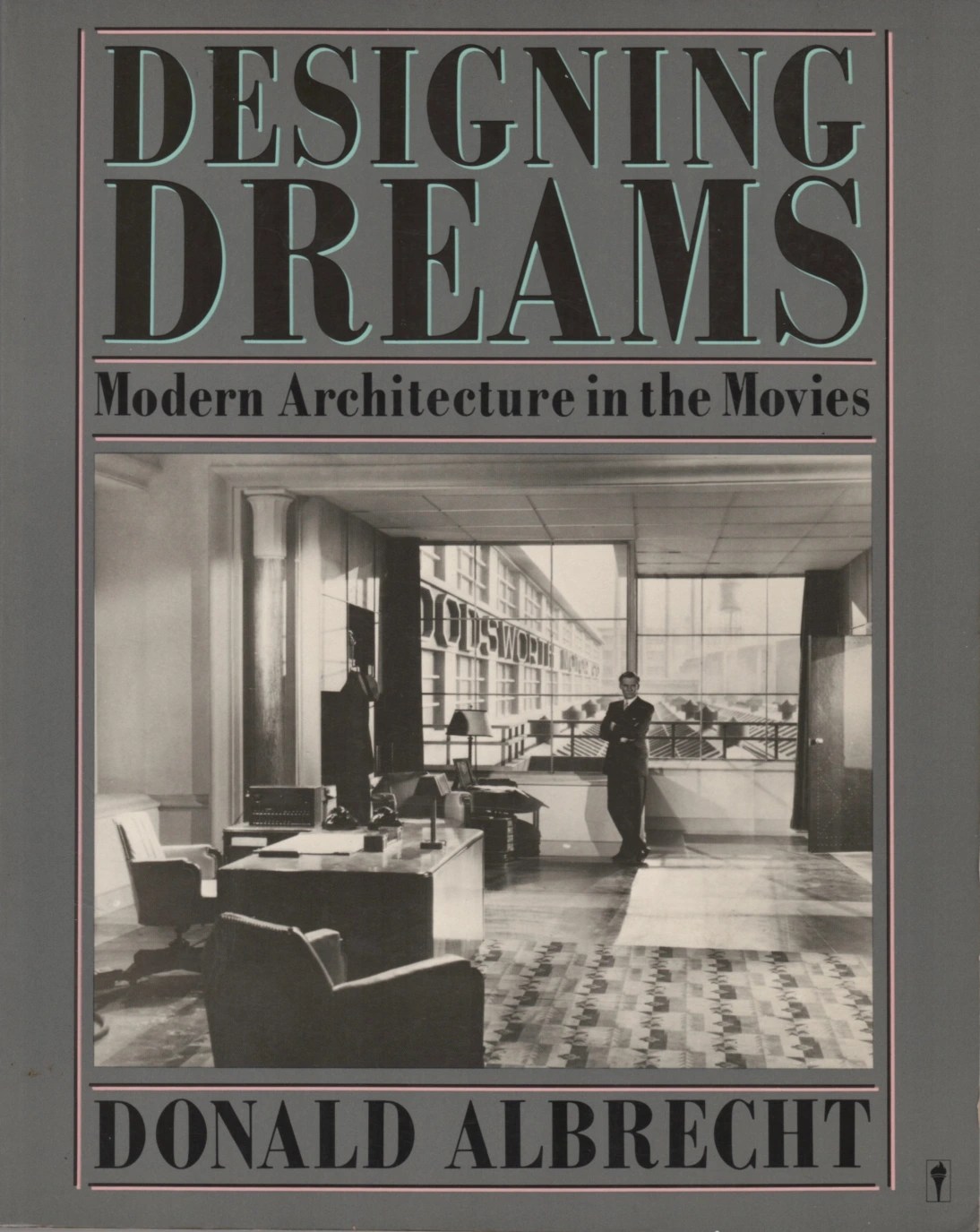
Designing Dream: Modern Architecture in the Movies, by Donald Albrecht, Perennial Library/Harper & Row, 1986.
I’ve visited this fine source before in “Deco Flicks.” Today and tomorrow in Parts 1 and 2, let’s see what author Donald Albrecht has to say about Thirties design as viewed in its movies.
Moviegoers’ Dreams. Albrecht writes, “Moviemakers, by contrast, created a utopia of wealthy nonconformists. Instead of workers’ housing, many popular films depicted deluxe villas and rooftop apartments; instead of factories, they featured executive offices for capitalist captains of industry; instead of sports clubs, sparkling nightclubs.”
No surprise, were we actually residing in the Depression, we’d much rather invest our movie time in such venues rather than in anything resembling cinema verité. (In fact, what with the depression of November 5, 2024, I for one feel the same way today.)
Film, Gloria Swanson, and Paul Nelson. Albrecht writes, “A typical feature produced during the Depression, the 1930 Hollywood film What a Widow! … offers a paradigm for the story of modern architecture in the movies, and as such introduces some of the major themes of this book.”

Albrecht recounts how architect Paul Nelson’s zeal for modern design prompted Gloria Swanson’s enthusiasm: “… Without the efforts of the remarkable Swanson, Nelson’s designs might never have reached the American screen.”
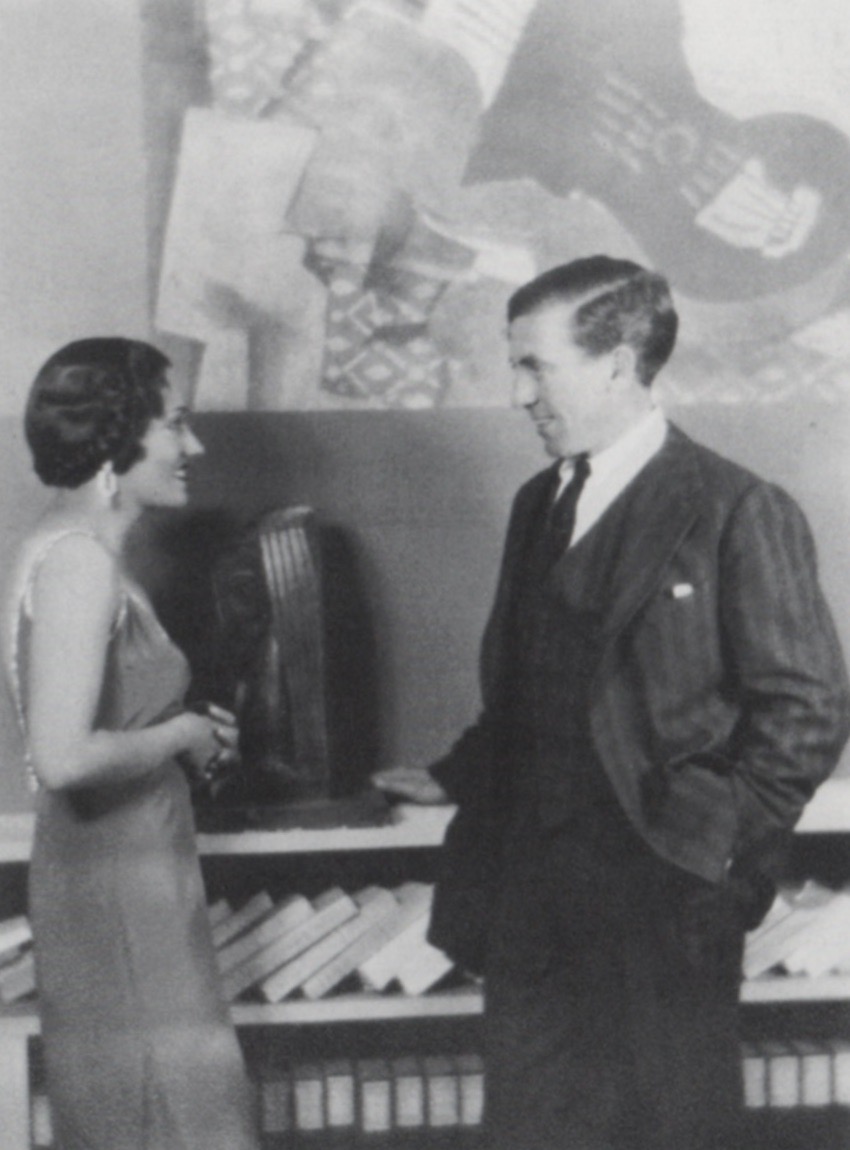
Gloria Swanson and Paul Nelson on the set of What a Widow! in the Pathé studios, Los Angeles, c. 1929. This and the following images from Designing Dreams.
Albrecht describes how Nelson, schooled at the Paris Ecole des Beaux-Arts, “rejected his conservative training and advocated instead the architectural modernism of Le Corbusier, a leader of the vanguard, whose talent flowered in the 1920s.”
Nelson and Le Corbusier. “Nelson’s stylistic experiments during his nine months of work on What a Widow! were largely guided by Le Corbusier’s ‘five points of architecture [pillars, roof garden, open floor plan, long windows, and open facades]…. “In Nelson’s own design,” Albrecht observes, “Le Corbusier’s influence is especially noticeable in the open living space of Tam’s Parisian villa, which is shaped by freestanding curvilinear walls and further defined by groupings of metal tubular furniture.”
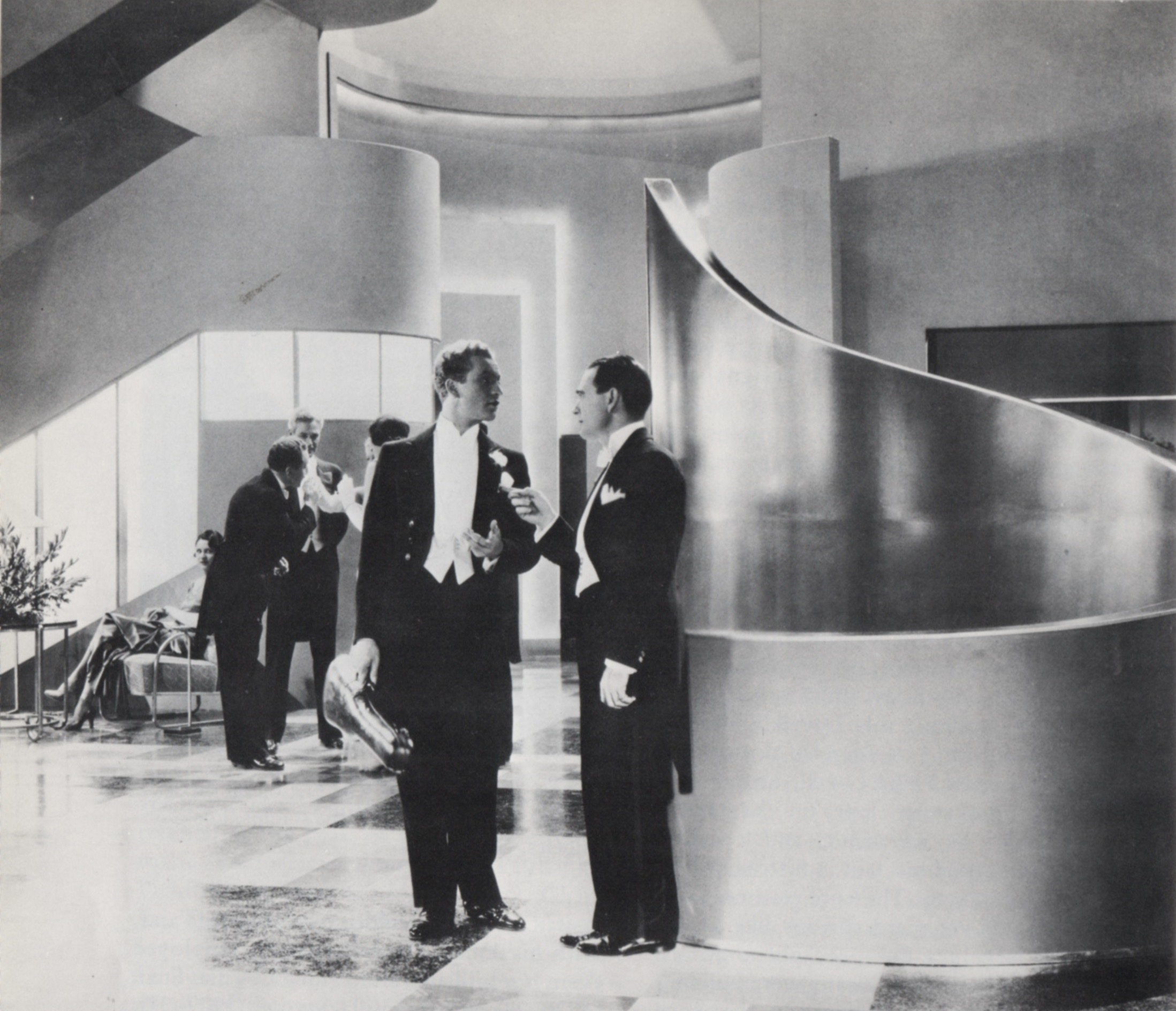
Albrecht continues, “The use of open, flowing space in the sets for What a Widow! illustrates one of modern architecture’s most significant contributions to film—namely, the vivid rendering of three-dimensional space on the flat, two-dimensional movie screen.”


“What a Widow!,” Albrecht summarizes, “marked the onset of a great decade of outstanding set design.”
Tomorrow in Part 2, Albrecht comments on several of my recent TCM viewings. ds
© Dennis Simanaitis, SimanaitisSays.com, 2024
 Simanaitis Says
With an author’s name like that, the book must be fantastic! 😉
Indeed ~ I have always loved Art Deco and thought the sets in that era’s movies to be exquisite .
I can’t relax in a modern house, my home is a 1923 Bungalow and I love it .
-Nate
I love the art-deco look, and the inner-Sunset and other older “suburbs” in SF and LA have a lot of houses in that style. Even when basically ordinary, they have a more welcoming feeling that typical ticky-tacky of the later ’50s and ’60s. Though I also like the Eichler look, which is not art-deco at all. Great selection of movies!
Another set of shows that uses art-deco dramatically is the Poirot series on PBS and Britbox.
As for alternate sources for old movies: TCM has an online presence, but like ESPN it isn’t really available unless you have a cable subscription. Might want to investigate some of the cable-substitutes like Sling. And there are still OTA old-movie channels though they mostly show B-movies and bloodbaths.
Does What A Widow survive? I’ve been trying to find it for several years, with no luck. I understand it was screened at MOMA in the early 70s, which suggests a viewable print likely still survives, somewhere. Thanks for any suggestions!
Wikipedia lists resources, but it doesn’t specify access.
Yes, Wikipedia describes several resources, the most promising being the Eastman Museum. According to them, they have only a small fragment of the film:
A safety sound negative which is also 350ft and is likely the same excerpt as the composite negative and was also printed in 1950.
A composite safety negative which is about 350ft of reel 5 (which equals about 4 minutes of footage). It was printed in 1950.
Hope springs eternal that a complete print surfaces somewhere. Thanks!