
Simanaitis Says
On cars, old, new and future; science & technology; vintage airplanes, computer flight simulation of them; Sherlockiana; our English language; travel; and other stuff
I WAS READING WITTGENSTEIN THE OTHER DAY….
WELL, YES, SO MUCH FOR that boastful opening. What I mean to say is that I was reading an article about Austrian philosopher Ludvig Wittgenstein in the London Review of Books, August 1, 2024: A.W. Moore’s “A Tove on the Table.”

And confessing my lack of philosophic ken, I admit I tried to look up “Tove,” but came up short and had to read Moore’s article in search of its context. I’ll return to this anon, but for impatient types recall Lewis Carroll’s “Twas brillig, and the slithy toves….”
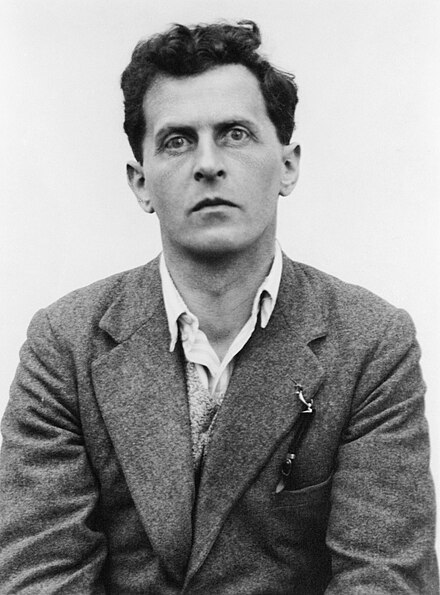
Ludvig Josef Johann Wittgenstein, 1889–1951, Austrian-British philosopher. He worked primarily in logic and the philosophy of mathematics, mind, and language. Photo on being awarded a scholarship from Trinity College, 1929.
Wittgenstein’s Tractacus Logico-Philosophicus. Wikipedia notes that Tractacus Logico-Philosophicus, hereinafter TLP, “is the only book-length philosophical work by the Austrian philosopher Ludwig Wittgenstein that was published during his lifetime. The project had a broad goal: to identify the relationship between language and reality, and to define the limits of science.”
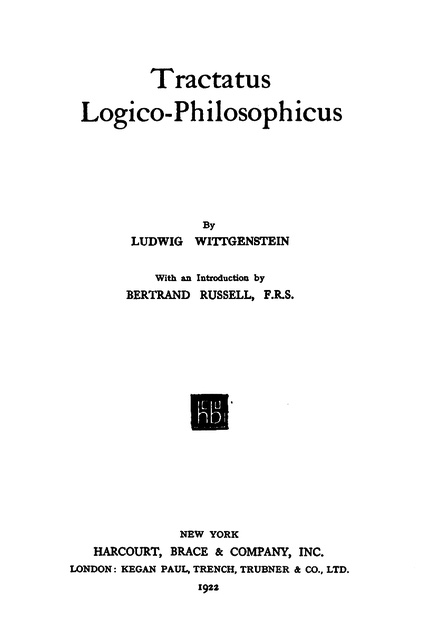
The title page of the first English edition, 1922. See “An Aero Engineer Philosopher Part 2” for more on Wittgenstein and Russell.
TLP was originally published in German in 1921; a year later the first Latin-titled English translation appeared. Moore notes in the LRB article, “The translation appeared under [C.K.] Ogden’s name, though it was mainly undertaken by Frank Ramsey, then still just a precocious mathematics undergraduate….Its chief drawback, as Wittgenstein’s remark to Ogden intimates, and as Michael Morris has marvellously put it, is that it is ‘dog-literal.’ ”
Geez, as an admittedly less-than-precocious math major, I was challenged enough with WPI’s German 101-102.
Later Translations. A second English translation, the Pears/McGuinnes, was produced in 1961. And, as Moore notes, “We now have three new English translations: by Michael Beaney for Oxford, Alexander Booth for Penguin and Damion Searls for Norton. (A fourth, by David Stern, Katia Saporiti and Joachim Schulte for Cambridge, is forthcoming.)”
Why So Many? Moore reminds us, “The book came out of copyright in 2021 (seventy years after Wittgenstein’s death), which is the reason new translation is possible. But it’s another matter whether such a thing is desirable.”
I refrain from sarcasm.
A Tidbit on TLP’s 75-Page Format. Moore describes, “It consists of 525 sections, or ‘propositions’, ranging in length from four words to about a page and a half of text and diagrams. Each is given a decimal number, with the numbers indicating subordination and interconnection. Thus propositions 2.21 and 2.22 are comments on proposition 2.2, which is itself a comment on proposition 2, which is one of the seven top-level propositions.”
He continues, “The propositions have an aphoristic quality. They are written with great compression, hardly any examples, and little explicit argument. They are for the most part general and abstract. Wittgenstein makes few concessions to his reader.”
This frightens me almost beyond reason.
Reality and Our Engagement With It. Moore recounts, “The whole thing has the air of a metaphysical disquisition on the fundamental character of reality and our engagement with it. The culmination, however, consists of two remarkable propositions that cast doubt on this impression: the penultimate proposition, numbered 6.54, in which Wittgenstein says that anyone who understands him will eventually recognise what he has been saying as nonsensical (by ‘nonsensical’ he does not mean absurd or foolish, but quite literally lacking in meaning); and the final proposition, numbered 7, in which, as if in explanation of the propensity to produce such nonsense, he says that we must keep silent about what we cannot speak about.”
A Work of Art. “First,” Moore says, “this book is not just a work of philosophy, it is a work of art.…Booth writes in his preface: ‘We are in the realm of craft, shape and, now and then, possibly even song.’ And Jan Zwicky, in her introduction to Booth’s translation, details the way the stress and play of vowel sounds in the final proposition of the book give it a certain musicality (‘Wovon man nicht sprechen kann, darüber muss man schweigen’).”
Not only does this sound musical, it sounds familiar (for it appears translated in that paragraph directly above it).
The Tove on a Table Argument. In discussing translational challenges of Wittgenstein’s non-sense=lack of meaning, Moore considers the sentence “I saw a big on the table.” He writes, “Here, it seems, there is an adjective where a noun should be. But advocates of the new reading deny that there can be an adjective where a noun should be. Being where a noun should be is already enough to prevent a word from counting as an adjective. What there is here, where a noun should be, is a homonym of an adjective, purporting to be a noun – but only purporting to be one, since it has no meaning in that role. The sentence as a whole is thus of a piece with ‘I saw a tove on the table.’ ”
“I am sympathetic to this view,” Moore writes. “But I am not now defending it, merely noting that I am not rejecting it, the point being that even words that are straightforwardly lacking in meaning can (because of their meaningful homonyms) contribute to the illusion of sense.”
Heady stuff, this philosophy.
Another bit caught my eye: “… or the description at 5.5423 of the two ways of seeing the Necker cube.” It turns out I’ve talked about Necker-cube-like objects here at “The Eyes Have It—0r D0 Th3y?” Another bit of philosophy for another day. ds
© Dennis Simanaitis, SimanaitisSays.com, 2024
 Simanaitis Says
When wordsmiths and philosophers collide.
And so, i adopt a wonderful new phrase, “dog-literal.”
Thanks as always.