
Simanaitis Says
On cars, old, new and future; science & technology; vintage airplanes, computer flight simulation of them; Sherlockiana; our English language; travel; and other stuff
ANXIETY AND THE SMARTPHONE
IT’S RARE THAT AAAS Science magazine and London Review of Books share substantial overlap. However, Science Editor-in-Chief H. Holden Thorp’s editorial “Unsettled Science on Social Media,” Science, June 19, 2024, and William Davies’s LRB review “Anticipatory Anxiety,” London Review of Books, June 20, 2024, both discuss pros and cons of Jonathan Haidt’s book The Anxious Generation: How the Great Rewiring of Childhood is Causing an Epidemic of Mental Illness.
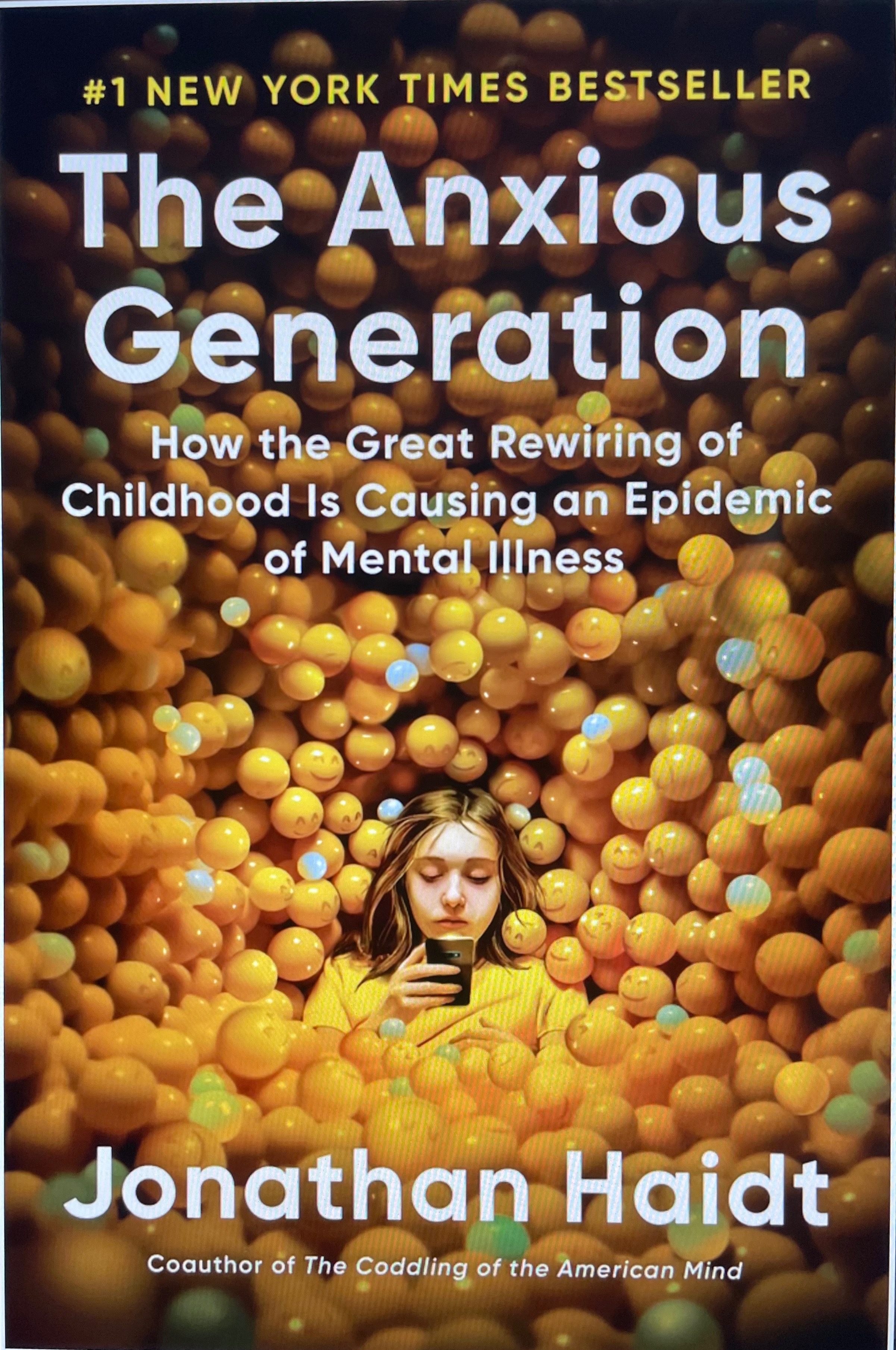
The Anxious Generation: How the Great Rewiring of Childhood is Causing an Epidemic of Mental Illness, by Jonathan Haidt, Penguin Press, 2024.
IndieBound writes, “A must-read for all parents: the generation-defining investigation into the collapse of youth mental health in the era of smartphones, social media, and big tech–and a plan for a healthier, freer childhood. ‘Erudite, engaging, combative, crusading.’ —New York Times Book Review (Editors’ Choice).”
Indeed, “combative.” Here are tidbits gleaned from both an American scientist perspective as well as an English sociologist/political economist one (William Davies teaches at Goldsmiths, University of London). I would also recommend that you read both multifaceted discussions.

Haidt’s Thesis. Science’s Thorp summarizes that Haidt’s new book “makes the case that smartphones and social media are largely responsible for the current mental health crisis among young people and that restricting their use below certain ages (14 for smartphones and 16 for social media) can have a positive effect on reversing or slowing the problem.”

LRB’s Davies frames Haidt’s thesis within the concept of anxiety: “It wasn’t just psychoanalysts and their psychiatrist co-travellers who had given so much credence to anxiety. Existentialists from Kierkegaard to Sartre had also turned to it in their search for fundamental truths about human beings.… ‘Anxiety disorders’ began to rise precipitously after 2008, becoming the world’s most common mental health disorder by 2019, affecting an estimated 4 per cent of the global population.”
Demography of Distress. Davies recounts, “The sharpest rise in mental health diagnoses after 2008 was among the young, girls and women especially.… In the US between 2010 and 2018, self-reported anxiety rose by 18 per cent for those aged between 35 and 49, but by 92 per cent for those aged between 18 and 25.”
Yet he cites a comparison: “Research on ‘subjective wellbeing’ consistently finds that it bottoms out when people are in their late forties (at 47, to be precise) before rising again until they are in their seventies.”
Hmm… Having made both passages, I’ll have to think about my own episodes of “subjective wellbeing.”

Gender Differences. Davies quotes Haidt: “Social media is, he says, worse for girls than for boys, because they are more likely to channel their aggression towards one another by means of social and reputational tactics, while boys are more likely to do so physically. Girls want community; boys want agency.”
Smartphone Influences. Both Thorp and Davies cite Haidt’s belief that smartphones have swapped productive “play-based childhood” with “phone-based childhood.” Thorp stresses Haidt’s claim that phone-based childhood “is the major cause of the international epidemic of adolescent mental health.”
Davies recounts, “Haidt thinks that smartphones are responsible for four identifiable harms: the loss of face-to-face social contact outside school, sleep deprivation, attention fragmentation and addiction.”

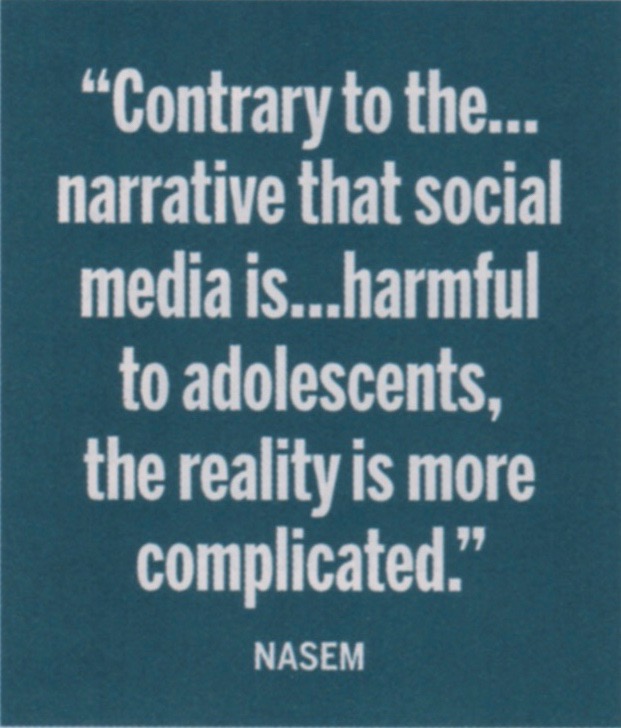
At the same time, others would beg to differ. Thorp notes, “Meanwhile, the U.S. National Academies of Sciences, Engineering, and Medicine (NASEM) released a report stating that ‘available research that links social media to health shows small effects and weak associations…. Contrary to the current cultural narrative that social media is universally harmful to adolescents, the reality is more complicated.’ ”
Thorp also writes, “The most aggressive critique of Haidt’s book came in a blistering review in Nature by Candice Odgers, a psychologist with expertise in adolescent mental health. Odgers told me that she was initially reluctant to review the book because of the amount of time and effort it would take to criticize it.”
Gee, this reminds me of a recent Presidential debate.
Correlation Versus Causation. Davies writes, “There has already been plenty of criticism of Haidt’s thesis, often pointing out that he mistakes correlation for causation. In a review for Nature, the psychologist Candice Odgers suggests that he may have the causality the wrong way round: children already suffering from anxiety and depression may become heavier users of smartphones and the platforms they make available.”
Davies quotes Odgers: “There are, unfortunately, no simple answers. The onset and development of mental disorders, such as anxiety and depression, are driven by a complex set of genetic and environmental factors.”

One Conclusion. Thorp writes in his Editorial, “Throughout the history of science and frequently during the COVID-19 pandemic, the public’s trust in science has been undermined when scientists with large public platforms have failed to state strongly enough that their pronouncements are based on science that remains in flux.”
That is, as has been observed here at SimanaitisSays, science is a progressive evolutionary endeavor. ds
© Dennis Simanaitis, SimanaitisSays.com, 2024

