
Simanaitis Says
On cars, old, new and future; science & technology; vintage airplanes, computer flight simulation of them; Sherlockiana; our English language; travel; and other stuff
NASH-HEALEY AND THE BENEFIT OF FORCED INDUCTION
ACTUALLY I ADMIRE NASH-HEALEYS of 1950-1952 Le Mans fame (finishing 4th, 6th, and 3rd overall, respectively) more than I do the marque’s later Pinin Farina iteration. To my eye, the 1955 Lancia Spyder, also a Pinin Farina design, is more pleasing.
On the other hand, R&T provided us with an excellent answer to an enthusiast’s query of the 1950s: What’s the benefit of supercharging a sports car?
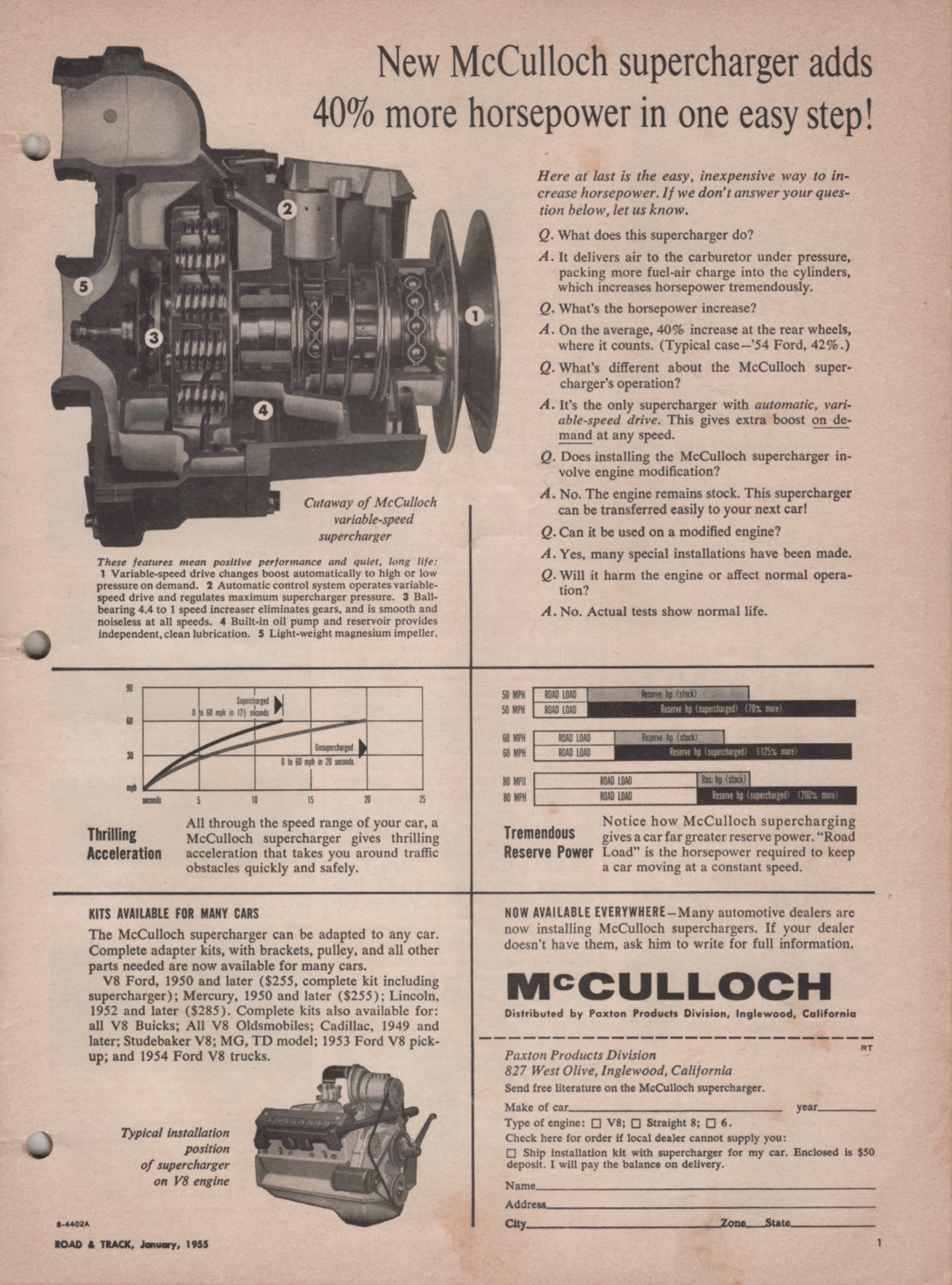
In June 1954 and January 1955, R&T tested exactly the same car, a Nash-Healey the personal property of George W. Mason, late president of American Motors. Reason for the second test was installation of the car’s McCulloch supercharger. Here are tidbits gleaned from both tests.
The Basics. Enhanced power can be obtained by forcing more air and fuel into the combustion process. A supercharger is basically a compressor getting its spin mechanically from the engine’s crankshaft. The famed Blower Bentleys had their superchargers mounted prominently in front of the radiator; Grand Prix cars of the Thirties were also supercharged.
Turbochargers, by contrast, derive their spin from the heat of the engine’s exhaust. Originally involving more bulky plumbing and notorious “turbo lag,” they were slow to arrive in automobiles: The 1962 Chevrolet Corvair Monza and Oldsmobile Jetfire were turbocharged. The concept became more common in the 1980s, and is ubiquitous today in production-car forced induction.
The Stock Nash-Healey. In June 1954, R&T recounted, “The first Nash-Healey was announced early in 1951, a union of Nash engine, Healey chassis and British bodywork…. In 1953 Nash announced that their sports car was to have new bodies, styled and built by Pinin Farina in Italy. Although these bodies are positively beautiful, and very well built, the price went up rather drastically.”
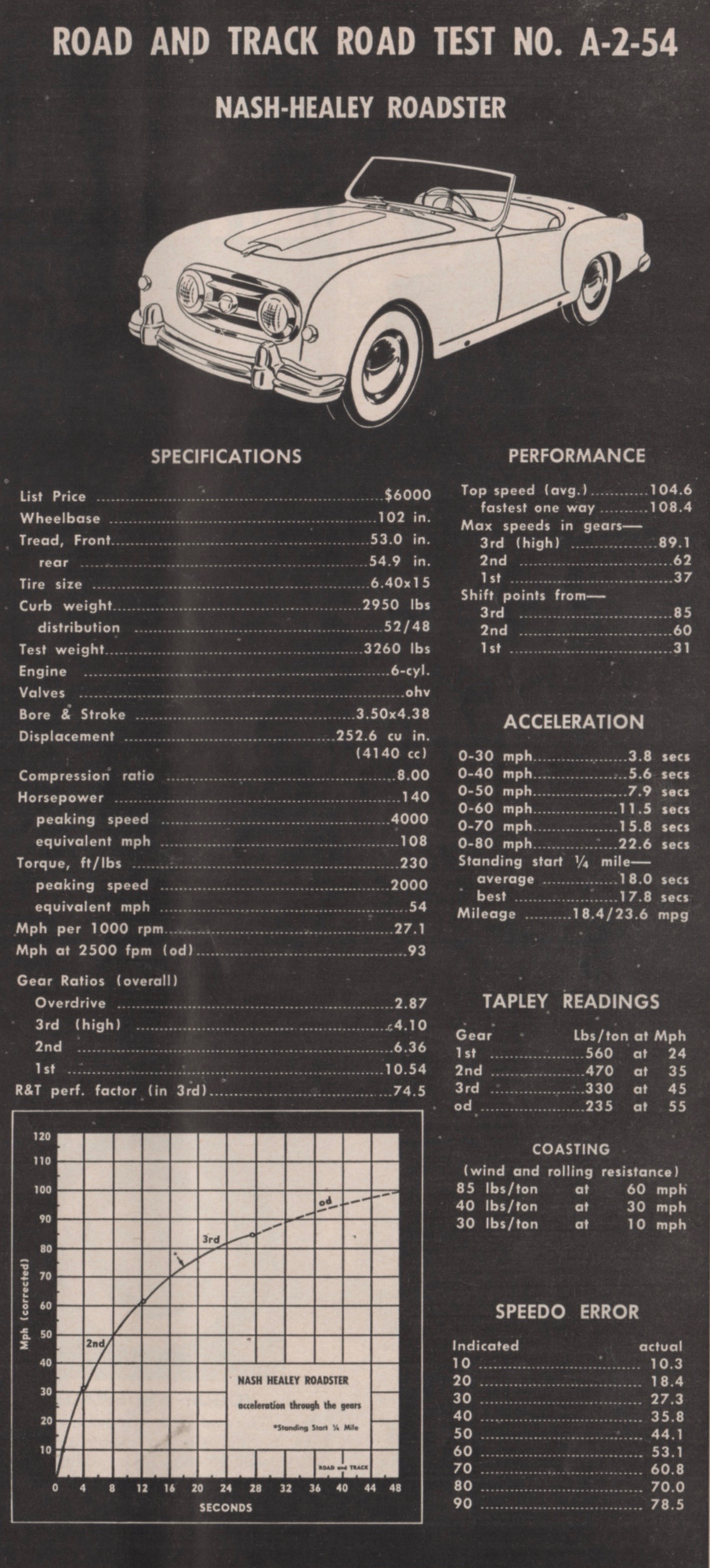
The Nash-Healey Roadster had a list price of $6000, and R&T reported, “Obviously the price is far too high, a fact that is now even more apparent with dealers quoting prices so far below the original $6000 asking figure that the situation is absurd. Even the factory branch in Los Angeles couldn’t tell us the exact price.”
An Effortless Drive. “The Nash-Healey,” R&T said, “is one of those few sports cars which is effortless to drive. It rides well, handles without a trace of vice or viciousness. The engine is smooth and quiet at all speeds. The three speed transmission, with overdrive, has a well placed easy to control lever that contributes to the general fun character of this machine.”
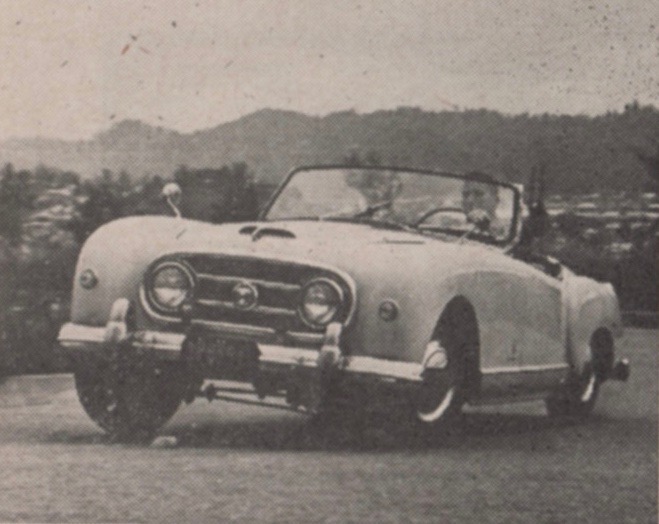
“Nash-Healey has more roll than a competition car but handles well for a touring car,” recounted R&T.
R&T summed up its June 1954 road test commenting, “Every Nash-Healey owner we’ve met is well satisfied with the car. What better recommendation is there?”
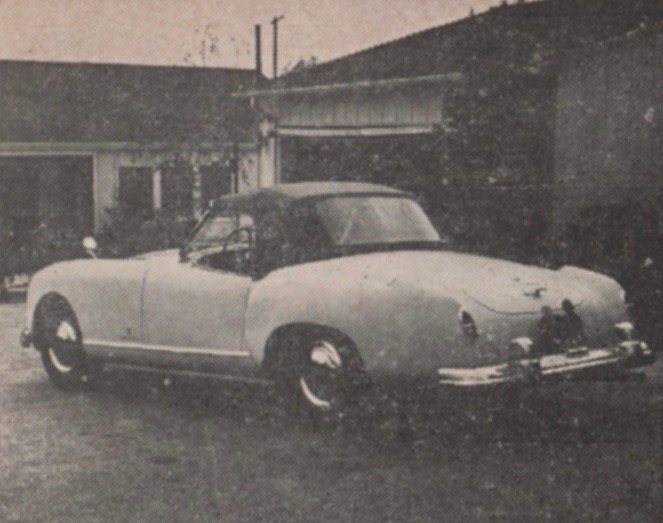
“Top is neat appearing and weatherproof,” noted R&T. “Cockpit is comfortable and attractive. Seat is notched for well-placed gear shift lever.”
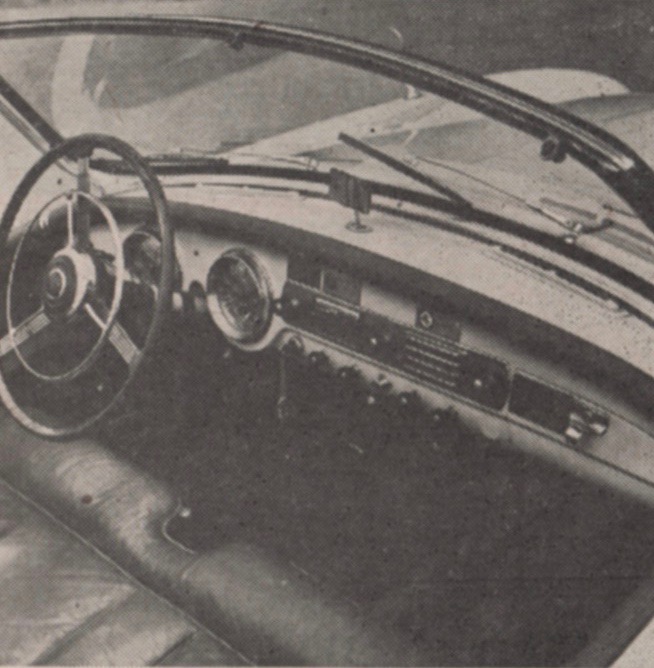
But Where are the Quirks? The enthusiast reader may also sense a lack of endearing quirks. Would supercharging help?
Quick shift to R&T, January 1955.
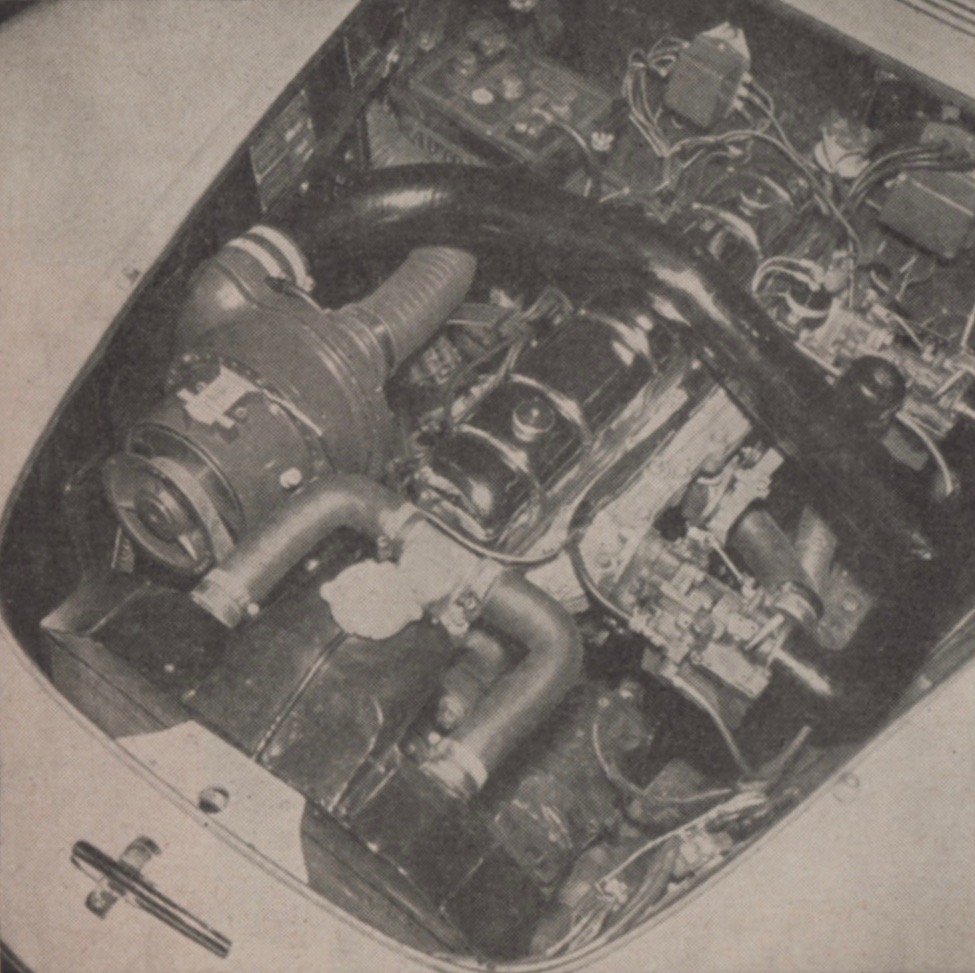
The McCulloch supercharger is an evident addition to the engine compartment.
The Supercharged Nash-Healey. R&T reported in January 1955, “No difficult modifications are required, except for the addition of a special crankshaft pulley to drive the blower. The unit itself is situated on the right hand side of the engine and a simple pipe pressurizes the two horizontal Carter carburetors. The distributor is obstructed by the flexible air intake hose, but this can be moved out of the way in less than a minute.”
“The real charm of the Nash-Healey,” R&T recalled, “has always been its low-speed, high-torque engine—which gives vivid performance even when driven in shiftless American style. The addition of the unique ‘automatic change-down McCulloch centrifugal supercharger had enhanced this virtue by a good 15%.”
The Sainted R&T Tapley Meter. “Tapley readings,” R&T said, “which are an indication of torque and hill climbing ability show that this blower works at low speed (for better torque) as well as at high speed (for higher bhp).
R&T continued, “Although the Nash-Healey has four forward speeds [three plus overdrive] they are rather widely spaced for the enthusiast who likes to ‘play tunes’ with the gearbox. The engine would readily exceed 5000 rpm, but a self imposed limit of 4800 rpm was used during the performance testing.”
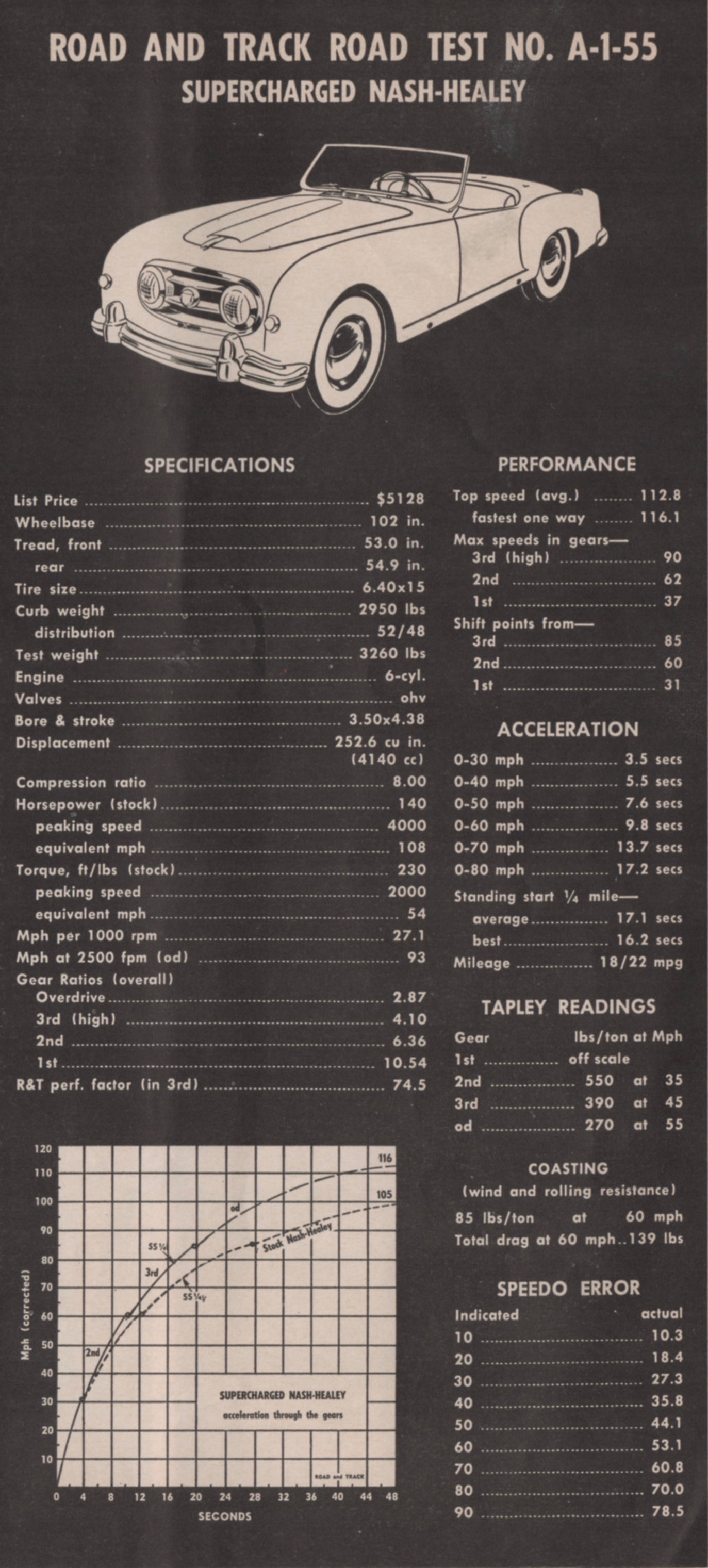
R&T recounted, “Acceleration from zero to 60 mph in 9.8 seconds is 15% better than the time recorded by the stock car, which speaks for itself. As an experiment, an exhaust plug (provided by McCulloch for test purposes) was removed and running with a straight exhaust the time to 60 mph was reduced to 9.0 seconds dead. The best time for a standing start 1/4 mile of 16.2 seconds was also recorded at this time.”
Other data panel figures were taken with the stock exhaust system and with top and side curtains in place.
Only a Bit More Thirsty. R&T reported, “Fuel consumption, with blower, is not seriously altered. The overall average for 322 miles of varied driving was only 1.6 mpg less than the comparable test of last June when the same car gave the remarkable figure of 23.6 mpg. This can of course be attributed to the overdrive which gives high cruising speeds at very low revolution rates.”
In Conclusion. “In June,” R&T said, “we commented on the high quality of the Pinin Farina body, the smooth running Nash engine and the good suspension. Now we must comment on what might be termed ‘wearing qualities.’ Many sports cars seem to get in poor mechanical condition in say 20,000 miles. Of course such cars are driven extremely hard, but this car had nearly 30,000 miles on the odometer with no work done on it except for that necessitated by being side-swiped. [Not during R&T’s use.] It ran as if it was good for another 30,000 miles without an engine overhaul.”
An interesting commentary on the 1955 state of automotive engineering art, supercharged or otherwise. ds
© Dennis Simanaitis, SimanaitisSays.com, 2024
 Simanaitis Says
A late friend owned a long….conga line of high end cars of the ’30s and ’40s, chiefly Gallic: Delahayes, Delage, Talbot-Lago, Bugatti, Hispano-Suiza K6 and J12, as well as the usual Auburns, Packard, Lincoln K, Marmon 16, and a ’39 Lagonda Rapide V-12, a Horch, Maybach Zeppelin, all beginning with a ’57 T-Bird in 1972. The only one he loved, in fact, sold and bought back four (4) times, was a Nash-Healey, the very one used in the Audrey Hepburn, Bogart, William Holden Sabrina.
I drove it, as i did many of his cars, and it and another friend’s Porsche 356B or C coupe were two cars that really had that “carved from a single billet of steel” feel, behaving precisely as R&T reported above.
To this “car guy” since the early 1950s (R&T fan since 1954) and the daily driver of a supercharged car (2006 Mercedes-Benz E55 AMG wagon), I was struck by your remembrance. (I almost used the word “blowhard,” but that applies only to the device, certainly not the writer.) Were these McCullochs developed from anything invented during The Great Misunderstanding? I wonder how many engines they overheated and blew up.
Those cheesy old ads are fun to read. Artist Chris Shapan creates funny parodies, at least on Facebook.