
Simanaitis Says
On cars, old, new and future; science & technology; vintage airplanes, computer flight simulation of them; Sherlockiana; our English language; travel; and other stuff
SO, HOW FAR IS THAT STATION ANYWAY?
STUDENTS USED TO tell me they liked having the answer in the back of the textbook. Here, in a sense, it’s in the back of the website.
Yesterday’s Peg Lynch item cited “A Simple Question of Algebra.” To wit: A man walks from home to the train station at a rate of one yard per second and misses his train by two minutes. If he had walked at four yards every three seconds, he would have arrived two and a half minutes early. How far is the station from his home?
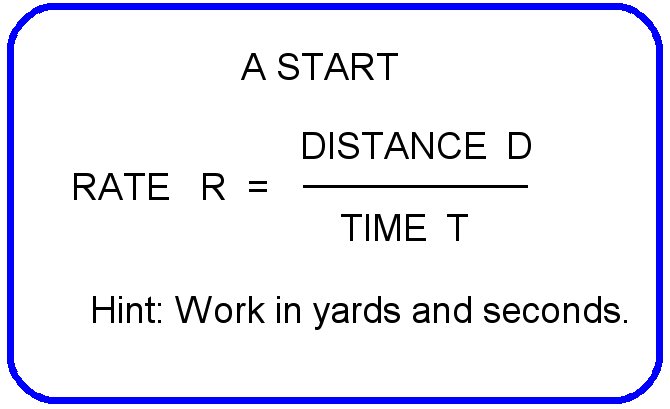
Yesterday, I offered a start and left the rest to the reader.
If all you want is the answer (shame on you), it’s 1080 yds. If you’re interested in details, read on.
Set up two equations of rate, R = D/T, one for being late, the other for being early. The two rates are known, 1 yd/sec and 4/3 yd/sec. D is unknown; and the two statements of time can be expressed algebraically.
Being late:Let R1 be 1 yd/sec. Let T1 be the ideal arrival time T plus the 2 minutes he’s late. That is, T1 = T + 120, changing to seconds. Algebraically:
R1=D/T1, or:
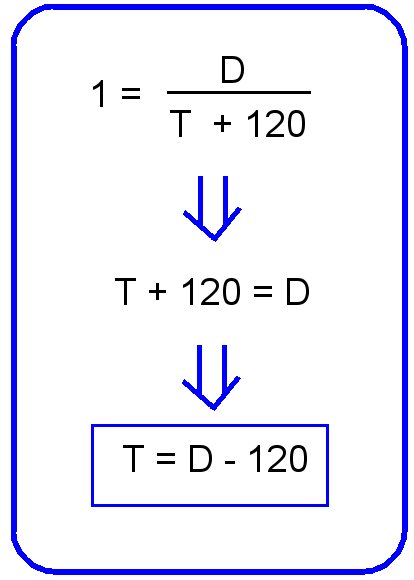
Being early: R2 is 4/3 yd/sec. Let T2 be the ideal arrival time T minus the 2 1/2 minutes he would have been early.
Algebraically, 4/3 = D/(T – 150), changing the 2 1/2-minute earliness into seconds. Then comes a bit more algebraic fooling.
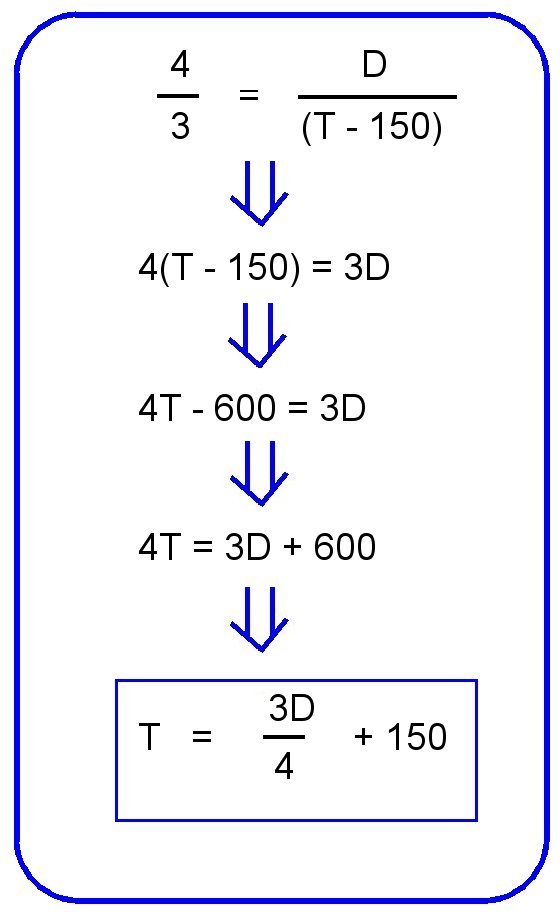
Thus, we have two expressions, both equal to T. And hence, D – 120 = 3D/4 + 150.
Solve for D and we’re done.
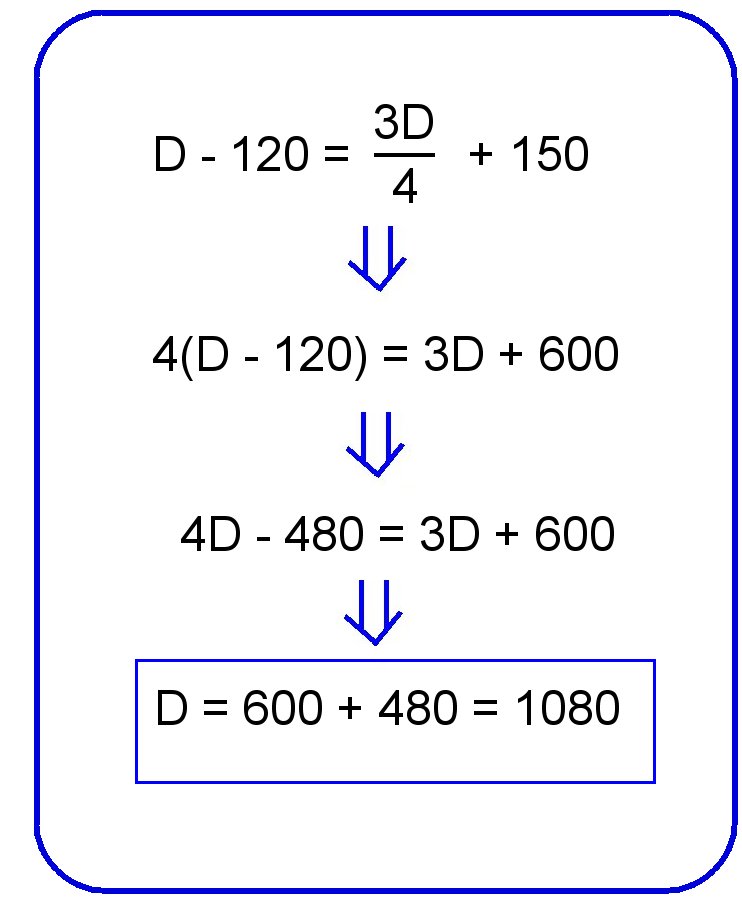
Let’s check this is true: Walking at one yd/sec, the man takes 1080 seconds or 18 minutes. He’s two minutes late. That is, the ideal time must be 16 minutes.
Instead, if he had walked 4/3 yd/sec, the trip to the station would have taken 810 seconds or 13 1/2 minutes, thus he would have been 2 1/2 minutes early.
Or, as Peg Lynch might have suggested, just leave the house a few minutes earlier and wear comfortable shoes. ds
© Dennis Simanaitis, SimanaitisSays.com, 2016


I’m more in the “leave early” camp than doing the algebra. There was a reason I wound up in journalism.
Interesting, I solved for the time of the train first and then back substituted to solve for distance.
I set up two equations:
D1 = 1.0 * (T+120)
D2 = 4/3 * (T-150)
But knowing that D1=D2, solved for T by setting the two as equal:
1.0 * (T+120) = 4/3 * (T-150)
T + 120 = 4/3 * T – 200
120 + 200 = 1/3 * T
T = 320 / (1/3)
T = 320 * 3
T = 960 seconds
Back substituting:
D1 = 960 + 120 = 1080 yards
D2 = 4/3 * (960 – 150) = 4/3 * 930 = 1080 yards
Whoops, noticed an error in the display of the math:
D1 = 1.0 * (T+120)
D2 = 4/3 * (T-150)
But knowing that D1=D2, solved for T by setting the two as equal:
1.0 * (T+120) = 4/3 * (T-150)
T + 120 = 4/3 * T – 200
120 + 200 = 1/3 * T
T = 320 / (1/3)
T = 320 * 3
T = 960 seconds
Back substituting:
D1 = 960 + 120 = 1080 yards
D2 = 4/3 * (960 – 150) = 4/3 * 810 = 1080 yards (not sure where that 930 came from)
Yes, a fine method. There’s more than one way to skin a… Ouch!
Your 960 secs is the “target time” of 16 minutes.
I considered solving by this T approach, but chose the D route as more appealing aesthetically, as D was the goal.