
Simanaitis Says
On cars, old, new and future; science & technology; vintage airplanes, computer flight simulation of them; Sherlockiana; our English language; travel; and other stuff
A WALK IN THE CITY
PEDESTRIANS AREN’T common in my portion of the world. (Book ’em on a 203—”Without a motor vehicle in the County of Orange, State of California.”) On the other hand, I have visited places that have throngs of pedestrians, the borough of Manhattan of New York City, for example.

Thus, recent research concerning pedestrian safety in The City got my interest. Reported in several media, “Crosswalks in New York Are Not Havens, Study Finds” was the title of one of them in The New York Times (see http://goo.gl/XAtg0).
It turns out I might be safer walking down the median of Interstate 405.
Researchers at the Langone Medical Center of New York University studied more than 1400 pedestrians and cyclists treated at Bellevue Hospital Center after vehicular collisions occurring over the period December 2008 to June 2011. Their results, published in the Journal of Trauma and Acute Care Surgery, reinforce intuition in some regards, but there are oddities as well.
Relatively few patients confessed to being overly wired—in one way or another. Among those 18 and older, 15 percent of pedestrians and 11 percent of cyclists had consumed alcohol prior to the collision. About 8 percent of both pedestrians and cyclists admitted to using an electronic device, cellphone or music player. Here, there was an age split; for those 7 to 17, the percentages climbed to more than 10 percent of pedestrians and nearly 30 percent for cyclists.
Be aware that in “The City” many cyclists aren’t sport riders, but rather delivery people of one sort or another. This was reflected in time-specific data, with cyclist injuries spiking from noon to 3 p.m. and resuming from 6 p.m. to midnight—times when food deliveries are made.
Curiously—and lamentably—less than a third of the cyclists in the study wore head protection. In NYC, helmets are required for any “Commercial Bicyclist” as well as for those ages 1-13. (See http://goo.gl/nI4tz.)
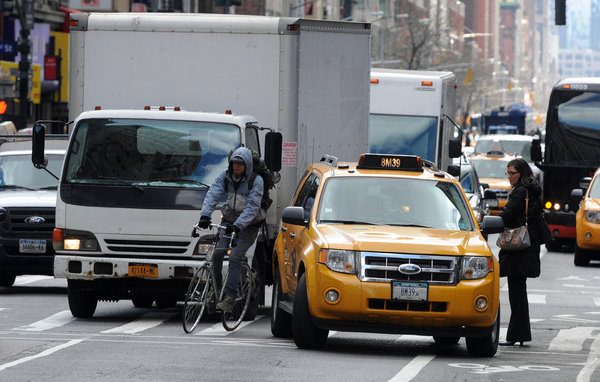
There are plenty of interactions on the streets of Manhattan. Image by Barton Silverman, The New York Times, April 2, 2013.
About 40 percent of injured bicyclists were hit by taxis; 25 percent of pedestrian injuries were also taxi encounters. By licensing and “Medallion” quota, there are only 13,237 taxis in NYC (with perhaps another 35,000 other for-hire gipsy cabs, limos and the like). This compares with 1,776,536 private cars included in 1,978,392 vehicles of all types. Although it may not seem so, by percentage, Medallion taxis account for a scant 0.7 percent of NYC registration figures.
In general, pedestrians had no safe havens from motor vehicles. Six percent got theirs while on a sidewalk. Of street injuries, 44 percent of the injured were in crosswalks, compared with 23 percent crossing midblock.
This reminds me of an informal canine study awhile back that indicated unaccompanied dogs preferred to cross the street in midblock.

The Hidden Life of Dogs, by Elizabeth Marshall Thomas, Gale Group, 1995, recounts how dogs cope with streets.
On reflection, their canine street cred makes sense: Midblock, there are only two paths of traffic to watch; at an intersection, there are at least four—and with turn options, many more.
Researchers admitted a shortcoming in their data. Pedestrians and cyclists who died at the scene are not included. Of the more than 1400 cases reviewed, 15 pedestrians and 3 cyclists died later, 12 within a day of the collision. NYC reported a total of 274 traffic deaths of all types, including purely vehicular, in 2012.
A bright spot for some of us: Being overweight helped. Victims with above-normal body mass were found to have less severe injuries than their trimmer counterparts. On the other hand, once admitted to the hospital, they fared worse.
Maybe we’re just bigger targets, yet, paradoxically, harder to give a good hit. ds
© Dennis Simanaitis, SimanaitisSays.com, 2013


Taxi tid-bit: NY city medallions are now selling for $1M, and are considered an investment opportunity (typically returning a virtually guaranteed 3%). Something to think about when hailing . . .
To paraphrase our mentor Winston, my memories of my first NY city cab ride years back, recall his “nothing as exhilarating as being shot at without result.” And I thought I was quite the hot hot-rodder back then.
Chances are good that those of us who are not athletic wouldn’t be on bicycles in an urban environment, so this instantly skews the results.