
Simanaitis Says
On cars, old, new and future; science & technology; vintage airplanes, computer flight simulation of them; Sherlockiana; our English language; travel; and other stuff
2012 HIGHS—AND LOWS
A JOYOUS New Year to you! I turn to Science magazine, published weekly by the American Association for the Advancement of Science, to celebrate the top scientific achievements of the past year. Named in its 21 December 2012 issue as “Breakthrough of the Year” is discovery of the Higgs boson. Another major achievement cited is NASA’s “Sky Crane” landing of the Curiosity Rover on Mars.
The Higgs boson deserves “Breakthrough of the Year” because it’s conjectured to be the subatomic particle responsible for matter having mass, for why, fundamentally, stuff behaves as it does.
The possible discovery of this illusive particle came in July at the Large Hadron Collider residing astride the French/Swiss border near Geneva.

The larger ring is the Large Hadron Collider; the smaller one, the Super Proton Synchrotron. The jagged purple line is the French/Swiss border.
The LHC, the world’s largest and highest-energy particle accelerator, is part of CERN, the European Organization for Nuclear Research. It operates in a tunnel that’s 17 miles in circumference, at a depth as great as 574 ft. below the terrain.
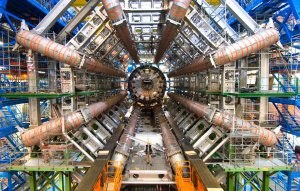
Engineering aspects of the Large Hadron Collider are astounding. Note the worker, lower center.
Subatomic particles are accelerated and guided by electromagnets, then collided. The collisions give rise to new particles, typically decaying in scant time.
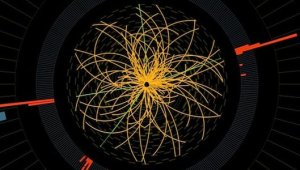
This rendering from CERN “might represent a decaying Higgs boson.”
Thus, researchers claim only the possible discovery of the Higgs boson. Further research may corroborate—or weaken—the theoretical model, and this, of course, is how science works. Nevertheless, this Higgs boson achievement is significant.
By contrast, the contents of my Tweet last summer (“Cleaning out my office after 33 years at R&T, I found three of them.”) have been discounted.
The entire Curiosity project continues to amaze. It’s akin to a routine look around a backyard—only the backyard is some 60 million miles away.
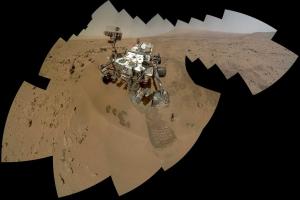
Curiosity takes its own snapshot! NASA image.
And its “Sky Crane” landing was fantastic. The Curiosity module entered the Martian atmosphere at around 13,200 mph and an altitude of 78 miles. After controlled deceleration and hypersonic maneuvering, a parachute deployed and reduced its velocity from around 900 to 180 mph.
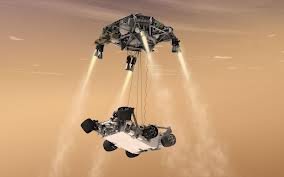
Curiosity relied on Sky Crane’s controlled propulsion for its final approach and landing. NASA rendering.
Still a mile above the Martian surface, the Sky Crane took over with its powered descent, continued deceleration and touchdown. Amazing.
There were lows as well. For me, close runners-up were the whackos expecting the end of time simply because the Mayan calendar reached an end of cycle (akin to yesterday’s December 31).
But more disturbing have been episodes of scientific ignorance concerning earthquakes. Seismologists recognize that precise prediction of earthquakes is not yet possible. Maybe some day, but not with our current understanding of plate tectonics.
Despite this, as reported in Science, 5 October 2012, an Italian court has sentenced seven scientists to six-year terms in prison. Their crime? Manslaughter, for not predicting the severity of the tragic L’Aquila earthquake in 2009.
Yet (see Science, 6 December 2012) American geophysicist Roger Bilham was denied entry into India, where he has done seismological research since 1967. In fact, though he was en route to Bhutan, authorities at the New Delhi airport packed Dr. Bilham back on a plane for the states. His crime? For overestimating the seismic hazards near a proposed nuclear power plant in Jaitapur, India.
It’s suspected that an Indian seismologist rival may have pressured the country’s Ministry of Home Affairs to place Dr. Bilham on the list of foreigners not allowed to visit India.
Have a Joyous 2013, with its inevitable highs and lows.
© Dennis Simanaitis, SimanaitisSays.com, 2013

