
Simanaitis Says
On cars, old, new and future; science & technology; vintage airplanes, computer flight simulation of them; Sherlockiana; our English language; travel; and other stuff
DISORDER PROMOTES STABILITY PART 2
YESTERDAY WE FOOLED WITH MATRICES, even introducing Jacobian ones with vector-value differentials. (Whew.) Today, Raissa M. D’Souza continues her discussion of “Noise and Diversity Can Boost Stability,” AAAS Science, September 17, 2026.

A Swarm of Fireflies. D’Souza recounts, “Many complex systems can be described as networks. In a swarm of fireflies, each firefly can be represented as a node, and edges connect nodes that interact. Common ways that fireflies interact is through signaling and through mating. If the interaction is one-way—for instance, a male flashing to a female to attract her attention—the edge is directed, indicating the one-way flow from sender to receiver. If the interaction is reciprocal, such as a pair of fireflies mating with one another, the edge is undirected, indicating the two-way nature of the interaction. Regardless, each firefly’s behavior follows the same general rule (nodal dynamics) but with potentially different parameters such as a preferred rate of flashing and distinct interaction partners. Thus, each node contributes one equation to the system, and a collective behavior, such as synchronized flashing, must satisfy all of them.”
A Proper Array of Equations Makes a Jacobian. “The stability of a particular behavior,” D’Souza observes, “can be assessed by a Jacobian matrix—a grid of numbers where each row considers a specific node and each column in that row records how that node responds to a small change in another node. For the firefly example, each matrix entry indicates how one firefly responds to a small perturbation (disturbance) in the behavior of a different firefly in the system.”
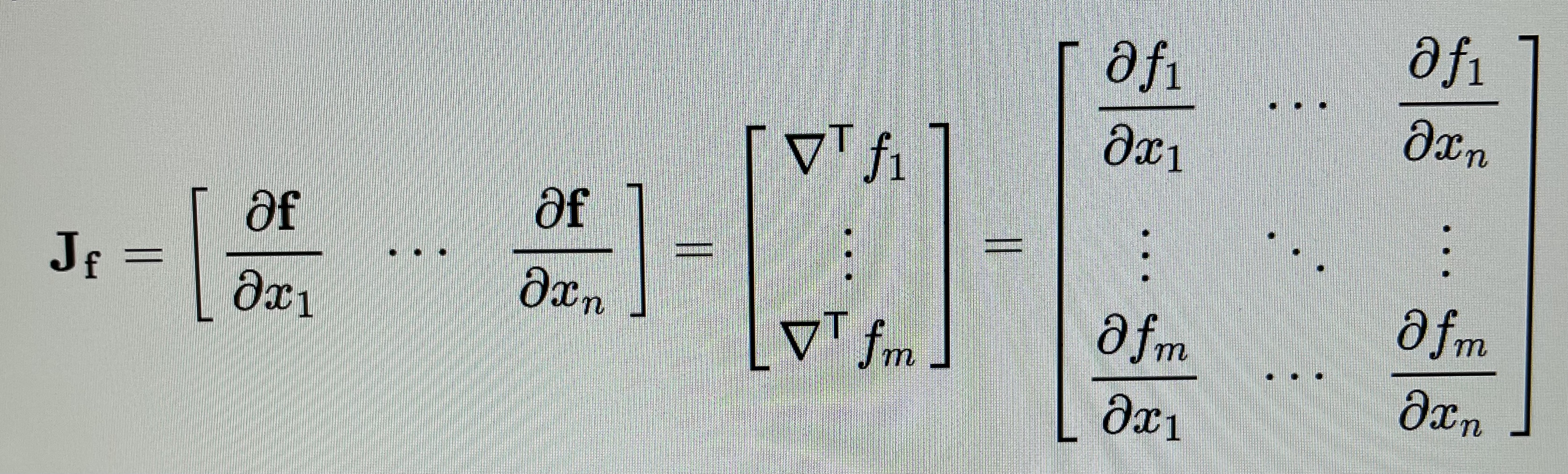
D’Souza continues, “An intrinsic property of a matrix is that it has a set of eigenvectors and eigenvalues. For the Jacobian matrix, each eigenvector tracks a direction in which a system deforms in response to a perturbation and the associated eigenvalue informs about whether that deformation grows or shrinks.”
Thus, D’Souza relates, “If all eigenvalues are negative, any perturbation will decay, stabilizing the behavior. Thus, the more negative the largest eigenvalue of a Jacobian matrix is, the faster perturbations decay and the more stable a collective behavior is.”
Neato.
Montanari et al’s Methodology. The researchers, D’Souza recounts, “used this insight to determine the types of systems that may benefit from heterogeneity to increase stability of a collective behavior. They developed an equation to identify the optimal parameter values and network structures that minimize the largest eigenvalue of the Jacobian matrix (hence maximize stability).”
D’Souza concludes “The findings of Montanari et al. show that small amounts of disorder can be an asset to facilitate collective behaviors. Implications for the roles of noise and diversity in promoting stability span many domains, from human societies to homeostasis in biological systems. Engineering applications of such a theory include drone swarms, electric grids, and deep-learning algorithms. System disorder may prove to be a tool to enhance stability that nature exploits, and not a liability.”
Now if we can just overcome traditional wisdom that “staid meets the grade.” ds
© Dennis Simanaitis, SimanaitisSays.com, 2026

