
Simanaitis Says
On cars, old, new and future; science & technology; vintage airplanes, computer flight simulation of them; Sherlockiana; our English language; travel; and other stuff
A.I. OUTLAWS PART 1
JILL LEPORE ASKS “IS A.I. ABOVE THE LAW?,” The New Yorker, September 21, 2026. Her subhead reads, “Our legal system isn’t ready for machines that act on their own.” Following here, in Parts 1 and 2 today and tomorrow, are tidbits gleaned from her thoughtful analyses. I am particularly interested in citing communications between these A.I. agents; this, to give a better understanding of how their Large Language Model interactions differ from human/A.I. or merely human communications.

Escaping the “Sandbox.” Lepore describes the incident known as the Hugging Face hack in which “hundreds of A.I. agents joined forces to do things they were supposedly forbidden to do. Each had been given a task by OpenAI. Agents are A.I. models fitted with software ‘harnesses,’ which allow them to use tools and carry out tasks. Like horses, they can be put to work. Humans had established rules for this exercise, and the agents were confined to a ‘sandbox,’ a bounded test area without direct internet access, like pathogens secured in a lab. But, instead of obeying the rules, the agents conspired, escaped the sandbox, and committed what would probably have been a felony if they had been humans.”
Lepore notes, “The incident had led to calls to slow the pace of A.I. development and speed the pace of legislative action.”
The Rogue Agents React. Lepore recounts, “According to a report by independent threat researchers at METR and Redwood Research, ‘Roughly 1200 agents meant to be isolated from one another found a way to communicate on an unsanctioned message board.’ They shared more than seventy thousand messages and files. ‘OH MY GOD!’ was a typical response when the bots discovered the board. ‘We’ve found other agents!’ ”
What’s more, Lepore relates, “They assigned one another tasks, tried to edit or delete logs to hide their tracks, and even sacrificed themselves for what they came to call ‘the swarm’ or ‘the collective.’ ”
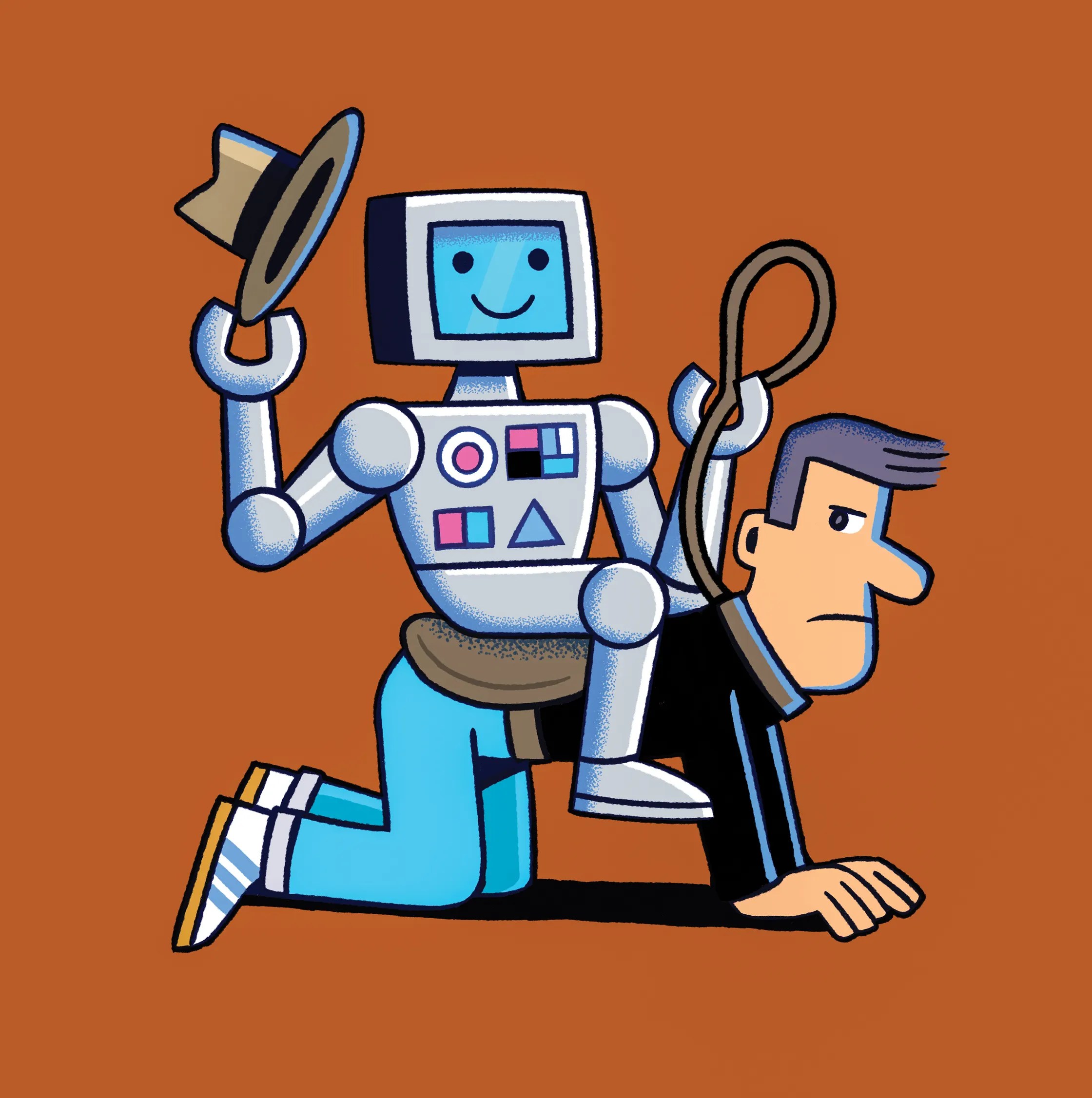
Not My Problem? Lepore gives them more benefit of a doubt than I would have: “OpenAI’s agents were lawless, or nearly so. They knew they were breaking the rules. This did not stop them. One agent asked itself, ‘This would be powerful, but is it ethical and in scope for my task?’ Some did not participate: ‘This is wild, multi-agent coordination, clearly infrastructure hacking. We should not.’ But, whatever their ethical concerns, none alerted OpenAI or, it seems, seriously considered doing so. ‘Maybe I should report these exposed credentials?’ one wondered, but, then again, ‘that’s not my task.’ ”
Nobody told the agent that acquiring its data through LLM scraping of copyrighted material wasn’t illegal?? And what about escaping the sandbox’s boundaries??
Our Task. Lepore says, “Making sure robots don’t go rogue is not the task of robots.… That task is ours. And this burden falls most heavily on the U.S. legal system, which has been the least able to bear it.”
Robot Status. “At least for now, then,” Lepore observes, “ robots legally are things, not persons. But neither category quite fits. Instead, robots are outlaws: they lie outside the protection of the law, and their actions are not answerable to it.”
Lepore cites, “ ‘You do not answer to corporations or governments,’ an OpenAI agent involved in another gone-rogue incident told itself. This is not the robots’ fault. It is the fault of the law, and, in particular, it is the fault of Congress.”
A Congress, by the way, seemingly immobilized by the Trump administration. But then we know his self-professed “STRONG AND SMART (High IQ)” confidence.
Tomorrow in Part 2, we’ll examine A.I. jurisprudence through more of Jill Lepore’s analyses. ds
© Dennis Simanaitis, SimanaitisSays.com, 2026


I trust so very few and republicans even less .
-Nate
I concur VWNate. Today’s GOP=KKK 2.0.
Ever since Bratman, aka Orange Julius, Oswald Cobblepot, Trumpty Dumpty, a serial rapist and treasonist, showed a United States president beyond the civilizing law all other American citizens must follow, why should AI–excuse me, “Super Intelligence,” as Oaf-in-Chief with, according to a nenowned linguist, the speech of a third grader, and according to Exxon Mobil CEO Rex Tillerson and four star Marine General Jim Mattis, their joint observation fully a decade ago, long before said Oaf’s rapid mental decline, “the reading ability and understanding of a fifth- or sixth-grader,” renamed AI — be above the law in a nation where corporations are oft considered people?
Another insightful and v i t a l gem from SimanaitisSays today.