
Simanaitis Says
On cars, old, new and future; science & technology; vintage airplanes, computer flight simulation of them; Sherlockiana; our English language; travel; and other stuff
SHAKE THINGS UP—IT’LL HELP PART 1
THOUGH SEEMINGLY PARADOXICAL, DISORDER CAN PROMOTE STABILITY. Raissa M. D’Souza describes how in “Noise and Diversity Can Boost Stability,” AAAS Science, September 17, 2026.
Real-world Examples. You’d think that collective behavior would benefit from a group’s elements acting in concert. However, D’Souza recounts, “This contrasts with many real-world examples. Fireflies that act as noisy, irregular oscillators still flash synchronously in colonies. Electric power grids are intentionally designed with mixed power sources and mismatching response times to promote stability.… On page 1241 of this issue Montanari et al. report a new theory that shows how parameter heterogeneity and noise can promote stability. The findings establish theoretical underpinnings for when and why disorder is an asset for stability, opening new avenues for understanding and controlling collective behaviors.”

Yury Suleymanov provides an Editor’s summary of Montanari et al.: “Traditionally, uniformity among components has been viewed as beneficial for stability based on simplified models. Montanari et al. challenged that paradigm, demonstrating that heterogeneity can actually enhance stability, particularly when the network’s Jacobian matrix is non-Hermitian, a property common in systems described by second-order equations or with internal degrees of freedom.”
This piqued my mathematical interest, because I had vague recollections of the linear algebra of matrices. Jacobians, eh….?
The Essentials. Wikipedia describes, “In mathematics, a matrix (pl.: matrices) is a rectangular array of numbers or other mathematical objects with elements or entries arranged in rows and columns, usually satisfying certain properties of addition and multiplication.” That is, matrices of appropriately matching dimensions can be added or multiplied, thus forming the algebraic concept of a field.
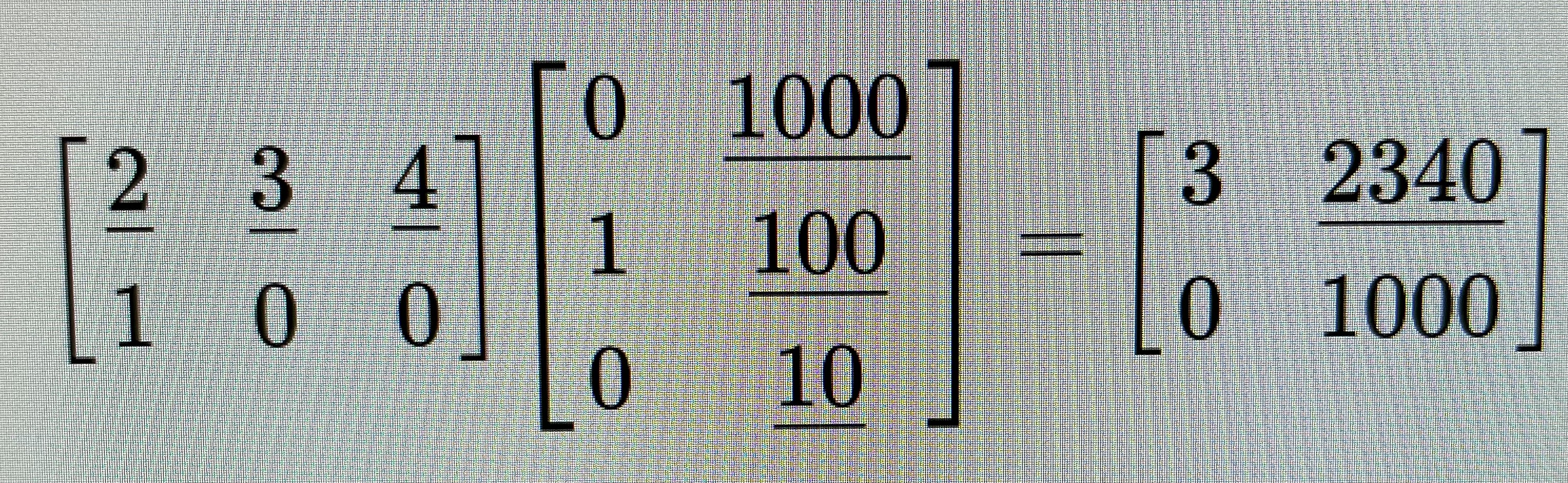
Matrix addition is simply term by term. Multiplication is a non-communicative row by column process, as shown above.
Wikipedia relates that matrix theory “was initially a sub-branch of linear algebra, but soon grew to include subjects related to graph theory, algebra, combinatorics and statistics.”
A Jacobian Matrix. Wikipedia describes a Jacobian matrix as “the natural generalization of the derivative and the differential of a usual function to vector valued functions of several variables.”
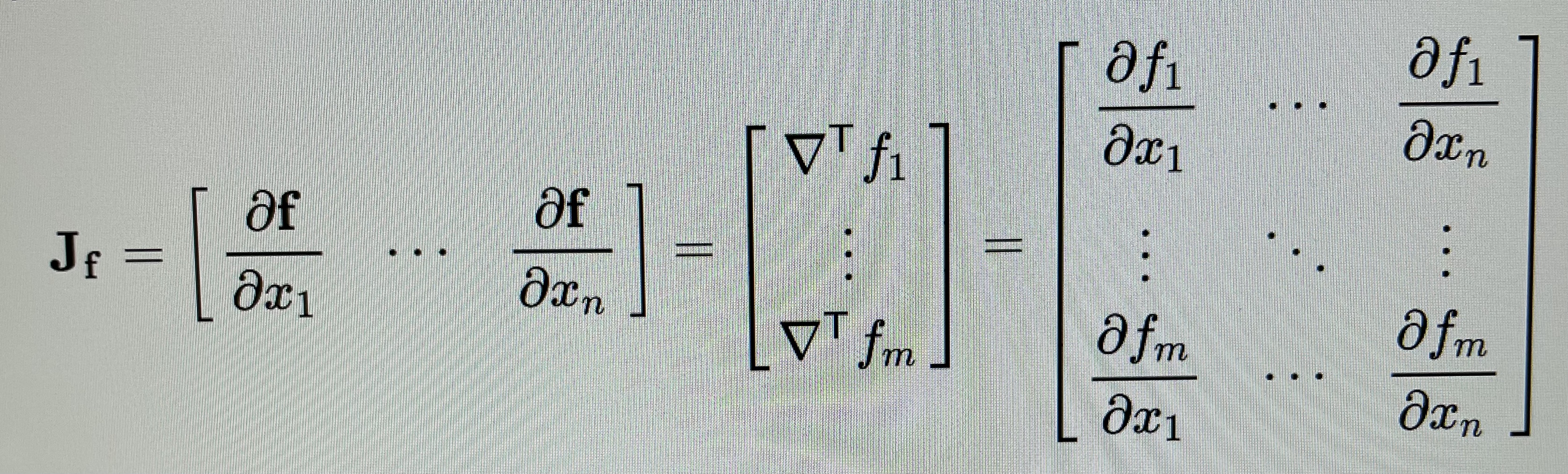
A Jacobian maxtrix. Image from Wikipedia.
Think of calculus, the mathematics study of motion, but replacing simple “f(x)=something” with vector-valued functions of several variables. And, in place of mere numerical entries in the rectangular array, the Jacobian matrix has these vector-valued functions of several variables.
By the way, recall that a vector is a mathematical object having both magnitude and direction. Without getting in too deep, then, vector calculus studies the motion of objects having these properties. The Jacobian matrix is a fundamental tool.
Stability? By the way, see also “Dynamical Systems, Anosov Flows and Arnold’s Cat,” SimanaitisSays, July 1, 2023, so we have similar understandings of stability.
Tomorrow in Part 2, we’ll see if this background helps to give us appreciation of Montanari et al.’s “Disorder-promoted Stability,” or at least of D’Souza’s “Noise and Diversity Can Boost Stability.” ds
© Dennis Simanaitis, SimanaitisSays.com, 2026


Akin to shaking out deadwood or a fettling run in vintage car?
I dunno. I’d have to check its Jacobian….