
Simanaitis Says
On cars, old, new and future; science & technology; vintage airplanes, computer flight simulation of them; Sherlockiana; our English language; travel; and other stuff
INVENTIONS THAT TRANSFORMED THE WORLD PART 2
THIS ALL STARTED WITH History Extra Magazine’s “What Was the Greatest Invention in History? 9 Experts Share Their Opinions.” Tidbits were gleaned from two of them in Part 1. Today, three other experts offer opinions, together with my observations originally appearing in SimanaitisSays.
Roman Concrete. Jess Venner, ancient historian, presenter, and author, observes, “The Pantheon in Rome should not exist. Or, at least, not in the form we see today. Its perfect concrete dome, spanning 43 metres and pierced by a great oculus ‘eye’, still stands almost two millennia after it was poured, and remains the largest unreinforced concrete dome in the world.”
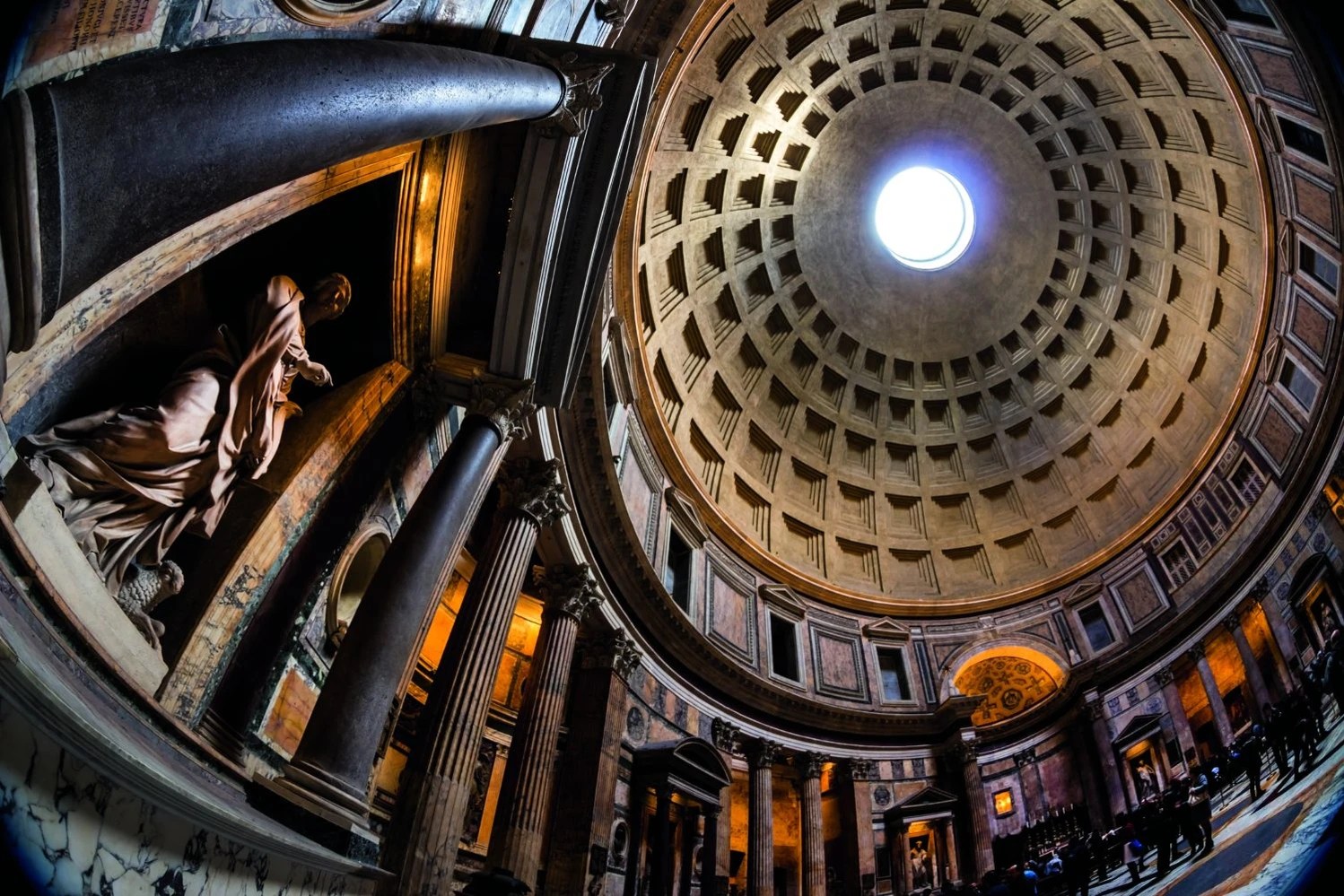
The Pantheon’s dramatic dome. This image by Dreamstime from History Extra.
“Concrete itself,” Venner recounts, “was not a Roman discovery…. But around 300 B.C., Roman engineers revolutionised the material by mixing volcanic ash (pozzolana) with lime and [sea] water…. Roman concrete was the foundation of an architectural revolution, one that shaped the physical world of the Romans and continues to astonish and inspire us today.”
The Steam Engine. Hannah Skoda, associate professor of medieval history at the University of Oxford, describes, “The invention of steam power was in many ways iterative, but the production of a steam engine by Baptist preacher and ironmonger Thomas Newcomen in 1712 was a transformative moment.”
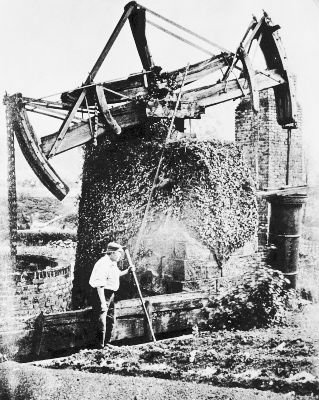
An 18th-century Newcomen engine, used to pump water from British mines. The walking beam takes the place of a crankshaft in transferring the reciprocation.
Wikipedia offers a schematic of its operation.
My Flame Eater. A cousin of Newcomen’s first practical atmospheric engine is described in “Flame Eater Atmospheric Engine,” SimanaitisSays, January 13, 2014.

Watt’s Contribution. Professor Skoda observes, “In 1765, its [Newcomen’s] design was refined by James Watt, who added a separate vessel for condensation. This meant an engine’s main cylinder could remain hot while steam condensed in a separate, cold chamber. As a result, machines could be both scaled down and made more powerful.”
She concludes, “The steam engine, of course, powered the industrial revolution. Factories, trains and ships were all driven by steam power, and it ushered in political, social and cultural transformations. In many ways, steam facilitated Britain’s global dominance. Patterns of labour were turned on their head, and many courageously protested as they found wages lowered, inequalities exacerbated and capital concentrated in the hands of those who owned the technology.”
A Modern Parallel. Of course, Artificial Intelligence, A.I., offers a similar—possibly more disruptive—revolution.
The World Wide Web. Marc Morris, medieval historian, writer, and presenter, offers yet another modern parallel: “The most important invention of my own lifetime has been the World Wide Web. At university in the early 1990s, it was essentially the preserve of computing enthusiasts and science students. By the end of the decade, even the most dry-as-dust history professors had been persuaded of the benefits of Sir Tim Berners-Lee’s big idea.”
“As more of the world’s archives have been put online,” Morris recounts, “research has been transformed out of all recognition…. Voluminous texts that would have taken months to wade through can be searched in an instant.”
The Tradeoff. “Alas,” Morris observes, “in the past decade or so, we have seen the downsides. A tool designed for the sharing of information can also be used to spread misinformation. Algorithms are tweaked so that the truth is suppressed and propaganda is promoted. Malevolent actors can rig elections, distort polls and even topple governments. The internet has led to measurable increases in division, racism and fascism.”
Having confronted this tradeoff and enjoyed the Internet’s research benefits for more than a decade here at SimanaitisSays, I concur completely with Morris’s conclusion: “Will the good outweigh the bad? Right now, as was famously, but mistakenly, said of the French Revolution, it is too soon to tell. Either way, when historians of the future are asked to name transformative inventions, the World Wide Web will be towards the top of their lists.”
Others on the History Extra List. What a fascinating collection of scholarly opinions: Others include, alphabetically, antibiotics, the printing press, the railway, and the Socratic Method. I’ve dabbled a little with each of the four: “How Come Pills Are (Often) in Orange Bottles?,” The First Book in English,” “Trains and Music,” and “Who or What Is Genius.”
And ain’t the World Wide Web an entertaining place to research them! ds
© Dennis Simanaitis, SimanaitisSays.com, 2026


I hope that in the end the internet will have been a good thing .
As a problem solver typ of person that I am I find it incredibly useful and enjoyable as well, I can research things and share with others my hard won collective knowledge of machines, their repair and maintenance .
-Nate