
Simanaitis Says
On cars, old, new and future; science & technology; vintage airplanes, computer flight simulation of them; Sherlockiana; our English language; travel; and other stuff
HOAX REDUX
GEEZ. I THOUGHT I HAD COVERED ALL THIS IN “Hoax: A Real Etymology,” SimanaitisSays, March 22, 2018. It even had lots of Trump references (Henry VIII was “Donald Trump in a codpiece” as described by British-born Glen Newey, Professor of Practical Philosophy at Universiteit Leiden, The Netherlands).
But, of course, 2018 was so Trump 1.0. Today let’s examine Scott Neuman’s “Fool Me Once: The Magical Origin of the Word Hoax,” NPR, October 1, 2025.

Neuman recounts that several hoaxes are on “President Trump’s personal list: climate change, Russiagate, and the Jeffrey Epstein controversy. History, by contrast, offers clearer, less politically fraught cases: the ‘missing link’ Piltdown Man, the photographs of Cottingley Fairies, the publication of Hitler’s forged personal diaries and even Balloon Boy.”
Hocus Pocus. Neuman confirms the existence of stage magician William Vincent, aka Mr. Hocus Pocus, around the 1620s. He also agrees with SimanaitisSays citing the magician’s phrase as “a deliberate corruption of the Latin used as part of the Catholic Eucharistic liturgy, ‘Hoc est enim corpus meum‘ or ‘This is My body.’ ”
Protestant/Catholic Happenings. “Vincent, who was English,” Neuman recounts, “lived during the religiously charged Thirty-Years War (1618 to 1648) when Anglican England, which indirectly aided the Protestant side in the conflict, would have been steeped in anti-Catholic sentiment.”
Neuman cites the English ruler King James I: “The Kings Majesties most excellent Hocus Pocus … because … at the playing of every Trick, he used to say, Hocus pocus, tontus talontus, vade celeriter jubeo, a dark composure of words, to blinde the eyes of the beholders …”
“The phrase,” Neuman describes, “blends authentic Latin with some playful nonsense—an effort worthy of Harry Potter. For instance, in Latin, vade celeriter jubeo means ‘I command you to go quickly.’ “
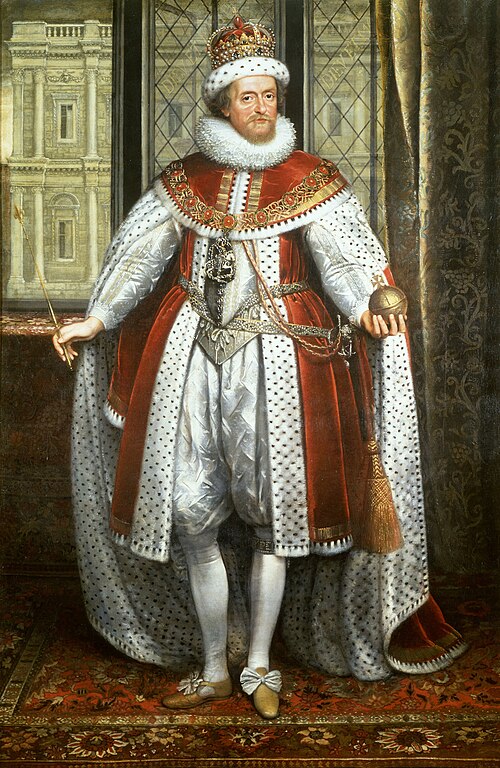
James IV (King of Scotland) and I (King of England and Ireland), 1566–1625. Baptised Roman Catholic, brought up Presbyterian and leaning Anglican during his rule. Portrait by Pal van Somer, c. 1620.
Complex Times for Christianity, Then and Now. It was a complex time for James I and religion. Indeed, remnants of this Christian controversy continue to this day.
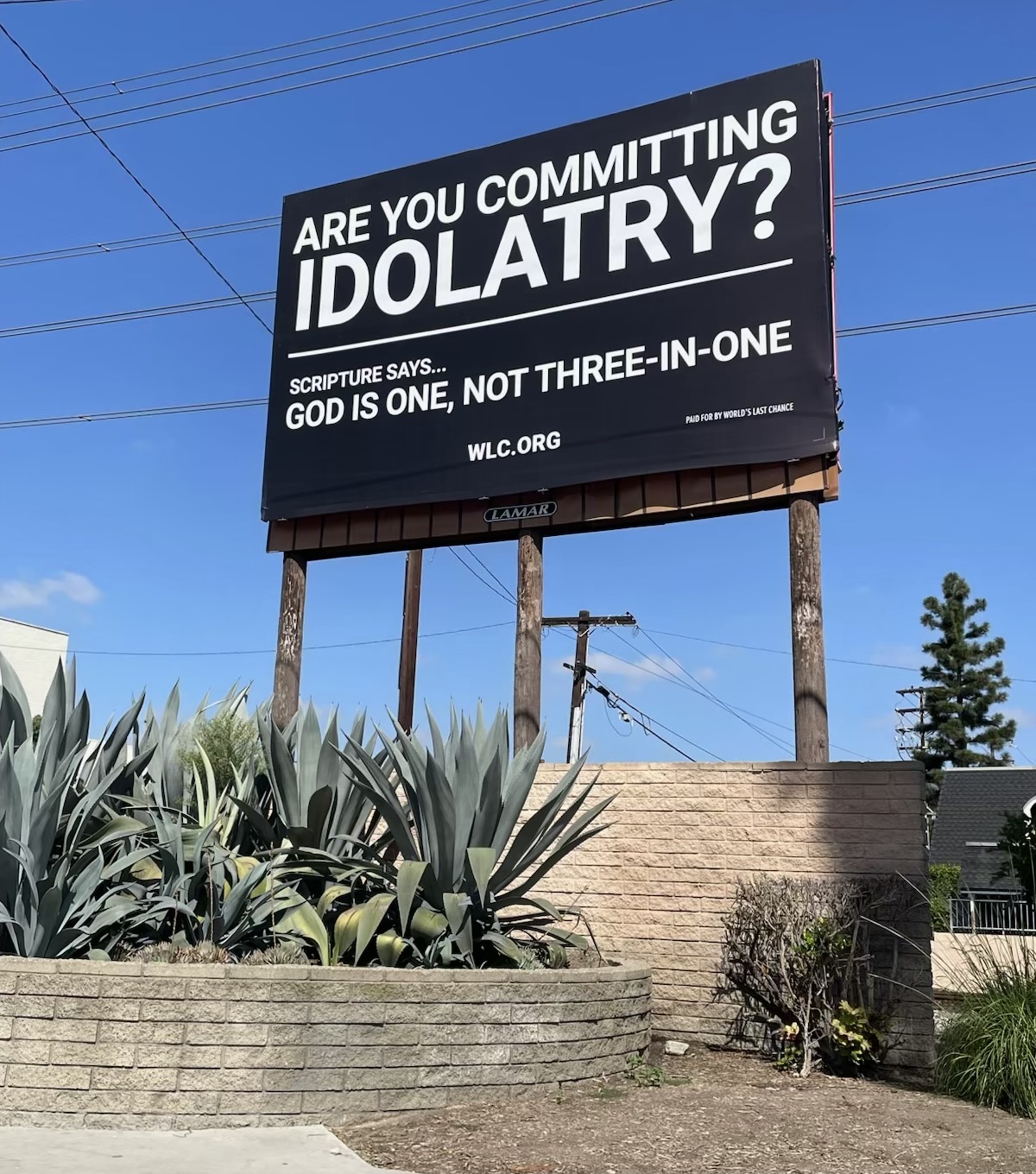
A billboard currently on Bristol Street in Santa Ana, California.
That portion of Orange County is largely Hispanic, hence of Roman Catholic heritage. But Orange County, also with a conservative contingent, apparently includes intolerant wackos (who, by the way, are also Flat-Earthers).
To me, it’s bad enough that some disavow the Constitution’s separation of church and state. It’s even worse when hairs are split on purely ecclesiastic matters. On the other hand, unlike during Europe’s Thirty Years War, free speech is a recognized right of our Constitution.
Back to Hoaxing. Neuman cites that “Getting from ‘hocus pocus’ to ‘hoax’ wasn’t much of a leap. And Merriam-Webster agrees: “probably a contraction of hocus… appearing circa 1800” in describing it as “1. An act intended to trick or dupe. 2. something accepted or established by fraud or fabrication.”

M-W chooses not to cite Trump’s “winning the 2020 election” as a well-orchestrated hoax—but many of us do.
Neuman notes, “Although it has its origin as a simple lie or deceit, today hoax has the connotation of a grander deception, says Aja Raden, author of The Truth About Lies: A Taxonomy of Deceit, Hoaxes and Cons.”
“ ‘It’s easier to convince someone you own an island than it is to convince them you own a condo,’ Raden says. Or an entire country, as it turns out.”
Enjoy Poyais! Neuman recounts, “In the 1820s, Gregor MacGregor announced the discovery of Poyais, a lush and prosperous paradise in Central America. ‘MacGregor embarked on an extensive infrastructure project but needed settlers and investors,’ notes Historic UK. He lured prospective colonists from London, Edinburgh, and Glasgow, selling shares and raising the enormous sum of £200,000 in a single year. He even published a detailed guidebook, tempting hopeful adventurers with visions of a new life in Poyais.”
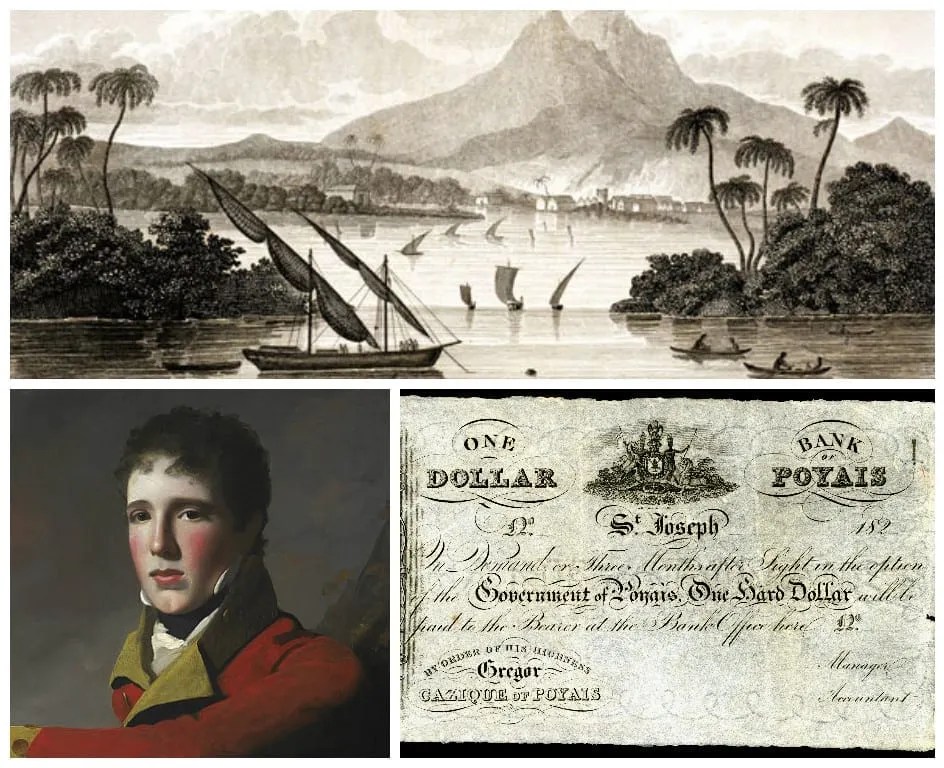
Image from Medium.
“ ‘The thing is, Poyais didn’t exist. He made it up,’ Raden says. Hundreds of would-be settlers set sail for the fictional land. Some died. The others landed in an uninhabited stretch of Nicaragua’s Mosquito Coast.”
Mencken’s History Spoof. Neuman continues, “Fast forward a century and Raden can point to another example as a deliberate piece of ‘fake news.’ In 1917, ‘H.L. Mencken made up the story that [President] Millard Fillmore apparently put the first bathtub in the White House,’ she says. The famed journalist’s literary lark quickly gained currency, being reprinted and taken as the truth. He later admitted: ‘My motive was simply to have some harmless fun in war days.’ ”
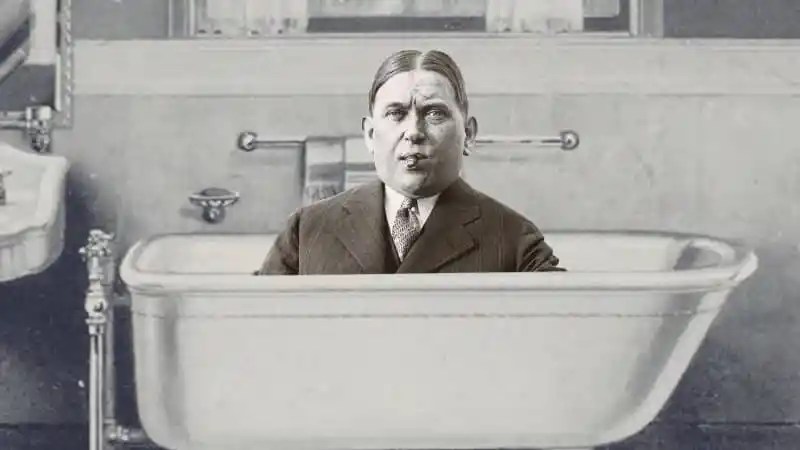
Image from Appalachian History.
“Apparently unwilling to throw the baby out with a good tall tale,” Neuman concludes, “decades after the fake story, President Harry S. Truman was ‘still proudly showing off’ the infamous White House bathtub to visitors, because Raden says, ‘he just liked believing it.’ ”
Yes, se non è vero, è ben trovato. Loosely, “It may not be true, but it’s a good story.” Fillmore’s bathtub yes; Trump’s 2020 win, no. ds
© Dennis Simanaitis, SimanaitisSays.com, 2025

