
Simanaitis Says
On cars, old, new and future; science & technology; vintage airplanes, computer flight simulation of them; Sherlockiana; our English language; travel; and other stuff
PORCINE MATTERS
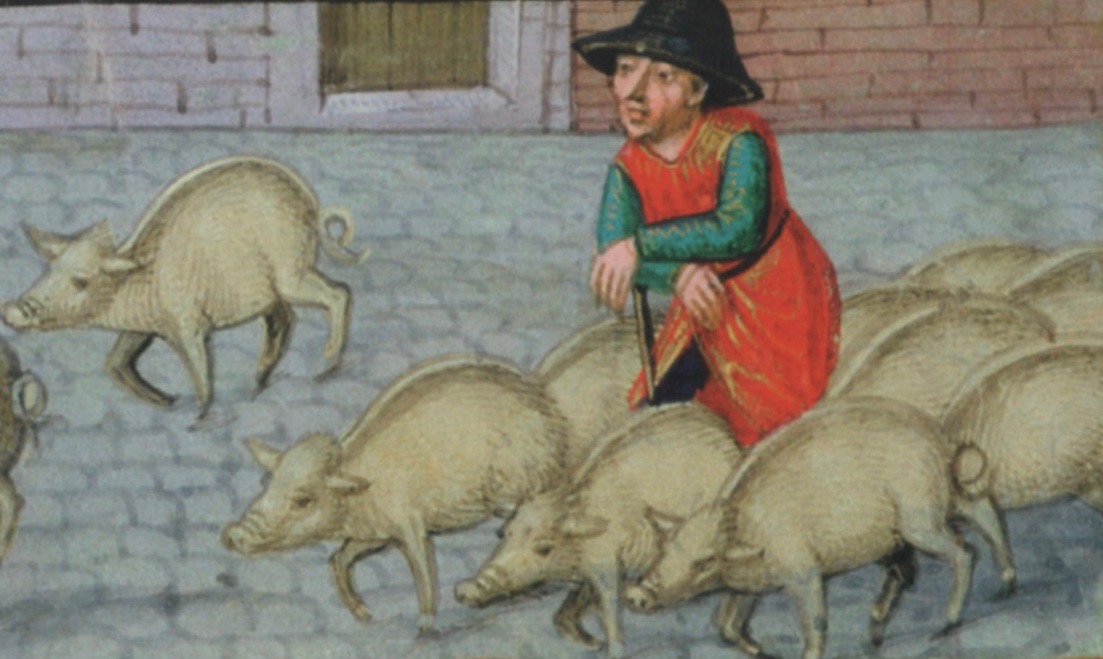
“PIGS,” WIKIPEDIA DESCRIBES, “have been featured in human culture since Neolithic time, appearing in art and literature for children and adults….” BBC History magazine, October 2024, had a related article, “Pigs in the Medieval City,” by Dolly Jørgensen. Here are some porcine tidbits gleaned from this and from my usual Internet sleuthing.

Whence the Problem. Jørgensen describes, “English medieval cities and towns in the late 13th century were experiencing a pig problem. The reason was simple: more people in towns equalled more pigs…. Raising pigs in the back garden of medieval homes was a standard practice. A taxation role for Reading in 1297 shows that 30 of 102 taxed households owned pigs.”
Pigs Uniquely Among Livestock. “People kept pigs,” Jørgensen recounts, “for one simple reason: to eat them. Unlike other livestock, which had uses while they were alive (cows produced milk, chickens laid eggs, horses transported riders), pigs were valuable only when dead. Pig products such as lard and salted bacon, which kept well over the winter, were crucial to the medieval diet.”

Dolly Jørgensen is Professor of History at University of Stavanger, Norway, and co-editor-in-chief of Environmental Humanities.
Porcine Threats. “While the abbot of York had complained about the stench, medieval pigs were also dangerous…. In 1436, John Luff of Ramsey left a boar and two sows unleashed and one of them broke down a door, knocked over a baby’s cradle, and ate the blanket.”
Pig Control. “While having swines in the city was a convenient meat source,” Jørgensen says, “they clearly needed to be closely managed…. In the earliest surviving town ordinance from York, which is dated to 1301, no one was permitted to let their pigs roam the streets day or night.”
“Medieval pigs,” Jørgensen describes, “were literally kept on a leash. In medieval drawings, the swineherd leading a pig in an urban area holds a rope tied to a hindfoot of the pig so he can pull it back. The swineherd also carried a staff to steer the animal and nudge it forward.”
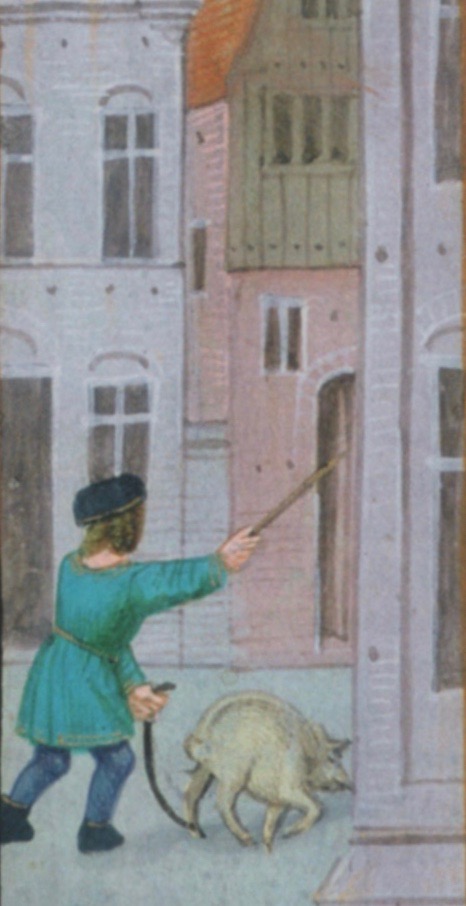
Plus, Jørgensen notes, “Yet modern readers should not think that pigs were running around creating havoc all the time. Town ordinances reminding owners about the rules governing the management of pigs appear infrequently over the 250 years from 1250 to 1500. Roaming pigs were considered out of the ordinary and unacceptable. Despite the swine-fuelled problems experienced in cities such as York and London, most people were minding their pigs on an everyday basis.”
Medieval Butchers’ Guilds. “Urban butchery,” Jørgensen writes, “was a regulated business, with guild rules and town ordinances governing practices and procedures.”
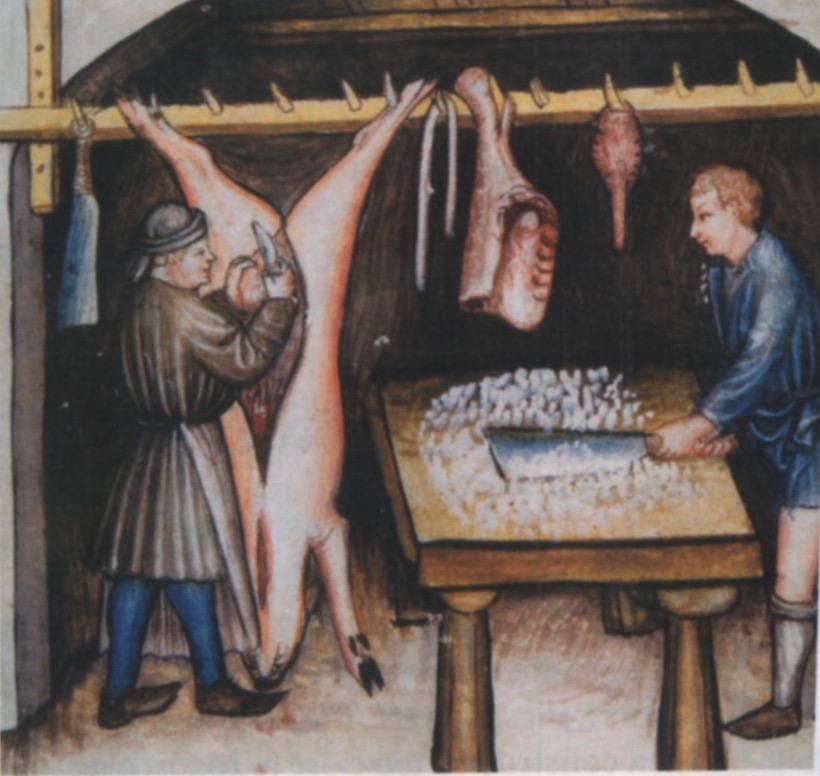
Living Cheek by Jowl. “Yet,” Jørgfensen observes, “pigs and humans lived cheek by jowl until comparatively recently. In fact, it wasn’t until the late 19th/early 20th century that city beautification and sanitation movements forced pigs out of urban tenement zones.”
I’m reminded of livestock herds and cow tunnels in New York City, these not all that long ago.
“Even when they were banished from our cities,” Jørgensen says, “pigs continued to live off the leftovers from our ever-growing urban areas—never more famously than when ‘victory pigs,’ fattened up by food-waste collection programmes, helped ward off hunger during the Second World War.”
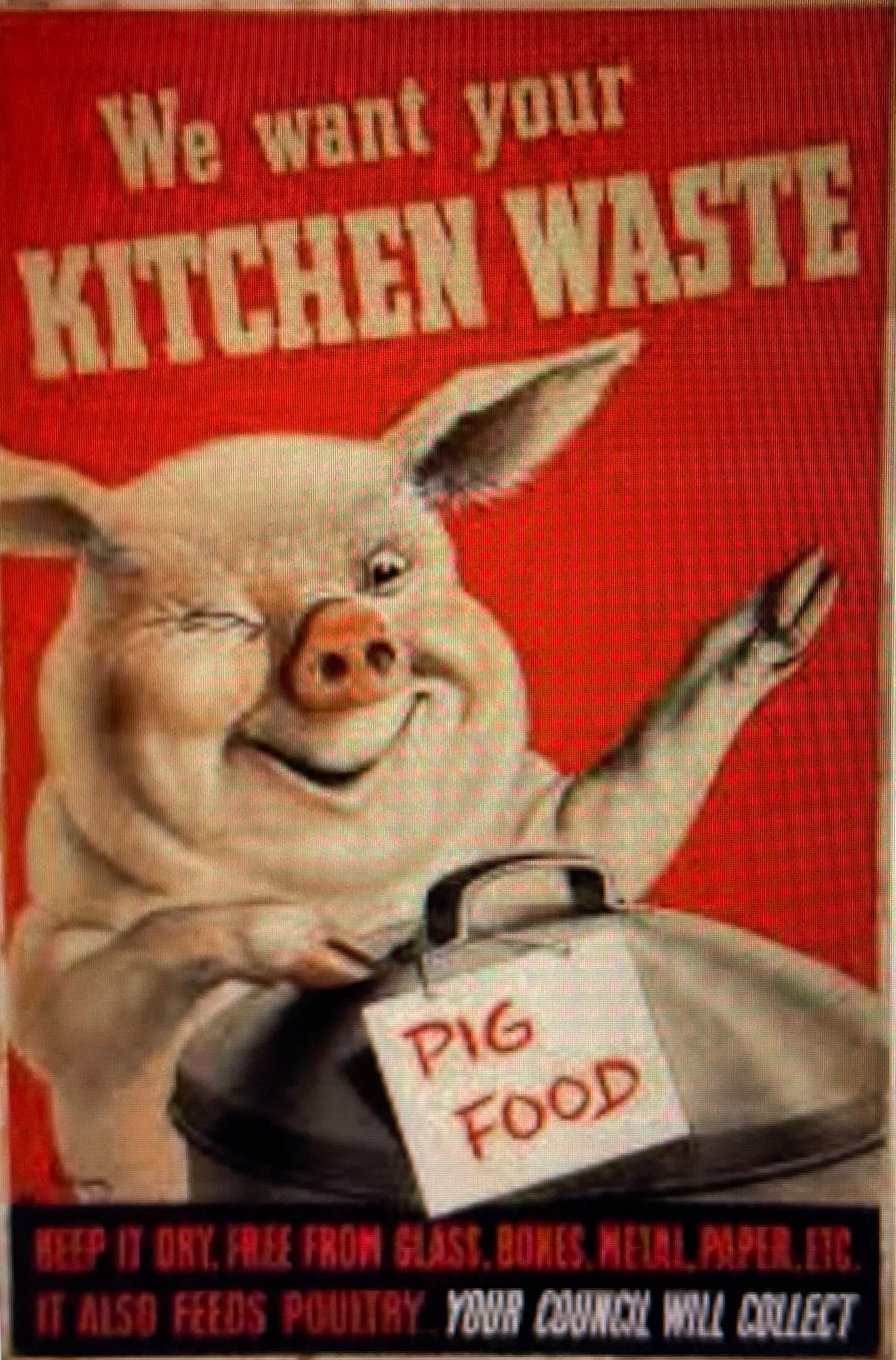
Image from devilsporridge.org.uk
In League with the Devil?? In a sidebar to her article, Jørgensen recounts, “Pigs are Satan’s representatives on Earth. That was the belief of many residents of medieval England—even as they kept swine in their gardens and feasted on salted bacon.”
Blame the Bible: “Pigs’ demonic associations,” Jørgensen writes, “stem chiefly from stories in the Bible. One is the well-known gospel tale of Jesus casting a legion of demons from a possessed man into a herd of pigs.” And then there’s the Prodigal Son: “The main protagonist of the tale falls on hard times—so hard, in fact, that he has to take a debasing job as a swineherd. To work with pigs was to associate yourself with filth, gluttony and sexual indiscretion.”
“So why did the pig acquire such a devilish reputation?,” Jørgensen writes. “The answer appears to lie in its natural characteristics. It has a large litter of piglets at one time, which is associated with lasciviousness. It likes to wallow in mud, regarded as unclean. And it is a rapacious eater of almost anything, which was identified with gluttony.”
A Tough Rap, However…. In our considerably more enlightened times, there are progressive farming movements such as Moink, which says of its humanely raised Pastured Pork, “Let a pig be a pig.”
I agree completely. ds
© Dennis Simanaitis, SimanaitisSays.com, 2024
 Simanaitis Says
Some animal behavorists rank porcine intellect above dogs, even border collies, though it is difficult to gauge linearly; the natural salience of humans as social stimulus for dogs might facilitate such learning to take place without specific training.
Two former farmers described how pigs, taken to the slaughterhouse, became hysterical when they realized something was happening to their friends. But regarding hogs’ omnivorousness, one of them also recounted how they were taught as children not to fall down in the pigpen.
As we’ve seen, entire counties of North Carolina and other states are lost to hog raising, rivers, streams, ground water ruined, the stench despoiling existence in adjacent counties.
Given every study not overtly or covertly funded by meat and dairy industry coming to the same conclusion, that the single best way to avoid heart disease, cardiovascular ills, hypertension, inflammation, high blood pressure, diabetes, cancer, macular degeneration, dementia (now termed type 3 diabetes, Alzheimer’s, is a plant-based, vegan repast, we’re sticking with Impossible sausage, and don’t miss a thing. So we’re glad not to contribute to the innumerable daily Auschwitzes and Dachaus of our fellow creatures.
However, may today’s conclusion herald the political end, and the beginning of sentencing in earnest, of one particular schwein.
To that welcomed end, bless Steve Kornacki at the Big Board.
As a former resident of York, England, I recall no problems with pigs, though right after World War II they were scarce. My parents raised vegetables, rabbits (for meat!), flowers, chickens, and two young boys, but I can’t quite recall any pigs.