
Simanaitis Says
On cars, old, new and future; science & technology; vintage airplanes, computer flight simulation of them; Sherlockiana; our English language; travel; and other stuff
VSCCA LE MANS ANNIVERSARY CELEBRATION
VINTAGE SPORTS CAR, THE MEMBER PUBLICATION of the Vintage Sports Car Club of America, celebrates Le Mans in its Number 2 2023 issue and also with its 2024 calendar. Editor Jim Donick (by the way, a fellow Sherlockian) assembled the article and calendar comments which prompted the following tidbits.
A Grand Prix at Le Mans. Le Mans, about 125 miles southwest of Paris, had hosted auto racing prior to its famed endurance event. The 1906 French Grand Prix was held on a 64.1-mile triangular course to the east of Le Mans.

1906 French Grand Prix, 12 laps of this 64.1-mile circuit. Image from Wikipedia.
The First Vignt-quatre Heures du Mans. The first 24-hour race took place on May 26-27, 1923, on a different circuit, also of public roads, essentially south of Le Mans.
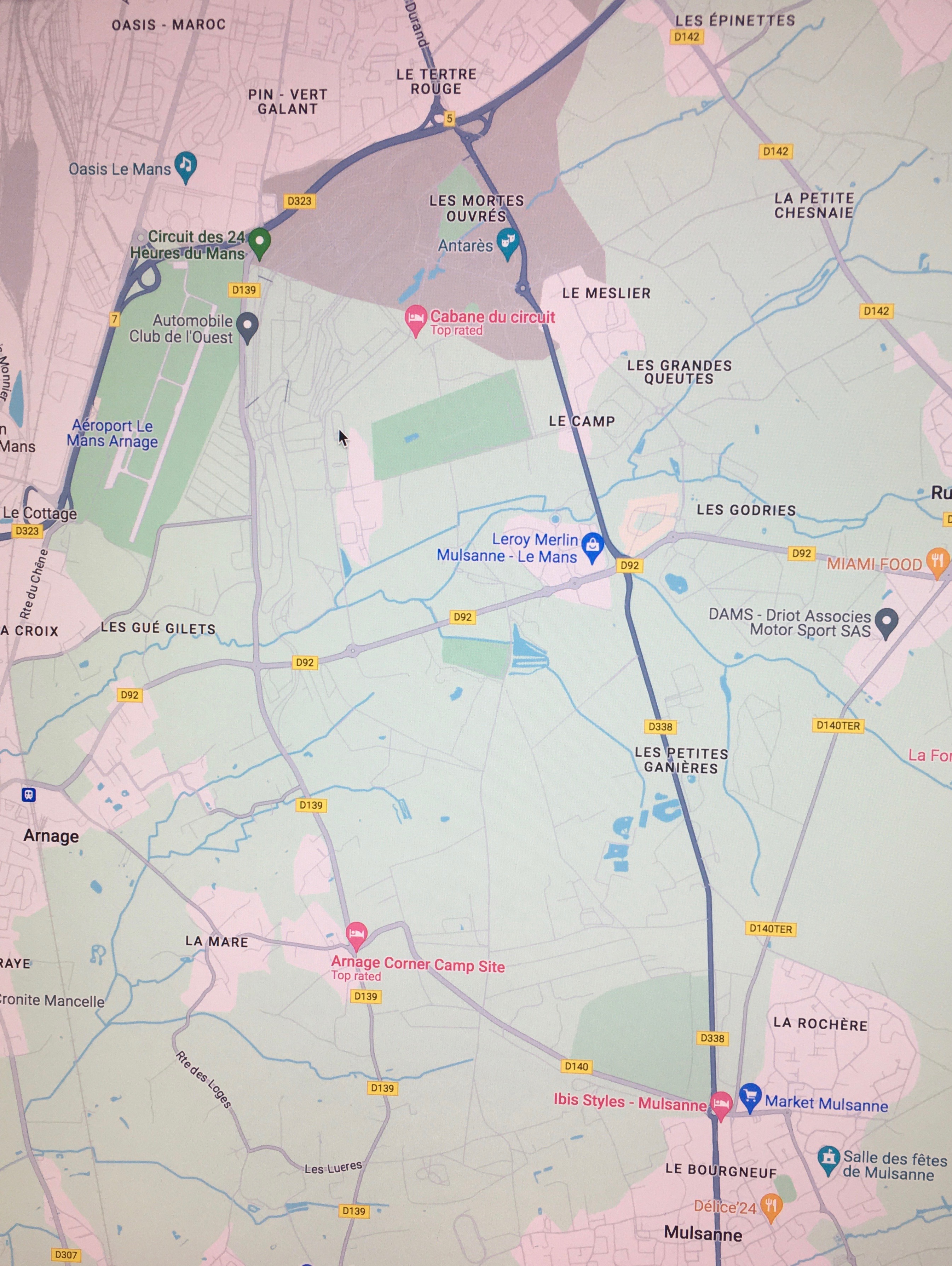
Image from Google Maps.
From the Automobile Club de L’Ouest follow D139 north to the edge of town, then right onto D323 to Le Tertre Rouge. Another right there onto D338 south to the village of Mulsanne. Another right onto D140 to Arnage, then onto D139 north to complete the circuit.
Prooduction Entries. Cars were standard four-seaters except for those under 1100 cc. Each carried 60 kg (132 lb) of lead ballast per passenger seat.
Wikipedia writes, “With the cars all painted in their national racing colours, there was a predominance of French blue cars except for a single green Bentley from Great Britain and two Belgian Excelsiors in yellow.”
A Chenard-Walcker, Wikipedia writes, “is often cited as the inaugural winner of the Le Mans 24 Hours, which it was on distance. However, the regulations stipulated it was merely the first of three annual races with the winner [of the Rudge-Whitworth Cup] being the one who exceeded their minimum stipulated by the greatest ratio. In fact, the leader at this first stage of the event (and awarded the Coupe Interim) was the 1.1-litre Salmson of Desvaux and Casse that finished 12th but had exceeded its target distance by 46 laps.”
Coupes Rudge-Whitworth. Indeed, Chenard-Walcker continued to score well enough at the 1924 and 1925 events that this firm won both the 1924-1925 Coupe Biennale Rudge-Whitworth and the overall Coupe Triennale Rudge-Whitworth.
The Chenard-Walcker also gets my vote for most innovative car at the 1925 Le Mans with its early attempt at aerodynamics.
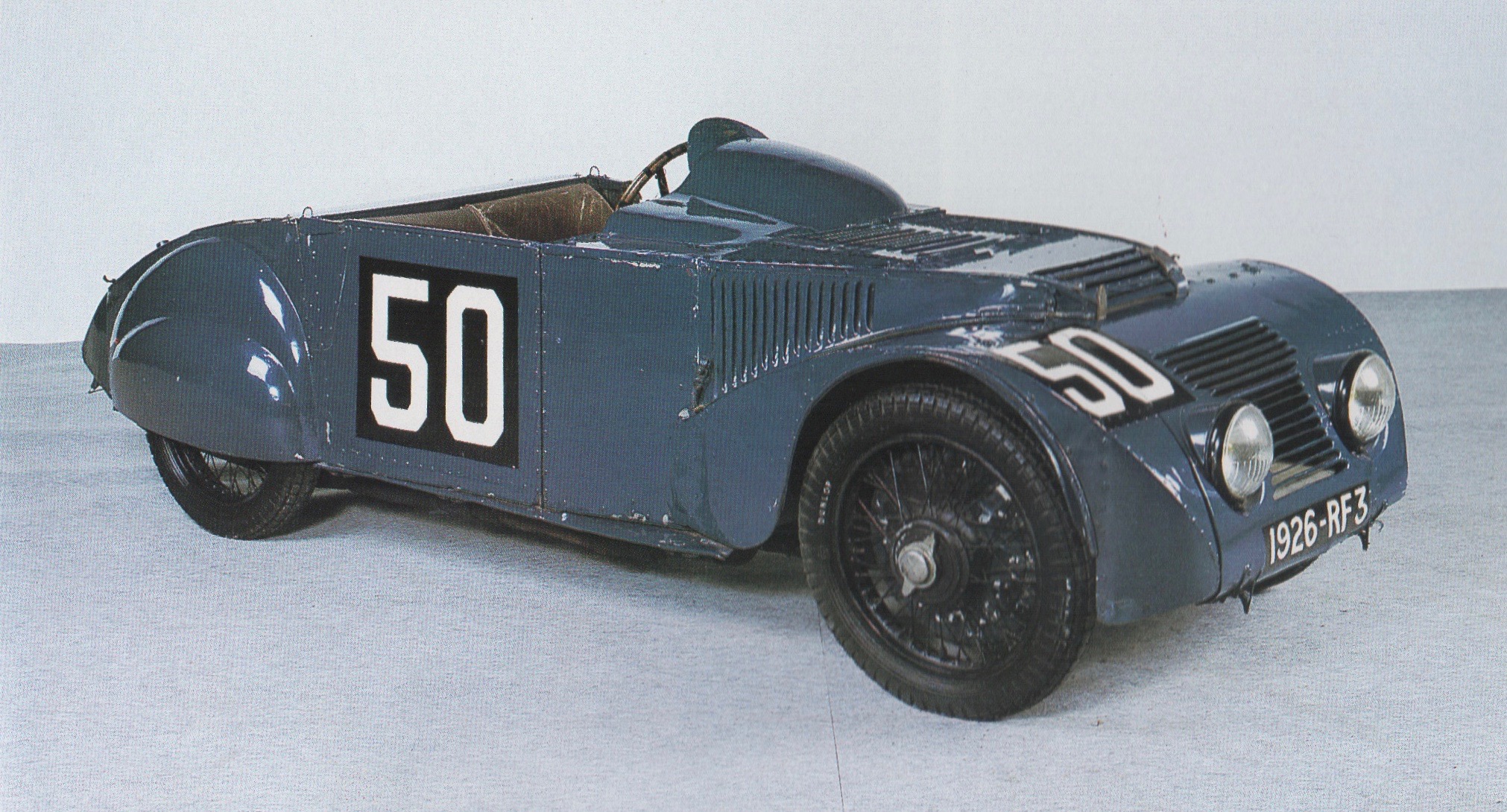
This Chenard-Walcker now resides in the Musée de l’Automobile de la Sarthe at Le Mans. It’s also the February car in the VSCCA 2024 calendar.
Fast Forward to 1949. What with one thing and another (general French labor strikes in 1936 and a madman named Adolf later), the 2023 Le Mans was only the 91st running of the event despite all this centenary jazz. No matter, because there have been memorable vignt-quatre heures in between. For example, postwar resumption of the race in 1949 was Ferrari’s first Le Mans entry—and first win there.
It was also memorable for Luigi Chinetti, (to become sorta Mr. F for North America): He and Peter Mitchell-Thomson (Brit Lord Selsdon) won, with Chinetti driving all but from 4:26 a.m. to 5:38 a.m.
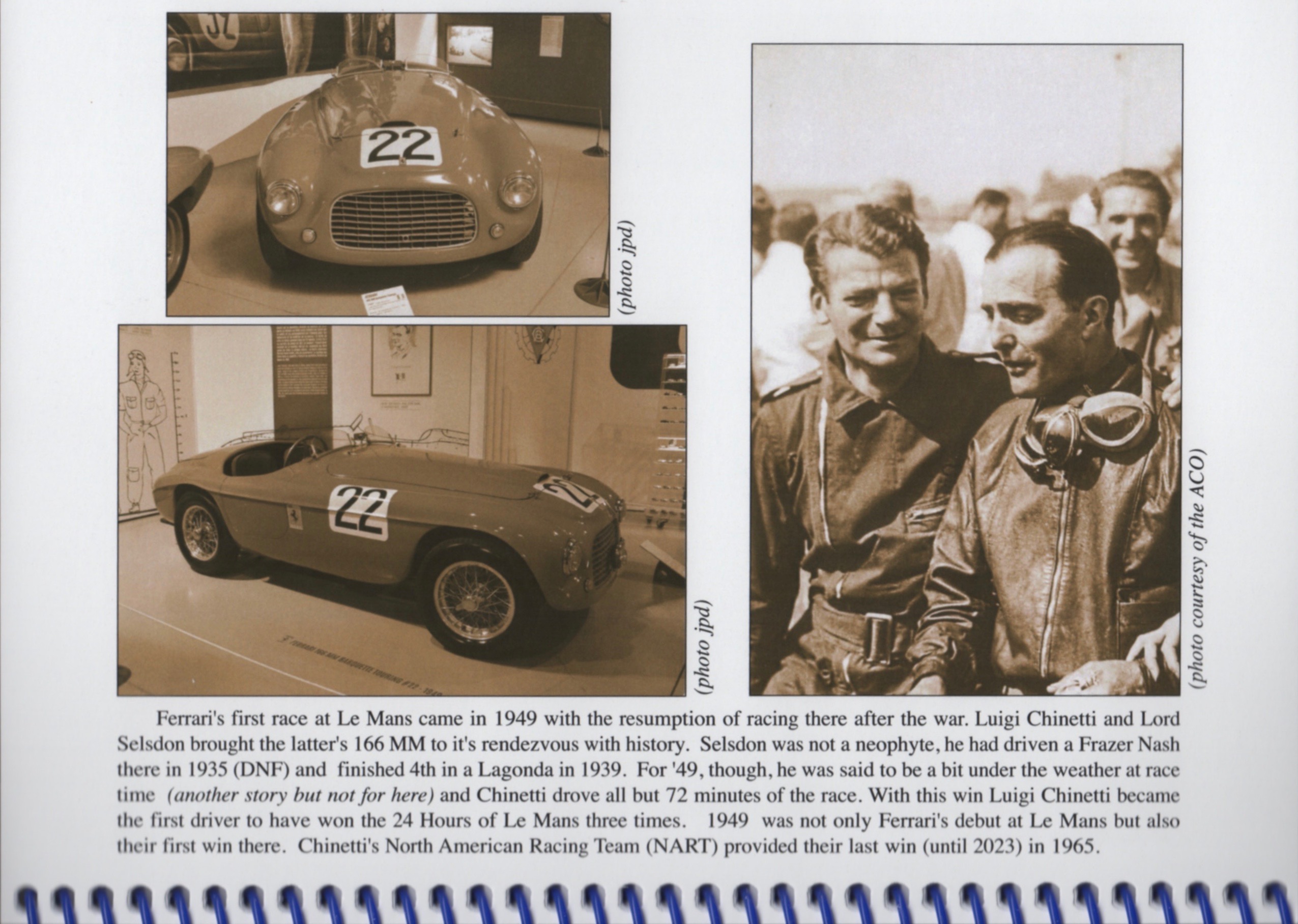
Most appropriately, VSCCA’s June 2024 images are of Lord Selsdon’s Ferrari 166 MM and its 1949 Le Mans winning duo.
“Selsdon was not a neophyte,” the calendar recounts, “he had driven a Frazer Nash there in 1935 (DNF) and finished 4th in a Lagonda in 1939.” By the way, that was the year pal Rob Walker co-drove his Delahaye 135 CS to 8th, (with appropriately changing from brown to black shoes for evening driving).
Briggs Cunningham’s 1950 Cadillac Coupe and Le Monstre. In his first foray to La Sarthe, American sportsman extraordinaire Briggs Cunningham entered a pair of Cadillacs. One was a fairly standard coupe; the other was an aerodynamic roadster specially designed by Grumman engineers.
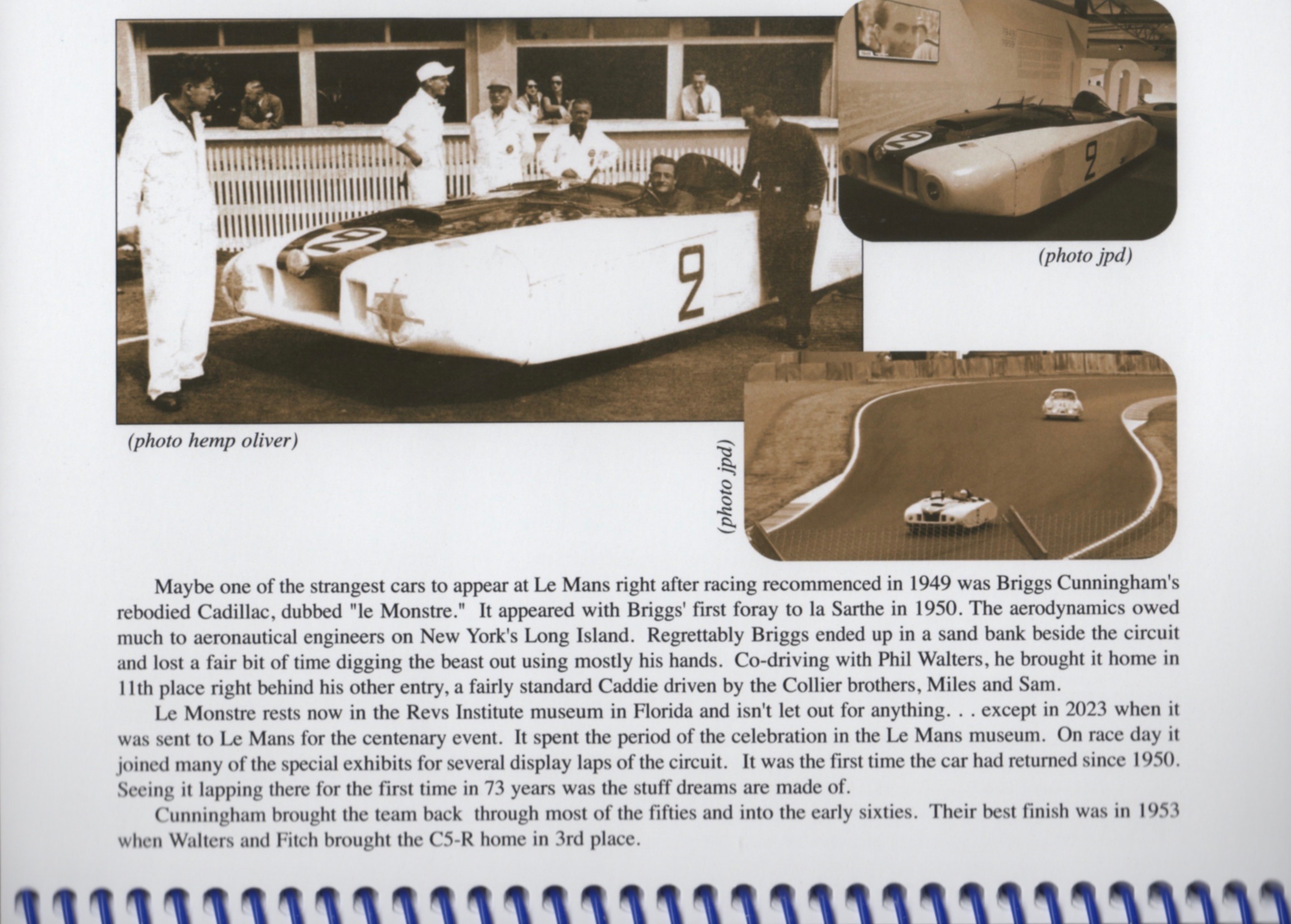
“Le Monstre,” one of Briggs Cunningham’s first entries to Le Mans. And VSCCA’s choice for August 2024.
“ ‘Le Monstre’ rests now in the Revs Institute museum in Florida,” the calendar notes, “except in 2023 when it joined many of the special exhibits for several display laps of the circuit. It was the first time the car had returned since 1950. Seeing it lapping there for the first time in 73 years was the stuff dreams are made of.”
You sure got that right, Jim. ds
© Dennis Simanaitis, SimanaitisSays.com, 2023


Great post, thanks for sharing. The early years of the 24 Hours of Le Mans
Are amazing. When the Ferrari won the Centennial race, I just couldn’t hold the tears.
In Which Monsignor Simanaitis tenders another fine pocket history. There are those uninterested in watching motorsports who’d nonetheless love to travel a wormhole to a late ’30s Le Mans, and walk the pits, seeing the cars worked on. Those enamored of Le Mans history might find a copy of Richard Hough’s 1961 A History of the World’s Sports Cars, with introductions by W. O. Bentley and S. C. H. Davis.
Similarly, some were more enthralled reading Ernest K. Gann’s Flying Circus and any of Antoine de Saint Exupery’s work than going up in prop jobs of various eras. The technology, sculpture, and occasional fettling of same suffice, if that’s not heresy.