
Simanaitis Says
On cars, old, new and future; science & technology; vintage airplanes, computer flight simulation of them; Sherlockiana; our English language; travel; and other stuff
A VERTICAL TOUR
BRITISH ASTRONOMER FRED HOYLE GOT ME THINKING about the sliver of atmosphere making life possible on Earth. Here are tidbits about this, sourced from one place and another, including SimanaitisSays.
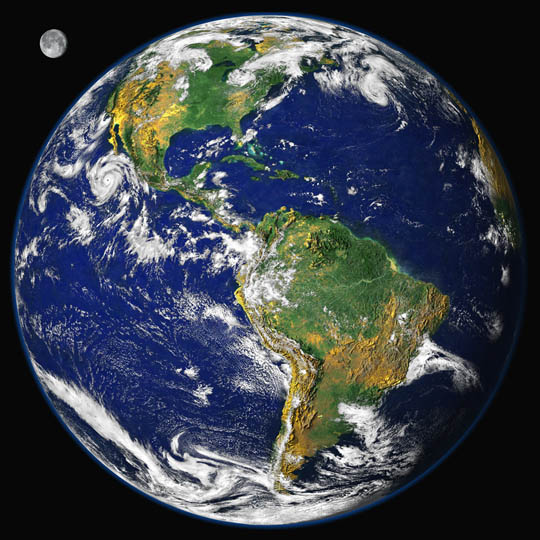
Our Beautiful Blue Marble. Image from NASA.
Hoyle’s One-Hour Drive. Astronomer Fred Hoyle, sorta the Brits’ Carl Sagan, was the first to point out that if one could drive a car upwards at 60 mph, it would take only about an hour to get into space. Let’s take that imaginary jaunt from sea level, with a route map provided by Wikipedia.
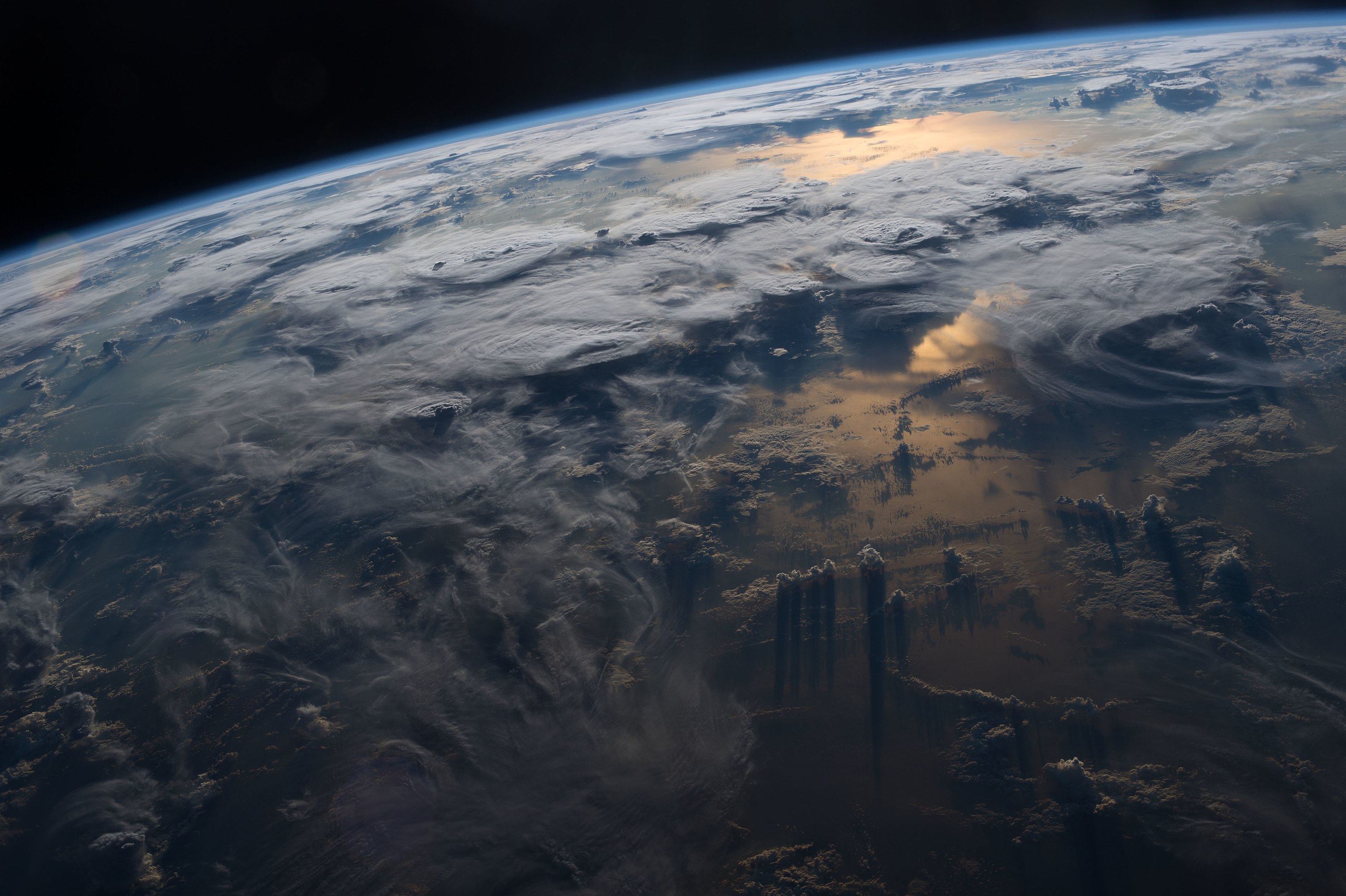
View from the International Space Station, 248 miles above Earth. The blue band at the horizon is the stratosphere, 12.4 to 31 miles into our journey. Image by NASA/Jeff Williams from Wikipedia.
The Limits of Human Habitation: At 2–3 Miles. Barely two minutes into our trip, we’d be at the elevation of La Paz, the capitol of Bolivia. It’s at 11,942 ft. and the highest of any of the world’s major cities. The rugged Peruvian gold/mercury-mining town of La Rinconada lies at about 3 miles, the most extreme human habitation.
Four Minutes Up, the Last Mammals. At four miles, as noted by Elizabeth Pennisi in Science, October 23, 2023, “Oxygen levels are just 40% of those at sea level, too low for mammals to live there—or so biologists thought until 3 years ago when a research team captured a live leaf-eared mouse at its summit.”
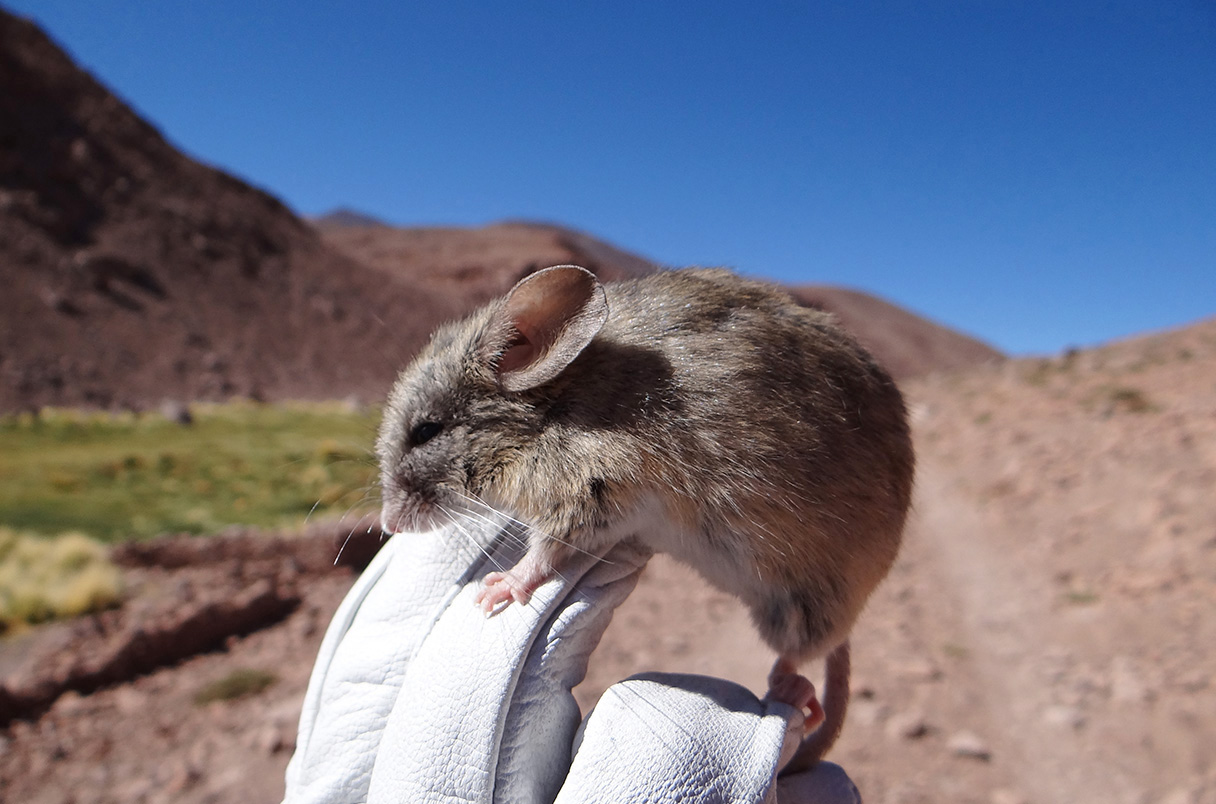
Andean leaf-eared mice, Phyllotis vaccarum, can be found living above 22,000 feet. Image by Marcial Quiroga-Carmona/Jay Storz from Science.
“The previous elevation record holder for mammals,” Pennisi notes, “was pikas, a rabbit relative, found nearly 6200 meters [20,341 ft, 3.85 miles] up on Mount Everest a century ago.”

A Himalayan Pika. Image by Patrick Diez from Wikipedia.
Gathering No Moss Beyond 4.02 Miles. Wikipedia notes, “The highest-altitude plant species is a moss that grows at 6,480 m (21,260 ft) [4.02 miles] on Mount Everest. The sandwort Arenaria bryophylla is the highest flowering plant in the world, occurring as high as 6,180 m (20,280 ft).”
“Are we there yet?” “No, we still have 56 miles to go.” “Is there a mall there?”
Traveling the Troposphere for 7 1/2 Minutes. Wikipedia notes that “The troposphere is the lowest layer of Earth’s atmosphere. It extends from Earth’s surface to an average height of about 12 km (7.5 mi; 39,000 ft), although this altitude varies from about 9 km (5.6 mi; 30,000 ft) at the geographic poles to 17 km (11 mi; 56,000 ft) at the Equator, with some variation due to weather.”
Not that the weather is affecting this equilateral bulge. As recounted at “Global Truths and Things to Ponder” here at SimanaitisSays, “Centrifugal force of the Earth’s rotation around its polar axis makes it fatter across the Equator than between North and South Poles…. According to NASA’s Goddard Space Flight Center, the Earth’s equatorial diameter is 7926 miles; its pole-to-pole diameter, 7900 miles. This 26 miles is a mere 0.3 percent difference in diameter, but it has ramifications in identifying Earth’s extremes.”
For one, an 13-mile-longer drive to space from the equator than from one of the poles. I suspect the weather would be better, though.
Few Planes to Dodge Beyond 8 Miles—But.… Most commercial airliners cruise at between 33,000 and 42,000 ft. (6.25–7.95 miles). But don’t get complacent, because, according to Jamie Green writing in The New York Times, November 5, 2023, “As humanity rushes back to space, we seem to be repeating some of the mistakes we’ve made on Earth.”
Image from The New York Times.
Debris Falling onto the Kármán Line? Green’s article concerns LEO, Low Earth Orbit, which stretches into space up to about 1200 miles above the Earth’s surface. This is well beyond our 60-mile jaunt, but orbits of debris from colliding satellites could decay onto the Kármán Line. At 100 km/54 nautical miles/62 miles/330,00 ft, it’s the generally accepted boundary between our atmosphere and outer space.
What’s to See for the Last 52 Miles? One hopes not much. Deyana Goh recounts “Japan’s Tsubame Records Lowest Ever Satellite Altitude,” at spacetechasia.com, January 6, 2020.
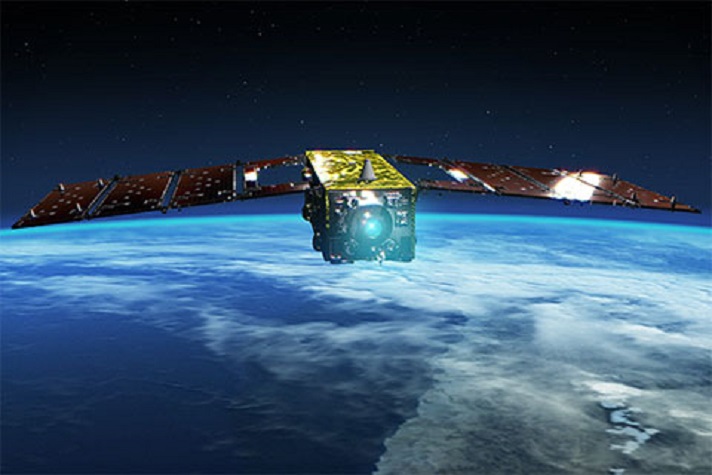
Earth Observation Satellite Tsubame. Image from JAXA.
Goh describes, “Tsubame maintained seven different orbital altitudes, and operated at an all-time low of 167.4 km [104.0 miles]. From this altitude, it managed to capture high-resolution satellite images despite the atmospheric drag and oxygen density, and propelled itself using an ion engine system and gas-jet thrusters.…. The 383-kg satellite was decommissioned on Oct. 1, 2019.”
“For satellites,” Goh writes, “an altitude of between 200 km and 300 km [124–186 miles] is characterized as ‘super low,’ which means the satellite will be exposed to 1000 times more atmospheric resistance and concentrated atomic oxygen that can cause it to deteriorate.”
Sounds to me like I’d rather drive an hour across Nevada. ds
© Dennis Simanaitis, SimanaitisSays.com, 2023


“Not that the weather is affecting this equilateral bulge.”
I’d bet against that statement. I understand that centrifugal force caused by rotation would create an equatorial bulge in both the planet and its atmosphere. But I would contend that temperature also affects the thickness of the troposphere at the equator compared to the poles, where colder, denser air gets by with less displacement to achieve an equivalent mass. Or as Wikipedia says about the tropopause (the boundary between the troposphere and stratosphere):
“Since the tropopause responds to the average temperature of the entire layer that lies underneath it, it is at its maximum levels over the Equator, and reaches minimum heights over the poles.”
(https://en.wikipedia.org/wiki/Tropopause)
Still, you’ve given me food for thought, Dennis: if the Earth is 7,926 miles in diameter, but the thickness of the atmosphere is only 60 miles and half of its mass lies below 3.5 miles, then your vertical tour shows that it wouldn’t take much bad behavior from us to muck it all up.