
Simanaitis Says
On cars, old, new and future; science & technology; vintage airplanes, computer flight simulation of them; Sherlockiana; our English language; travel; and other stuff
“SEX AND THE MUSIC LIBRARIAN” PART 2
YESTERDAY, NICK SLONIMSKY BEGAN SHARING A PRESENTATION he offered to the Music Librarian Association. Today in Part 2, we continue enjoying his erudition and offbeat humor.
A Wife’s Identical Twin Sister. A colleague, Nick notes, “figuratively raised his eyebrows when he came across an item in Baker’s on the Neapolitan opera composer Luigi Ricci, Sr., which mentioned the fact that Ricci had a son by his wife’s identical twin sister. He jotted in the margin, ‘Could he tell the difference?’ ”
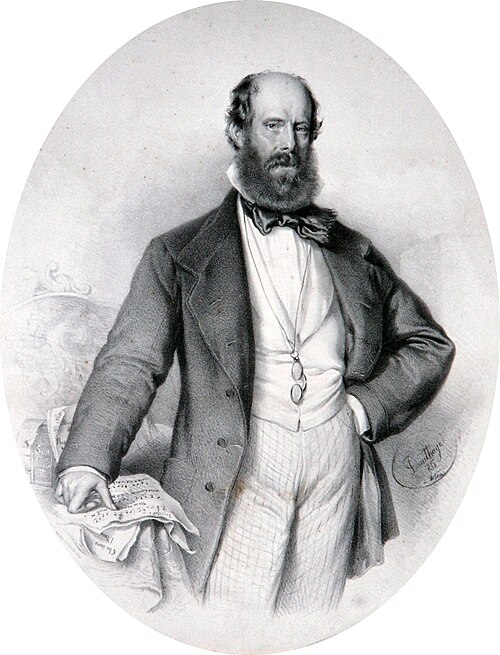
A Phony Bastard. “What to do about celebrated musicians who claim to be bastards but are nothing of the sort? Such was the claim of the famous pianist Sigismond Thalberg. He spread the rumor that he was the illegitimate son of a petty duke and a shabby baroness. Grove’s Dictionary [5th ed.] supported the claim and declared in a footnote that his birth certificate was lost.”
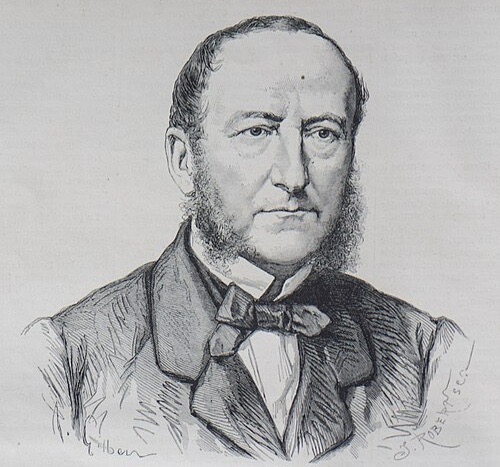
Nick’s Research. “Well, I got that birth certificate from the archives in Geneva, where Thalberg was born, and it says in plain French that he was the son of a non-ducal Frankfurt merchant Thalberg and a non-baroness named Stein.”
Se Non E Vera…. “But so attractive was the glamour of noble origin, however illegitimate, in the nineteenth century, that Thalberg allowed the circulation of a fabricated letter, supposedly written by his baroness mother to his duke father, suggesting that he should be named Thalberg, since he was destined to become as deep an artist as a valley—Thal—and as lofty a spirit as a mountain—Berg!”
Good thing his real father wasn’t a Boeufmerde.
The Music Library and Political History. “A music library is by intent a depository of wisdom and information, ever ready to answer questions from perplexed music lovers. Was Wagner an illegitimate son of actor Geyer whom Wagner’s mother married after Wagner’s father’s death? Who cares?”
“The Nazis cared, very deeply so, because there was something suspiciously semitic in Geyer’s profile and even in Wagner’s own profile. To their great relief, Nazi genealogists managed to prove that all the Geyers were hereditary Aryans. Illegitimacy never bothered them; the important point was to prove that, whether legitimate or illegitimate, Wagner was racially pure.”
But Not Particularly Honorable. “As all music librarians [and even us non-specialists] know, Wagner stole Liszt’s daughter Cosima from her wedded husband Hans von Bülow, while the latter was busy rehearsing Tristan und Isolde. When Cosima von Bülow procreated a female child, Wagner brazenly named her Isolde.”
“Some forty years later, Isolde sued her mother for equal rights in Wagner’s estate, but the courts ruled against her, pointing out that the putative time of conception—the period between eight and ten months before her birth—took place when Bülow was still lodging in direct proximity to Cosima, and therefore could have been Isolde’s real father.”
Yeah. Coulda.
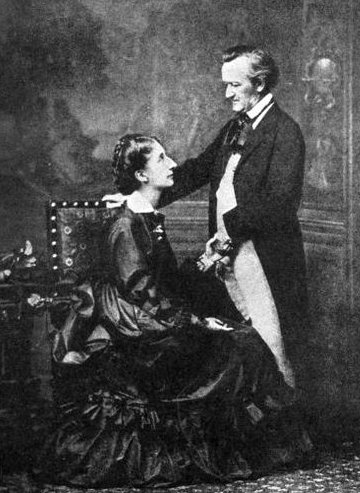
Citing Ethan Mordden’s Opera Anecdotes, I noted, “Wagner was 55 at the time; Cosima was 31. While still married to von Bülow, she conceived Wagner’s child.”
The Russian Word “Nebylitza.” “The Russians have a wonderful word Nebylitza—literally, an ‘unwasity’ (un-was-ity).”
I wonder: Google Translate defines the Russian небылити (nebyliti) as “tall tale” in English; might this be related to Nick’s unwasity?
An Unwasitic Brahms? “Many sexual unwasities are found in popular biographies of great composers, Take Brahms. When he had his first confrontation with females en masse, conducting a Hamburg girls’ chorus as an unbearded youth (he matured, pogonologically speaking, only when he began writing symphonies), he fainted and had to be carried away.”
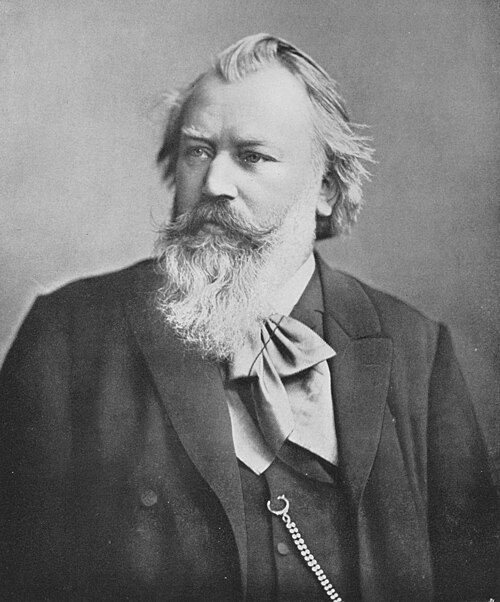
“Some biographers try to whip up his platonic friendship with Clara Schumann into something passionate, only to fail dismally.”
The Best for Last. “An ideal sex story, from the standpoint of fact-conscious music librarians, is the courtship of Miss Smithson by Berlioz via the Fantastic Symphony: There is a unique romantic story, opium smoking, psychedelic hallucinations, and in the end actual marriage. This is sex in excelis.”

I’m sure the MLA members enjoyed Nick’s presentation. I hope you enjoyed these tidbits too. ds
© Dennis Simanaitis, SimanaitisSays.com, 2026


IMO ;
If you need psychedelics to enjoy the sex you need a different partner .
-Nate
(whom also took another man’s wife away when he decided he was bored with her)