
Simanaitis Says
On cars, old, new and future; science & technology; vintage airplanes, computer flight simulation of them; Sherlockiana; our English language; travel; and other stuff
THE PLANTS’ REVENGE PART 1
JACQUES DUMAIS OBSERVES, “PLANTS AND ANIMALS INTERACT in countless ways, but in most cases the plant appears to be a passive participant in the interaction….” Here, though Dionaea muscipula, the Venus Flytrap, gets its revenge in Dumais’s article “Exceeding Nature’s Biological Speed Limits,” Science, June 11, 2026. Parts 1 and 2 today and tomorrow are tidbits gleaned from this article, together with my usual Internet sleuthing.
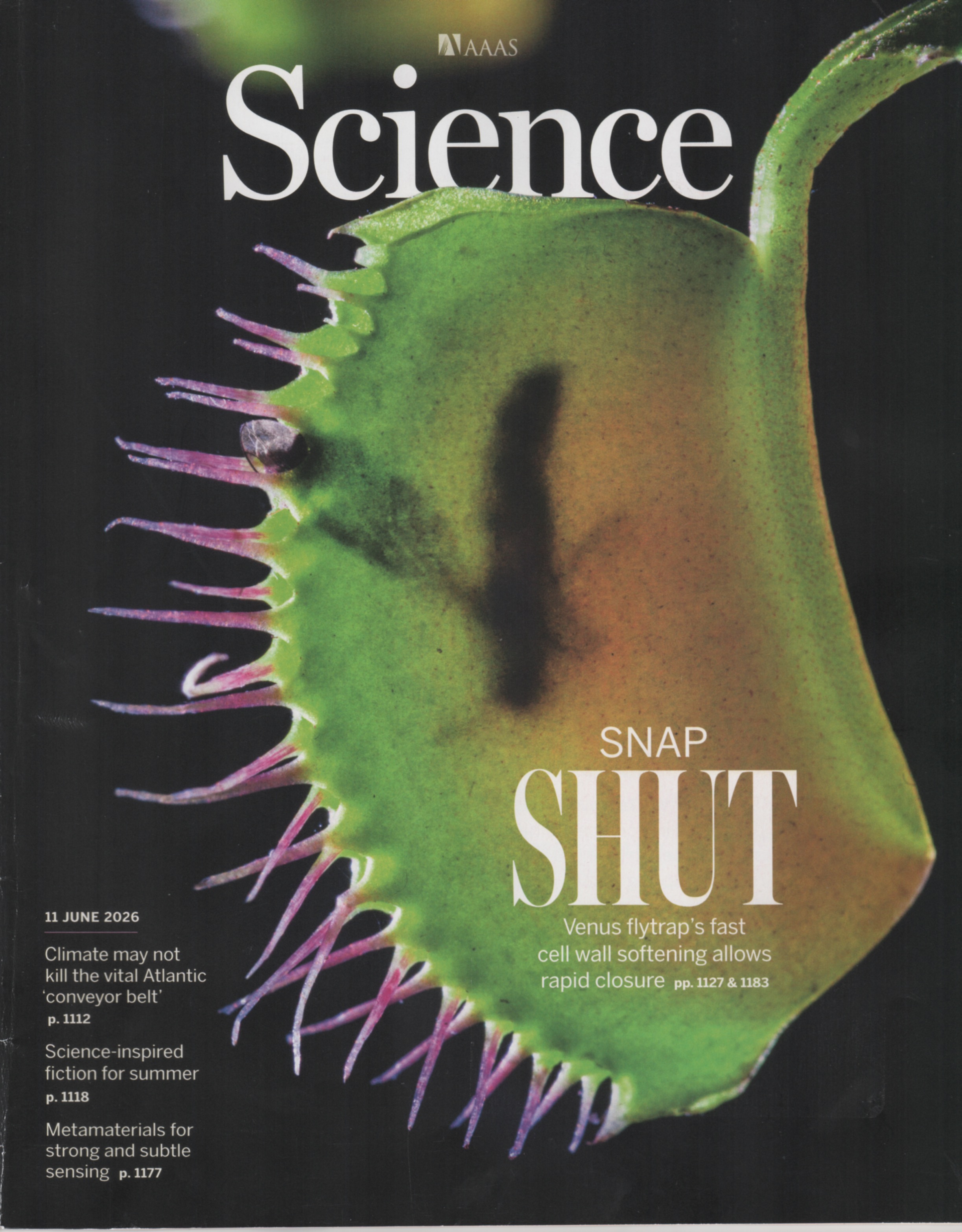
There are Plants… and Plants. Jacques Dumais says that the usual plant response is “seemingly reduced to offering chemical rewards or deterrents or providing visual and volatile cues, such as flowers. However, a small subset of plant-animal interactions is of an entirely different nature. In these cases, plants take charge, tricking animals with active mechanisms of their own, often achieving speeds that exceed those of their animal counterparts.”
How Fast? Dumais recounts, “How is fast motion produced by organisms best known for slow and steady growth? On page 1183 of this issue, Ryu et al. report a compelling mechanism for the snap of the Venus flytrap (Dionaea muscipula), which seamlessly combines a rapid cell wall relaxation and an elastic instability, with lethal consequences for its prey.”
Fast Growth and an Elastic Snap. Dumais describes, “In its open configuration, the two lobes of the Venus flytrap curve outward. When one of the trap’s hairs detects an insect, the cell walls of the outer epidermis soften.”
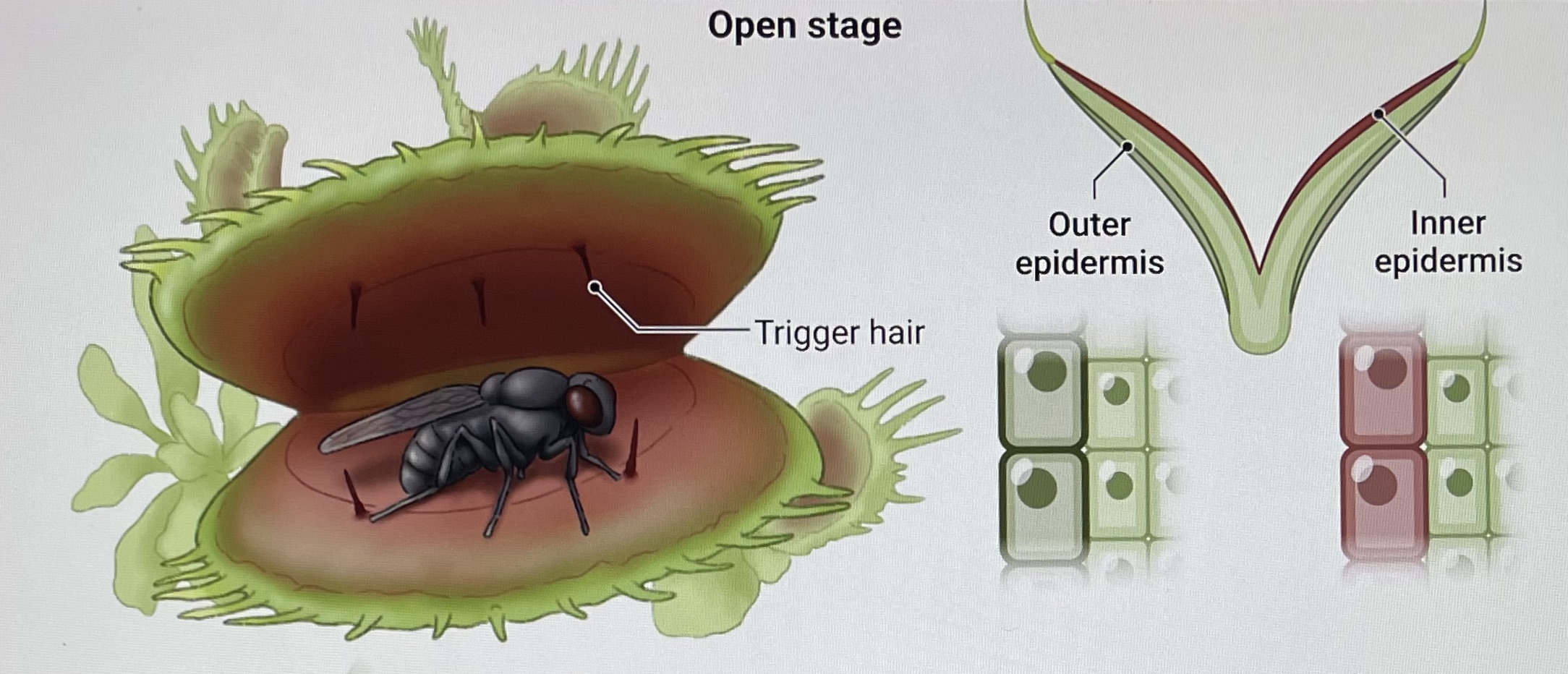
“This fast, growth-like process,” Dumais continues, “perturbs the internal force equilibrium of the lobes, shifting the trap into its intermediate, unstable configuration over a period of ~1.0 s.”
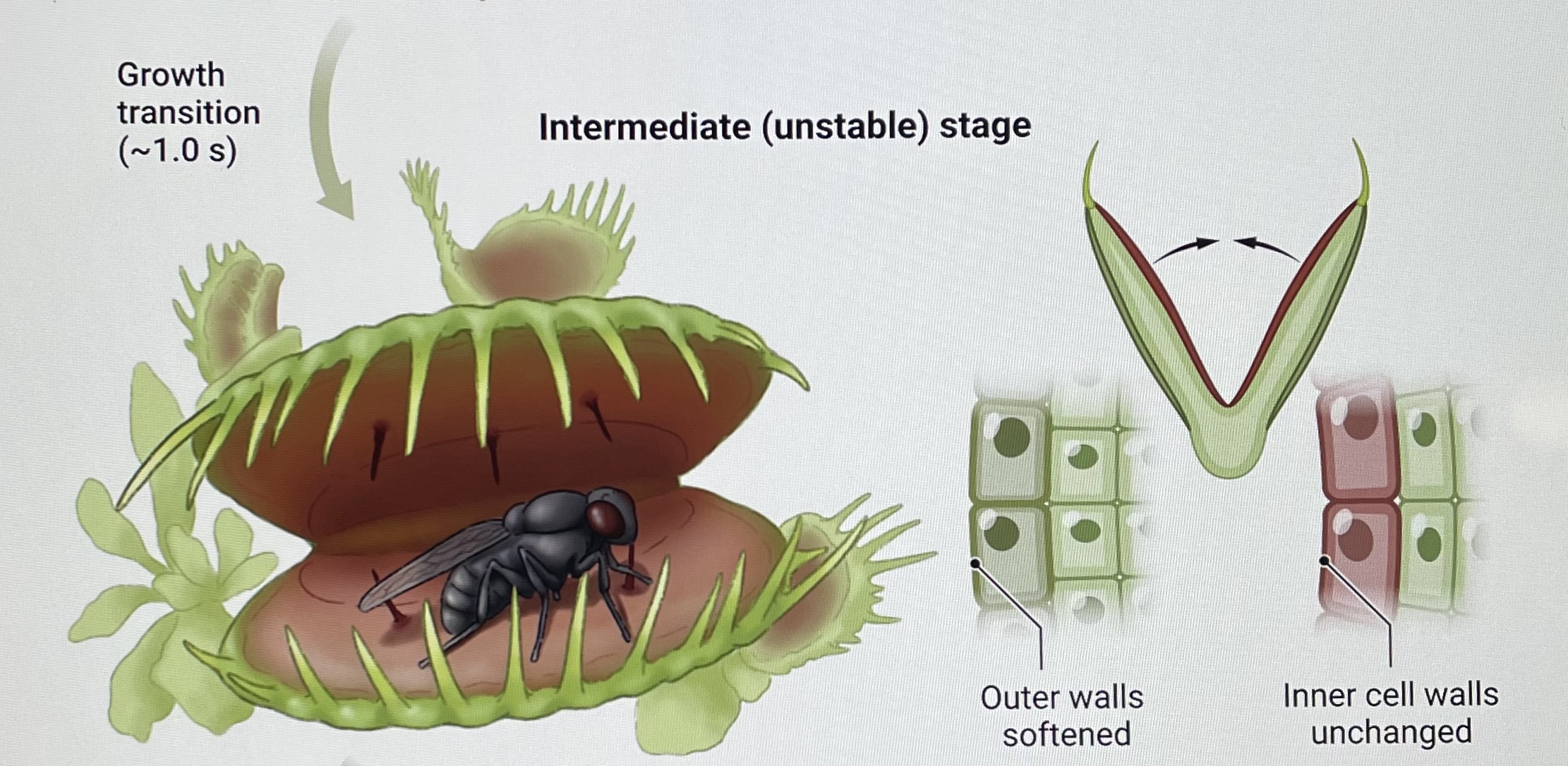
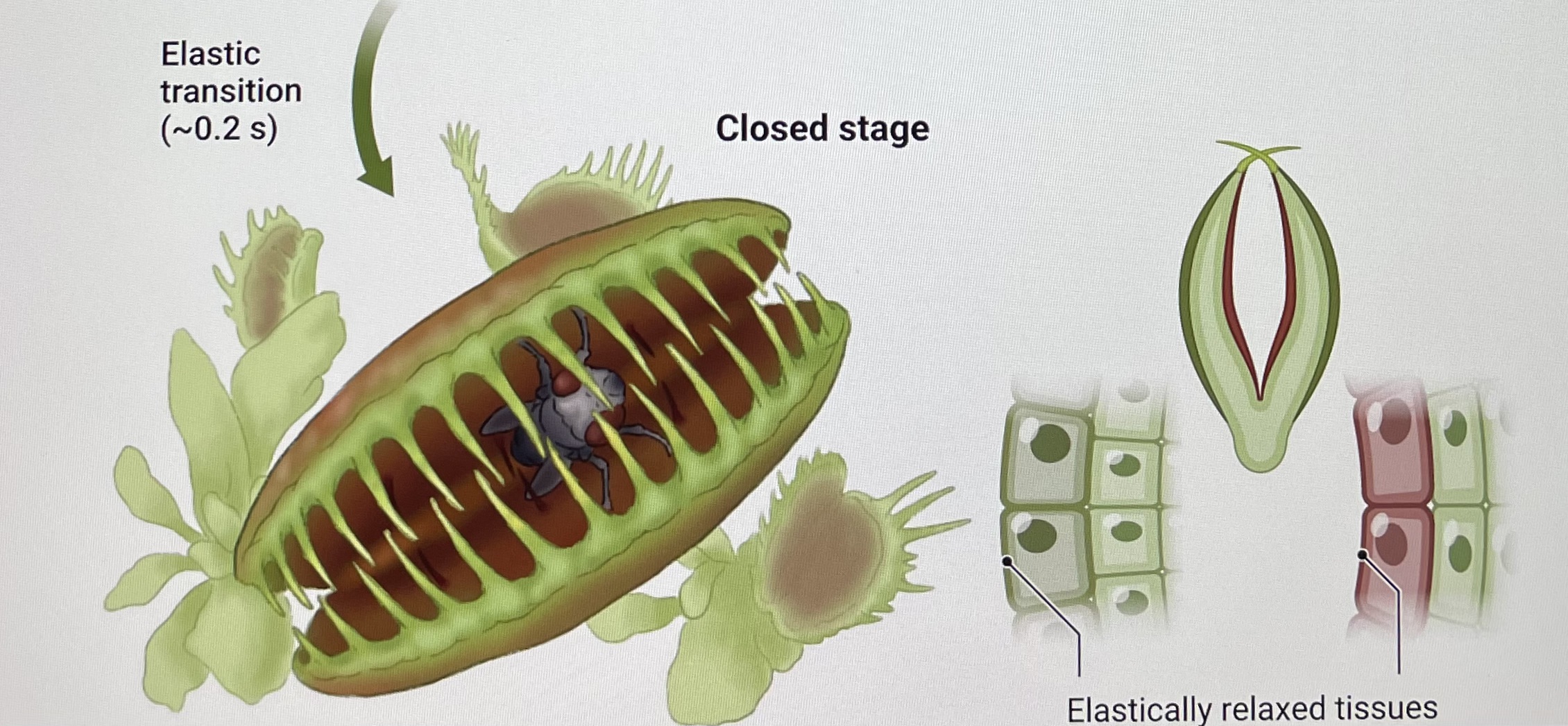
Then, Dumais recounts, “Stored elastic energy then snaps the trap shut in a transition that takes ~0.2 s.”
In Detail. Dumais recounts, “The Venus flytrap is a carnivorous plant with jawlike leaves consisting of two lobes joined by a hinge. When an insect or spider contacts one of the sensitive hairs located near the center of the trap, the ‘jaw’ snaps shut, trapping the prey between the two lobes. The plant then digests the captured meal with excreted enzymes. The basic outline of the trap closure mechanism has been known for some time. The movement of one of the trap’s hairs triggers an action potential that traverses the leaf in about 0.1 s.”
“What ensues, geometrically,” Dumais describes, “is a change in the intrinsic curvature of the trap, forcing it to switch from a configuration where the two lobes curve outward to a configuration where they curve inward toward each other, thereby imprisoning the prey. Because the transition between the open and closed configurations involves a high-energy, unstable state, trap closure is initially slow (up to 1 s) as it builds up to the intermediate configuration but is followed by a fast (0.1 to 0.2 s), elastically driven snap into the closed configuration.”
An Open Question. “However,” Dumais notes, “a fundamental question lingers about the nature of the initial physiological impetus that forces the trap out of its open configuration.”
“Two main mechanisms have been put forward,” Dumais relates. “In one hypothesis, the trap relies on changes in the relative concentration of solutes to move water to the cells found on the outer surface of the trap. The resulting swelling of the outer surface would be the motor driving the trap from the open state to its intermediate high-energy state.”
“The second alternative,” Dumais describes, “implicates a more local response, whereby the tense walls of the cells covering the outer surface of the trap are made to relax quickly by the release or activation of wall-modifying enzymes so that the trap’s internal force balance is shifted toward, and ultimately beyond, the intermediate unstable configuration. This wall relaxation mechanism is essentially how plants grow, but it would have to occur over a timescale far shorter than what is customary for plant growth processes for the trap to be effective.”
Tomorrow in Part 2, we’ll delve into Ryu et al.’s “Fast Cell Wall Softening Causes Venus Flytrap Closure” and learn about other plants getting their revenge. ds
© Dennis Simanaitis, SimanaitisSays.com, 2026

